

Childhood in the Middle Ages: Toys, Work and School
Medieval children have a bad reputation. Popular history often paints them as tiny adults in itchy clothes, put to work as soon as they could walk, by parents who barely noticed them. The real picture is far more cheerful, and a lot noisier. Medieval childhood had toy knights and miniature jugs, ball games and ice skates, schoolmasters with Latin grammar and parents who wept when their children came home for the holidays. Ready to go back to being seven? Mind the hobby horses.
Jump to a section:

Did medieval childhood really exist?
The gloomy picture comes largely from one book. In a book published in 1960, and translated into English in 1962 as Centuries of Childhood, the French historian Philippe Ariès argued that people in the Middle Ages did not see childhood as a separate stage of life, and treated children as small, unfinished adults. His idea was hugely influential outside universities, but historians have since taken it apart.
The leading expert on English medieval childhood, Nicholas Orme, does not mince his words. As quoted by the magazine Works in Progress, he writes: “It cannot be overemphasised that there is nothing to be said for Ariès’s view.” The evidence of real affection is everywhere. When Katherine, a young daughter of King Henry III and Queen Eleanor of Provence, died at the age of three, the queen, according to the chronicler Matthew Paris as quoted in Works in Progress, fell ill with grief. And in a schoolbook from Oxford in the 1490s, a boy describes coming home for the holidays: “we wept for joy, each to other”.
The ages of a medieval child
Medieval scholars did divide childhood into stages, borrowing the idea of “the ages of man” from ancient writers. Orme explains the usual scheme. Infancy lasted from birth to about seven. From seven to fourteen came a stage associated with play. For a noble boy, seven could also mark the start of the long road to knighthood. From fourteen onwards came adolescence, when the body and mind were thought to mature.
So a medieval seven-year-old was not seen as an adult. But for many children, the years after seven brought school, chores or training in the family trade, and life got a lot busier.
A dangerous start in life

There is no avoiding the sad part. Medieval babies faced terrible odds. Orme cites estimates that around a quarter of English children may not have lived to see their first birthday, roughly another 12.5 per cent between the ages of one and four, and about 6 per cent between five and nine. Accidents claimed lives too.
We know about those accidents thanks to an unexpected source: the coroners’ rolls, the records of inquests into sudden deaths. The historian Barbara Hanawalt calls them a remarkably rich source on how children were raised, because they record what happened, where the parents were and who saw it. Yet, as Orme stresses, there is no sign that such high death rates made parents care any less.
Medieval toys: knights, jugs and a bird that sticks out its tongue
The best proof that medieval children played is that their toys survive. Many have been pulled out of the mud of the River Thames in London. In a 1998 article summarised by Medievalists.net, the archaeologist Geoff Egan wrote that hundreds had turned up in London alone over the previous twenty years.
- Toy knights. The London Museum owns a little pewter knight on horseback, just over 5 cm tall and made around 1300. According to the museum, it is the oldest known hollow pewter figure from England and among the first metal toys of the Middle Ages to be made in quantity. Egan noted that later toy knights kept up with real armour fashions, a bit like action figures today.
- Miniature jugs, cups and plates. Tiny pewter jugs are the commonest early toys to survive, often decorated to look like real pottery. A stone mould for making them was even found in Hereford.
- A bird with a moving tongue. One 14th-century metal bird rocks on a bar, and as it tips, a rod slides its tongue in and out. Egan suggested it might be the oldest surviving toy with moving parts since Roman times.
- Hobby horses, whistles and buzz bones. Children rode hobby horses in the margins of illuminated manuscripts, blew clay whistles and spun pig bones on a string to make them hum, though archaeologists are not always sure whether such objects were toys or something else.
Plenty of toys have vanished, of course. Toys made of wood, cloth or wax rotted away long ago, which is why metal, bone and clay toys dominate museum shelves.
Games, sport and fighting cocks
For a lively picture of medieval childhood at play, look at London around 1173. A writer called William FitzStephen described the city’s pastimes, and his account was later copied by the Tudor historian John Stow. On Shrove Tuesday, schoolboys brought fighting cocks to their schoolmaster and spent the morning watching them fight. After lunch, the youths of the city headed out to the fields to play ball.
Winter had its own fun. When the marshy ground north of the city froze, young Londoners went skating. According to the London Museum, which owns one of their bone skates, FitzStephen wrote that “Some of them fit shinbones of cattle on their feet, tying them round their ankles.” They pushed themselves along with iron-tipped poles.
Not everyone approved. Works in Progress notes that English rulers repeatedly tried to ban ball games such as football, which officials dismissed as “dishonest and useless”. The bans were widely ignored, which tells you everything about how popular those games were.
Going to school in the Middle Ages
School was not for everyone, but it was more common than many people think. In bigger towns, two kinds of school often stood side by side near the great churches. Song schools taught younger children to read, sing and follow church services. Grammar schools taught Latin, the shared language of the Church, the law and learning across Europe.
Lessons were long and repetitive. According to an article in Schools Week about Oxford’s early grammar schools, pupils could be at it from sunrise to sunset, chanting phrases until they stuck. Most grammar schools charged fees, so the pupils mostly came from families who could afford them. A few founders paid for free schools, and Thomas More, the future author of Utopia, learned his Latin at one of them, St Anthony’s in London.
Because of those fees, many children never set foot in a grammar school. For them, education meant learning the skills of the household, the farm or the workshop.
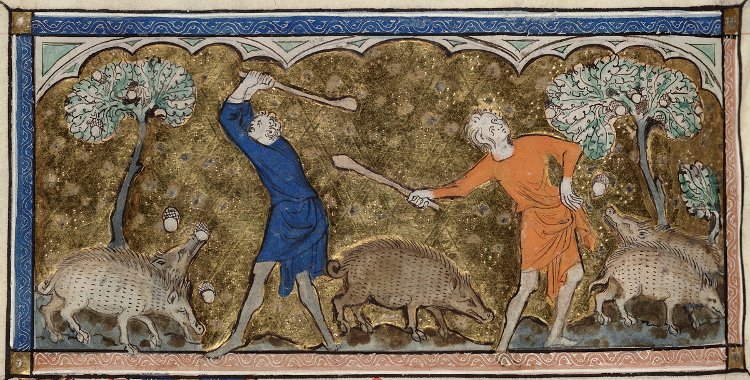
Work and apprenticeship
In towns, the next big step for many boys was an apprenticeship. London’s civic records, published by British History Online, show that the shortest term allowed was seven years, and some apprentices served far longer. One boy in the early 1300s was bound for sixteen years. A national statute of the early 1400s complains of country children being bound as apprentices in towns when they were twelve.
The deal had obligations on both sides. The master had to give his apprentice food, a bed, clothes and proper training in the trade. In return, the family often paid a fee. The cordwainers, London’s shoemakers, demanded 40 shillings in 1271 for teaching an apprentice. Raising a child was expensive too. Works in Progress estimates that feeding a child cost about 15 per cent of average income.
What medieval childhood was really like
Medieval childhood was shorter, harder and more dangerous than ours. Many children did not survive it, and many started work young. But it was still childhood, with toys, games, friends, school for some and parents who loved them. The pewter knights in the Thames mud are a reminder that some things never change: children will always find a way to play.
For the bigger picture of ordinary life, explore daily life in the Middle Ages. Or see what was on a family’s table in the story of what medieval peasants ate, step inside a medieval house, or find out how heavy real armour was, the kind those toy knights were copying.
Frequently asked questions
What toys did medieval children have?
Toy knights on horseback, miniature jugs, cups and plates, hobby horses, whistles, balls and humming bones on a string. Metal, bone and clay toys survive best, so we know much less about the wooden and cloth ones.
At what age did medieval children start work or school?
Medieval writers saw seven as the end of infancy, and the years after it brought school or chores for many children. An English statute of the early 1400s mentions country children being apprenticed in towns at twelve, and in London an apprenticeship lasted at least seven years.
Is it true that medieval parents did not love their children?
No. That idea comes mainly from Philippe Ariès’s book of 1960, and historians such as Nicholas Orme have shown it is wrong. Letters, chronicles, schoolbooks and the toys themselves all point to real affection.
How many medieval children died young?
A great many. Historians, as Orme notes, estimate that about a quarter of English babies did not survive infancy, with many more lost before the age of ten.
What games did medieval children play?
Ball games, races on hobby horses, cockfights at Shrovetide and, when the marshes froze, skating on bones. William FitzStephen described London’s young people enjoying all of these around 1173.
Sources
- Nicholas Orme, via Medievalists.net, Childhood in Medieval England, c.500-1500 (Representing Childhood project, 2005)
- Samuel Hughes, Works in Progress, Did medieval people love their children? (2026)
- Geoff Egan, via Medievalists.net, Miniature toys of medieval childhood (British Archaeology, 1998)
- London Museum, Miniature knight on horseback
- London Museum, Bone skate
- Matt Hoffman, Mental Floss, 10 Common Children’s Toys in the Middle Ages (2026)
- Barbara Hanawalt, via Medievalists.net, Conception Through Infancy in Medieval English Historical and Folklore Sources (Folklore Forum, 1980)
- John Stow, A Survey of London (1598), via the Map of Early Modern London, Sports and Pastimes
- British History Online, Calendar of the Plea and Memoranda Rolls of the City of London, Volume 2: Introduction: Apprenticeship
- Laura McInerney, Schools Week, Grammar schools aren’t from the 1950s, they’re from the Middle Ages (2016)
- Word on Fire, Neither of Us Can Sing: The Schools of Medieval England, Thomas More, and the Classical Education Movement