
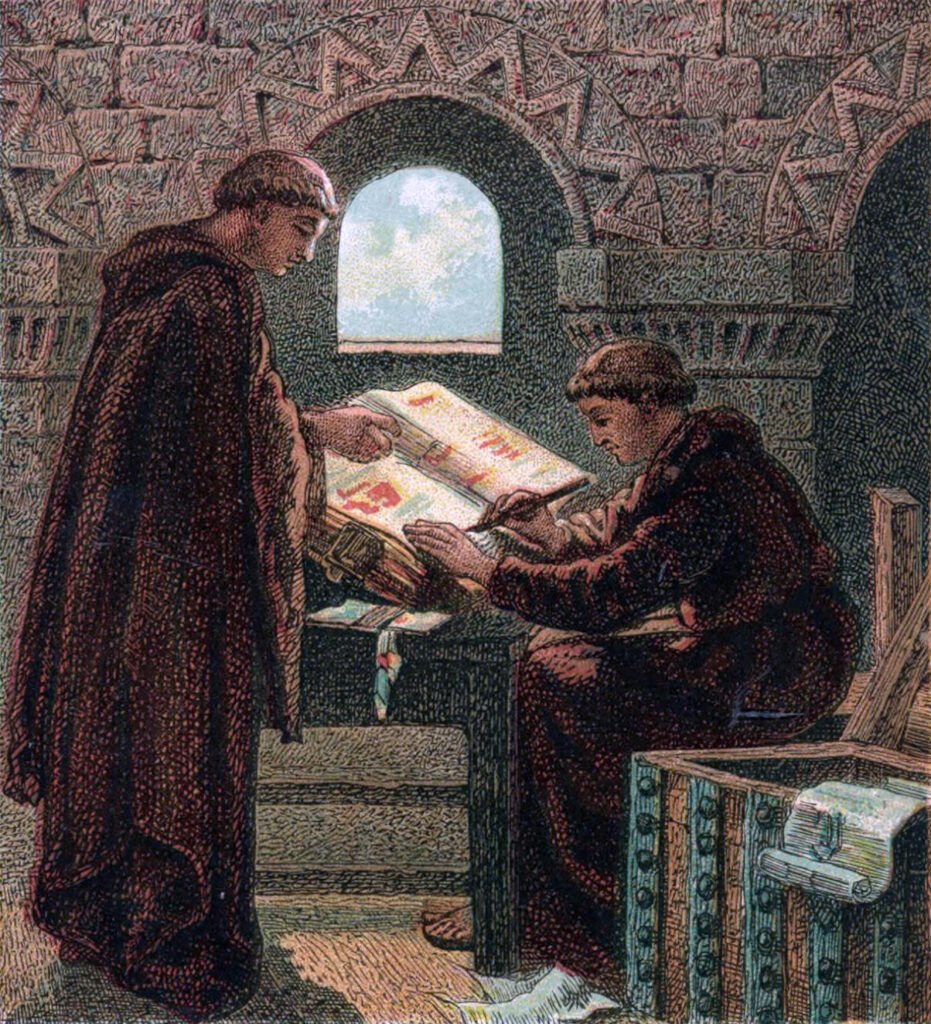
What Was the Domesday Book? William the Conqueror’s Great Survey
Twenty years after he conquered England, William the Conqueror had a question that every new owner eventually asks: what exactly have I got? So he sent his officials into almost every corner of the country to count the land, the people, the ploughs, the mills and the pigs. The result was the Domesday Book, the most famous survey in English history and one of the most remarkable documents of the Middle Ages. It is also, if you think about it, one of the grandest property surveys ever attempted in the Middle Ages. Let’s open it up and see what’s inside.
Jump to a section:
What was the Domesday Book?
The Domesday Book is the written record of a huge survey of England carried out in 1086. According to the historian David Roffe, writing in History Today, William ordered it while keeping Christmas at Gloucester with his court in 1085. The National Archives, which looks after the book today, points out that this came almost two decades after the Norman Conquest.
The survey went county by county. It recorded who held each piece of land, what it was worth, and what was on it, from fields and woods to mills, fisheries and quarries. It even looked backwards, noting what many estates had been worth before 1066. In other words, it was a snapshot of an entire kingdom, taken at a single moment.
Why did William want it?
Oddly, nobody wrote down a clear answer at the time, and historians still debate it. World History Encyclopedia’s Mark Cartwright sums up the main theories. The most likely one is that William wanted to settle who legally owned what, end land disputes and work out how much income the country produced, ready for future taxes. Others link it to the threat of a Danish invasion, which meant William needed money and soldiers fast.
About a century later, a royal treasurer called Richard FitzNigel offered his own explanation. As Roffe notes, FitzNigel believed the survey was made “to bring the conquered people under the rule of written law”. Whatever the motive, everyone agrees on one thing: the Domesday Book is a record of England as it stood in 1086.
How did the Domesday survey work?
The organisation was remarkable for the eleventh century. Cartwright explains that England was split into groups of counties, called circuits, and teams of royal commissioners were sent to each one. In every area they held public hearings, questioned witnesses and checked the documents that landowners produced. Juries made up of equal numbers of English and Norman members helped, and a second wave of inspectors then checked the first wave’s work. Medieval auditors, it seems, did not trust anyone either.
And it was fast. A study led by Professor Stephen Baxter of the University of Oxford, reported by Exeter Cathedral, concluded that the first draft of the survey, covering everything below the River Tees, was put together within 100 days. Baxter calls it “arguably the first systematic use of big data in British history”.
Not everyone was impressed. One chronicler, writing in the Anglo-Saxon Chronicle, moaned that the inquiry was so thorough that, in one well-known translation, “not even an ox, nor a cow, nor a swine was there left, that was not set down in his writ”. You can almost hear the sigh.
What is actually written in Domesday?
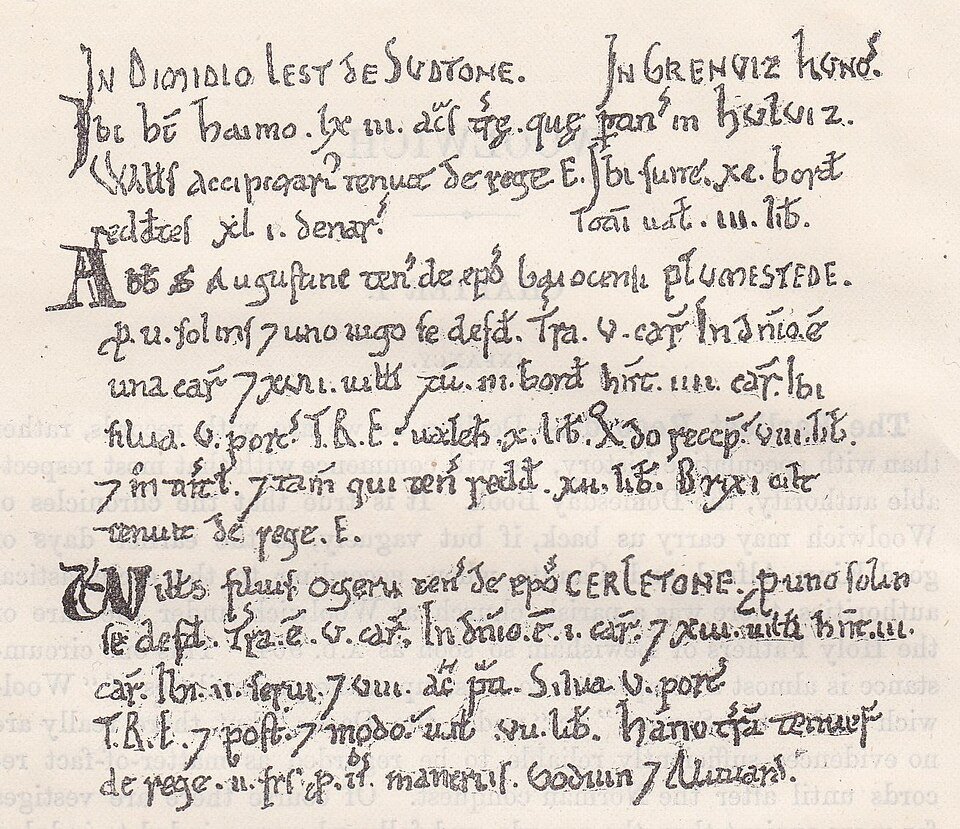
Each entry follows a similar pattern. According to Cartwright, the record for a manor lists its lord, the free peasants and the unfree ones, the ploughs, the mills, the animals and an estimate of its yearly value. It is dry stuff, but every line is a little window into a real place.
Take Kensington, today one of the most expensive corners of London. NBC News, reporting on the book’s arrival online, quoted its Domesday entry: “meadow for two ploughs, pasture for the livestock … woodland for 200 pigs and three arpents of vineyard”. Holborn appears as Holeburne and Islington as Iseldone. Altogether the book names some 13,418 places, and for many English towns and villages it is one of the earliest written records.
There are some sobering numbers too. The same report notes that the king’s family, along with a few powerful barons, held around 40 per cent of the land. Most ordinary people are not named at all, only counted, and a local history study of Domesday puts roughly one in ten of those counted down as slaves. Cartwright estimates that the kingdom held up to two million people, around 90 per cent of whom lived in the countryside.

Great Domesday and Little Domesday
The “book” is actually two books. Little Domesday covers just three counties in the east of England: Essex, Norfolk and Suffolk. Great Domesday covers the rest. Confusingly, Little Domesday has more pages than Great Domesday, even though its pages are smaller, because its entries are far more detailed, right down to the livestock.
Little Domesday was probably meant to be tidied up and added to the main volume, Cartwright suggests, but the job was abandoned after William’s death in September 1087. So in a sense, the most famous book in English history was never quite finished.
Both volumes are written in Latin, packed with abbreviations, and there are some surprising gaps. London and Winchester, two of the most important towns in the kingdom, are missing. So is much of the far north, including the lands that later became County Durham, Northumberland, Cumberland and Westmorland. Most of these areas did not pay the national land tax, and parts of the north-west were still under Scottish rule.
The book is not the only survivor of the survey, either. Exeter Cathedral holds the Exon Domesday, which preserves fuller returns for the south-west of England and was written by several scribes in the summer of 1086. The cathedral describes it as the earliest surviving Domesday manuscript.
Why is it called the Domesday Book?
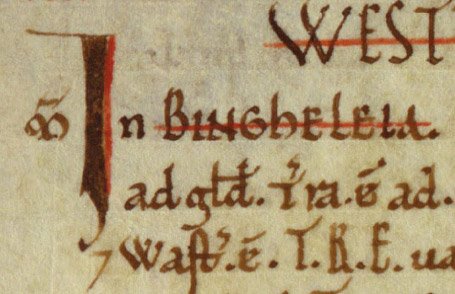
Not because of the end of the world, at least not directly. At first it had duller names, such as the book of the Exchequer or the great book of Winchester, the city where it was kept. Cartwright notes that the name Domesday Book was in common use by the twelfth century.
The usual explanation comes from FitzNigel, who wrote a guide to the royal treasury known as the Dialogue of the Exchequer. He said the English called it Domesday because its verdicts were final, like those of the Last Judgement. Once something was written in the book, there was no appeal.
The adventures of a 900-year-old book
For a pair of fragile volumes, the book has had a surprisingly eventful life. The National Archives tells the story. In the thirteenth century it moved from Winchester to Westminster. By around 1600 it was locked in an iron-bound chest with three locks, and three different officials each held one of the keys.
It fled the plague to Hertford during Queen Elizabeth I’s reign and was rushed out to Nonsuch in 1666, out of reach of the Great Fire that swept through London. It survived the fire that destroyed the old Houses of Parliament in 1834. During the First World War it was sent to Bodmin Prison in Cornwall for safekeeping, and in the Second World War it hid in Shepton Mallet Prison in Somerset. Since 1977 it has lived at Kew, home of the National Archives, in carefully controlled conditions. For its 900th birthday in 1986, it was rebound, and the two books became five volumes.
Domesday goes digital
That 900th anniversary produced one of the great ironies of the computer age. The BBC launched a new “Domesday” of its own, a giant multimedia survey of Britain stored on laser discs. According to the Science Museum Group, more than a million people took part, including over 10,000 schools. But the equipment needed to read it cost around £5,000, very few people bought it, and the technology soon became obsolete. The museum calls it “a good example of the perils of media obsolescence”. The original, written on parchment, is still perfectly readable more than 900 years later.
The parchment version has gone online too. In 2006 the National Archives made the whole of Domesday available to download. At the time, a survey found that 13 per cent of people believed Domesday was part of the Bible, and 2 per cent believed it was by Dan Brown.
Why the Domesday Book still matters
Domesday shows how a conquering king took control of a country not only with castles and soldiers, but with ink. It tells us who won and who lost after 1066, how people farmed and what their land was worth. And for many English places, it is one of the first pages of their written history.
To see how William won his kingdom in the first place, read the story of William the Conqueror and the year 1066. To understand how rulers gained and kept control, explore medieval kings, or find out what life was like for the people Domesday counted by reading about the medieval serf.
Frequently asked questions
Who ordered the Domesday survey, and when?
William the Conqueror, during the Christmas he spent at Gloucester in 1085. The survey itself was carried out in 1086.
What information did the survey record?
Who held the land, how much it was worth, and what was on it: ploughs, mills, woods, meadows, fisheries, animals and the number of peasants and slaves. Most ordinary people were counted rather than named.
Where can you see Domesday today?
The National Archives keeps it at Kew, in south-west London. The volumes are very fragile, so they are rarely displayed, but the whole text can be viewed online.
Which parts of England are missing from it?
London and Winchester were left out, along with much of the far north, including the lands that later became County Durham, Northumberland, Cumberland and Westmorland.
Is the Domesday Book connected to the end of the world?
Only as a comparison. “Doom” meant judgement, and people said the book’s decisions were as final as the Last Judgement. Nothing in it predicts the end of the world.
Sources
- Mark Cartwright, World History Encyclopedia, Domesday Book (2018)
- The National Archives, Domesday: on the record and on the road
- David Roffe, History Today, via Medievalists.net, Decoding Domesday
- Exeter Cathedral, Exeter Cathedral’s ancient manuscript unlocks mysteries of the Domesday Book in a major new study
- NBC News, 11th-century Domesday Book goes online (2006)
- Science Museum Group, BBC Domesday Project
- Anglo-Saxon Chronicle, extract in the Internet Medieval Sourcebook, Fordham University, The Domesday Book
- Wikipedia, Domesday Book
- Vauxhall History, Slavery in the Brixton Hundred, 1086