
Three Popes at Once: The Western Schism
The Catholic Church has one pope. That’s rather the point of a pope. Medieval gossip even claimed that one of them had secretly been a woman, the legendary Pope Joan. Yet for almost forty years, from 1378 to 1417, Western Europe had two of them, each excommunicating the other, and then, thanks to a meeting that was supposed to fix the problem, three. Kings picked sides, cardinals switched loyalties, and ordinary believers had no reliable way of knowing whose blessing counted. This mess is called the Western Schism, and it involved a rioting Roman mob, cardinals arrested and tortured, an escape in disguise and a stubborn old man in a seaside castle. Grab a mitre. Any mitre.
Jump to a section:

How the Western Schism began
For most of the 1300s, the popes didn’t live in Rome at all. From 1309 they were based at Avignon in the south of France, close to the French crown and far from the chaos of Roman politics. Many Italians, and plenty of others, saw this as a disgrace. In 1377 Pope Gregory XI finally brought the papacy back to Rome. Then, on 27 March 1378, he died there.
The cardinals who met to choose his successor had an angry audience. A Roman crowd surrounded the conclave, demanding a Roman, or at least an Italian, pope, and nobody wanted the papacy heading back to France. On 8 April 1378 the cardinals chose Bartolomeo Prignano, the archbishop of Bari, who became Urban VI.
It went wrong almost immediately. Urban turned out to be furious, tactless and determined to cut the cardinals’ comforts down to size. The German-born historian Ludwig von Pastor (1854–1928) called him “naturally arbitrary and extremely violent and imprudent”. Within months, most of the cardinals had left Rome and declared that his election was invalid, because they had voted out of fear of the mob. On 20 September 1378, thirteen of them met at Fondi and elected a new pope, Clement VII. He soon set up his court in Avignon. Now there were two.
Choosing your pope like choosing a team
Europe split along political lines more than religious ones. In broad terms, France, Scotland and, after some hesitation, Castile, Aragon and Navarre backed the pope in Avignon, while England, most of the Holy Roman Empire and most of Italy stood by the pope in Rome. Countries that were already enemies, like England and France, unsurprisingly ended up on opposite sides. Some kingdoms changed sides as their alliances shifted.
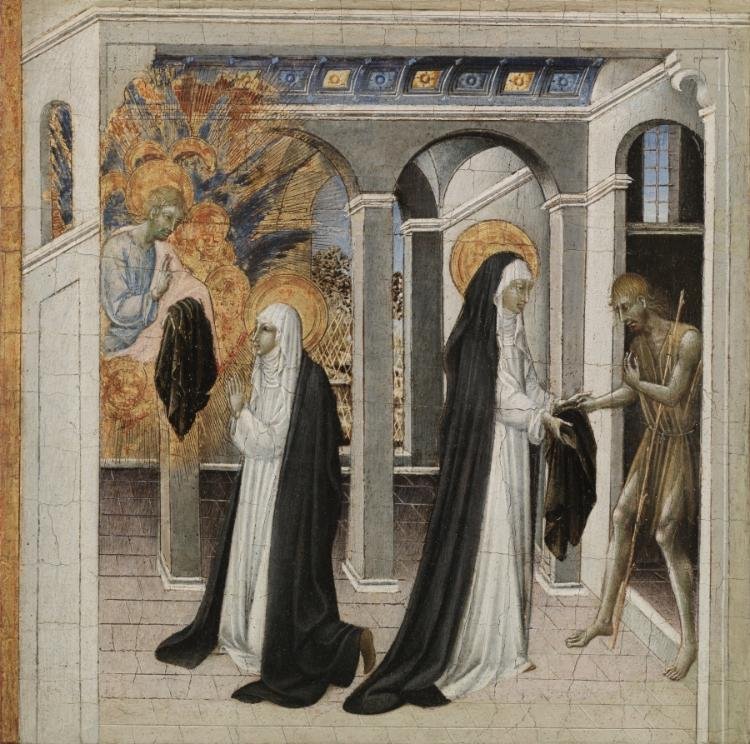
Both popes had their own cardinals, their own officials and their own tax collectors, and both excommunicated the other’s supporters. Even saints disagreed. Catherine of Siena, one of the most famous holy women of the age, backed Urban passionately and called the cardinals who had abandoned him “devils in human form”.
Urban, meanwhile, lived up to his reputation. When a group of his cardinals suggested putting him under supervision, he had them seized, tortured and executed. One later writer called it a crime unheard of through the centuries. Popes died, but the split didn’t. When Urban died in 1389 and Clement in 1394, each side simply elected a new pope of its own. The Avignon line passed to a tough Aragonese cardinal, Pedro de Luna, who became Benedict XIII.
How two popes became three
By the early 1400s, almost everyone agreed that the schism had to end. The question was how. In 1406 the two rival popes, Gregory XII in Rome and Benedict XIII in Avignon, both agreed in principle to resign. Neither actually did.
So in 1409 a group of cardinals from both sides gave up waiting and called a council at Pisa. It declared both popes deposed as schismatics and heretics and elected a fresh pope, Alexander V. It was a bold plan with one small flaw: neither of the existing popes accepted it. The Western Schism now had three popes, each with followers and each claiming to be the only real one. When Alexander died in 1410, the Pisan line chose a successor, Baldassarre Cossa, who took the name John XXIII. He is the same John XXIII who appears in the story of indulgences, raising money by selling pardons.
The Council of Constance cleans up
Under pressure from Sigismund, King of the Romans, John XXIII summoned a great council to meet at Constance, in what is now southern Germany, in 1414. Thousands of churchmen, princes and envoys came. It soon became clear that the council intended to remove John along with the other two.
He did not wait to find out. In March 1415 John slipped out of Constance, reportedly disguised as a postman, and headed down the Rhine with the help of his ally, Frederick IV, Duke of Austria. The escape didn’t last. He was brought back, deposed, and tried on charges that included heresy and simony, the buying and selling of church offices. In April 1415 the council also issued a decree, Haec sancta, declaring that a general council drew its authority directly from Christ and could even judge a pope.
Gregory XII, the Roman pope, handled his exit with more dignity. He formally recognised the council and then, on 4 July 1415, had his resignation announced at Constance through a representative. He was the last pope to resign until Benedict XVI in 2013.
That left Benedict XIII, who refused point-blank. Deposed and excommunicated in 1417, he held out in the castle of Peñíscola on the coast of Valencia, where he had already taken refuge, and went on calling himself the true pope, protected by the Crown of Aragon. He died there on 23 May 1423, at about 80, still unconvinced. On 11 November 1417 the council elected Martin V, a member of the powerful Roman Colonna family, and the Western Schism was effectively over.

What the schism left behind
The damage outlasted the split. For forty years, rival popes had excommunicated each other, sold offices to raise money and treated whole kingdoms as bargaining chips. Many people concluded that the papacy needed watching. The idea that a church council could stand above a pope, known as conciliarism, gained strong support, until Pope Pius II banned appeals from a pope to a future council in 1460.
Historians often see the schism as one of the long-term causes of the Reformation a century later, because it badly weakened the papacy’s prestige. The Catholic Church today counts the Roman popes as the legitimate line and treats the Avignon and Pisan claimants as antipopes. That’s why, when Cardinal Angelo Roncalli was elected in 1958, he could take the name John XXIII all over again.
Don’t confuse the Western Schism with the much older quarrel that divided Rome from Constantinople; that story is told in the East-West Schism of 1054. To see how the Church ran daily life while its leaders squabbled, read about the medieval Church.
Frequently asked questions
How many popes were there at once during the Western Schism?
Two from 1378, and three from 1409, when the Council of Pisa elected a pope of its own without getting rid of the other two.
Why were the popes in Avignon?
The papacy moved there in 1309 and stayed for most of the 14th century, partly because of the influence of the French crown and partly because Rome was dangerously unstable.
What is an antipope?
Someone who claims to be pope in opposition to the pope the Church later recognises as legitimate. Clement VII, Benedict XIII and the Pisan popes are all counted as antipopes.
Who ended the Western Schism?
The Council of Constance, which removed or accepted the resignations of the rival claimants and elected Martin V in 1417.
Sources
- Wikipedia, Western Schism
- Wikipedia, Pope Urban VI
- Wikipedia, Antipope John XXIII
- Wikipedia, Pope Gregory XII
- Wikipedia, Antipope Benedict XIII