The Medieval Church: How Religion Shaped Everyday Life
In medieval Europe, religion was not one part of life among many. It marked the hours of the day, the days of the year and every turning point from the cradle to the grave. The medieval Church was also a landowner, a school, a hospital, a court and, at times, a rival to kings. Its priests baptised the newborn and buried the dead, its monks copied the books, and its quarrels could split a continent.

A Church for every stage of life
For most people the Church meant the local parish and its priest. Villagers were expected in church every week, both to hear the service and to confess. The priest baptised their children, confirmed them and buried them.
He also stood between his parishioners and God. People were taught that they needed a priest in order to pray properly and to understand scripture. His authority came from the bishop who had ordained him, whose own authority came from above, in a chain that led all the way to the pope.
All of this had to be paid for. Every household owed the tithe, a tenth of what it earned or grew, which supported the priest and the wider Church. The Church gave something back in the form of time off, because its festivals and holy days were almost the only breaks in a peasant’s working year. Those holy days set the rhythm of daily life in the Middle Ages.
How the medieval Church was organised
The Church was built like a pyramid. At the top was the pope. Around him were the cardinals, who advised him and ran the central administration. Below them came the archbishops and bishops, each responsible for a cathedral and the region around it. At the base were the priests, each looking after the church of one village, one town or one parish.
The hierarchy had a formidable weapon. Excommunication shut a person out of the Church altogether. In a society where everybody belonged to it, that meant being cut off from the hope of salvation and from ordinary dealings with one’s neighbours as well. Archbishops used the threat against nobles, against whole towns and even against monasteries.
Monks and nuns
Alongside the parish clergy were the men and women who withdrew from the world to live in religious communities. Most of them in western Europe followed a rule written by Benedict of Nursia, who lived from about 480 to 534. It is often summed up in two Latin words, ora et labora: pray and work.
Prayer came first. The community gathered in church eight times every day, starting in the dark before sunrise and finishing at bedtime. The day began early, at about half past four in summer and half past seven in winter. Speaking was forbidden in the church, the kitchen, the dining hall and the dormitory. In winter there was one meal a day, and in summer two. Monks shaved the crown of the head, leaving the ring of hair called the tonsure.
Many did not choose this life for themselves. Children were handed over to monasteries before their teens, some of them only five years old. Those who entered at fifteen or older began as novices.
Keepers of books and medicine
Monasteries were the libraries of the early Middle Ages. Until the 13th century, most books were made by monks and nuns, who prepared the parchment, mixed the ink and copied every line by hand. A single book could take many months. Without that patient work, much of the literature of the ancient world would have been lost.
Monasteries also cared for the sick. Their gardens grew medicinal herbs, and the larger houses had hospitals attached.
Rich monks, plain monks and beggars
Not all religious communities looked alike. In the early 12th century the great abbey of Cluny, in France, built a church of enormous size, with tall towers outside and rich decoration inside. Others thought this was a betrayal of the monastic ideal. Bernard of Clairvaux, the leading figure of the Cistercian order, who lived from 1090 to 1153, called such ornament both a distraction and a waste of money. Cistercian buildings were kept as plain as possible.
The 13th century brought a different answer. The Franciscans and the Dominicans, founded by Francis of Assisi and Dominic, promised to own nothing at all. They are known as mendicants, from the Latin word for begging.
Saints, relics and pilgrimage
Medieval Christians believed that holy people remained powerful after death, and that their power lingered in physical things. A relic was a part of a saint’s body, or an object that he or she had touched. Relics were kept in containers made of gold, silver, ivory, enamel and precious stones. Since Charlemagne’s reign, no altar could be without one.
Their value made them worth stealing. The body of Saint Mark ended up in Venice and that of Saint Nicholas in Bari, both carried off from the churches that had first held them.
To be near a famous relic, people travelled. A pilgrim might be keeping a promise, making up for a crime, looking for a cure or simply hoping to strengthen his faith. Jerusalem and Rome were the oldest destinations. Later, huge crowds made for Santiago de Compostela in Galicia, in Spain, where the apostle James was believed to be buried. The roads leading there are still lined with the churches, hostels, hospitals and bridges built to serve them.
English pilgrims had a goal closer to home. After Archbishop Thomas Becket was killed in Canterbury Cathedral on 29 December 1170, his shrine became a favourite destination. Pilgrims took home souvenirs, the simplest of which were badges. In the later Middle Ages many also travelled to earn indulgences, by which the Church promised to reduce the punishment due for a person’s sins.
,_f.32_-_BL_Harley_MS_5102.jpg?width=1200)
Cathedrals: faith in stone
Nothing shows the wealth and ambition of medieval religion better than its cathedrals. Chartres, in France, was begun in 1145 and largely rebuilt in just 26 years after a fire in 1194. Its stained-glass windows, made in the 12th and 13th centuries, survive in remarkable condition, and UNESCO ranks the building as the finest achievement of French Gothic art.
Not every project moved so fast. Cologne Cathedral was started in 1248, and work on it finally ended in 1880. In England, the spire of Salisbury Cathedral, built between 1310 and 1330, rises 123 metres above the ground.
Popes, kings and holy war
Religious authority and royal power were tangled together from the start. On Christmas Day in 800 it was a pope, Leo III, who made Charlemagne an emperor. Nearly four centuries later the quarrel between King Henry II of England and Thomas Becket ended in the archbishop’s murder. For medieval kings, a strong-willed archbishop could be as dangerous as a rebel baron
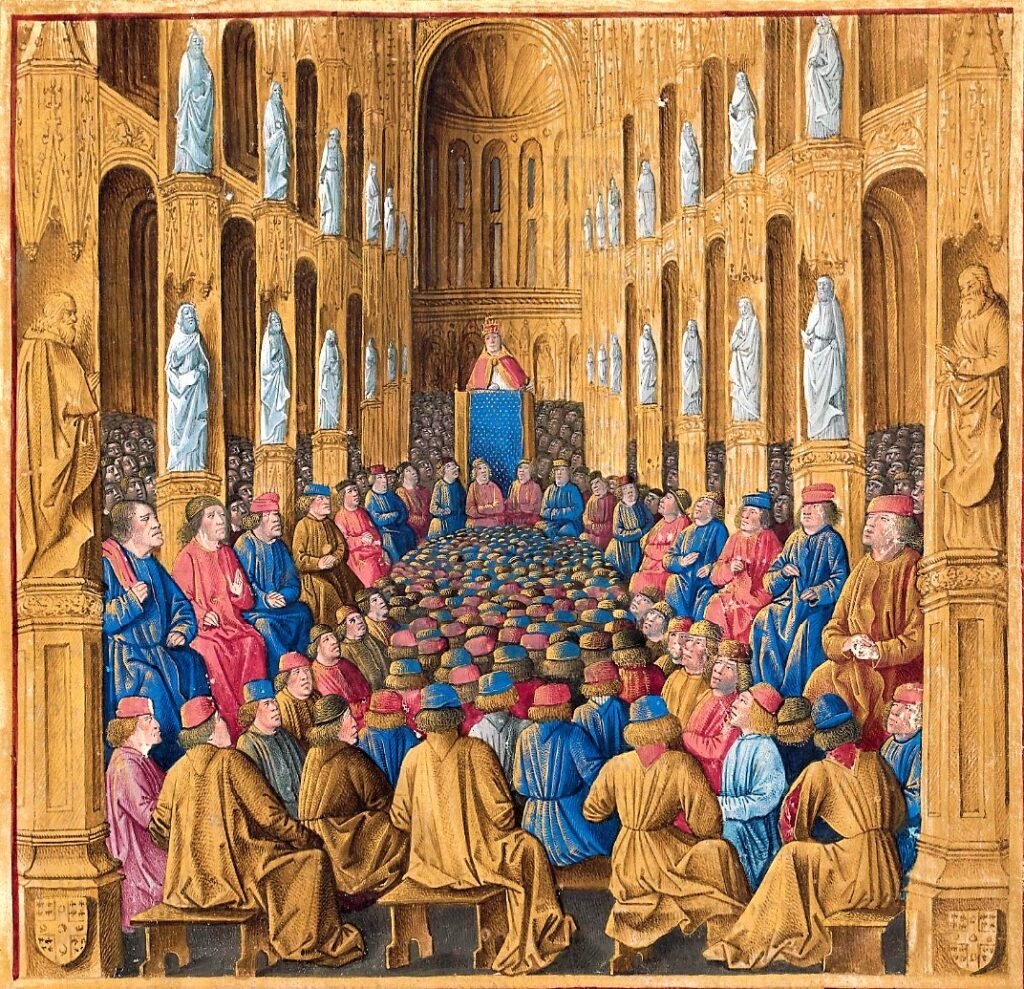
The Church could also raise armies. In November 1095, at Clermont in France, Pope Urban II preached the sermon that launched the First Crusade. Less than four years later, on 15 July 1099, Jerusalem fell to the Crusaders after a siege of five weeks. It remains one of the most famous episodes in medieval siege warfare.
A Church divided
For all its claims to unity, the medieval Church split more than once.
The deepest break came in 1054, when the pope in Rome and the patriarch of Constantinople excommunicated each other. The quarrel hardened into a lasting separation between the Catholic West and the Orthodox East. The excommunications were not withdrawn until 1965.
The papacy itself could be paralysed. After a pope died in 1268, the cardinals took almost three years to agree on a successor, the longest papal election in history. Worse followed. Between 1378 and 1417 there were two rival popes at once, one in Rome and one in Avignon, and later three. The crisis ended only in November 1417, when a council meeting at Constance set aside the rival claimants and Martin V was chosen as the one pope.
Critics of the Church
Wealth and scandal bred resentment. The movements that the Church condemned as heresies generally began as protests against what their followers saw as corruption among the clergy. The sale of indulgences drew particular anger, and it was one of the abuses that later reformers, Martin Luther among them, set out to challenge.
What the medieval Church left behind
It is easy to see the medieval Church only through its failures: the rival popes, the stolen relics, the trade in forgiveness. But the same institution taught people to read, copied the books that carried ancient learning into the modern world, nursed the sick and raised some of the most beautiful buildings ever made. For a thousand years, almost everything that happened in Europe happened in its shadow.
Frequently asked questions
How much was the tithe?
One tenth. Every household was expected to give a tenth of its income or produce to support the parish priest and the Church.
How often did monks pray?
Eight times a day. The first service was held before daybreak and the last at bedtime.
What did it mean to be excommunicated?
It meant being expelled from the Church, and with that from normal dealings with other Christians.
Why did the medieval Church have more than one pope?
From 1378 to 1417 rival popes, based in Rome and in Avignon, each claimed to be the true one, and for a time there were three. It ended in 1417, when Martin V was chosen as the only pope.
Sources
- Joshua J. Mark, “Medieval Church”, World History Encyclopedia
- The Metropolitan Museum of Art, “Monasticism in Western Medieval Europe”
- Mark Cartwright, “The Daily Life of Medieval Monks”, World History Encyclopedia
- The Metropolitan Museum of Art, “Medicine in the Middle Ages”
- The Metropolitan Museum of Art, “Relics and Reliquaries in Medieval Christianity”
- The Metropolitan Museum of Art, “Pilgrimage in Medieval Europe”
- UNESCO World Heritage Centre, “Routes of Santiago de Compostela”
- The British Museum, “Thomas Becket: murder and the making of a saint”
- UNESCO World Heritage Centre, “Chartres Cathedral”
- UNESCO World Heritage Centre, “Cologne Cathedral”
- Salisbury Cathedral, “What to see”
- The Metropolitan Museum of Art, “Carolingian Art”
- The Metropolitan Museum of Art, “The Crusades (1095–1291)”
- Encyclopaedia Britannica, “East-West Schism”
- Vatican News, “The Conclave from the Middle Ages to the present day”
- Encyclopaedia Britannica, “Western Schism”