Medieval Kings: How They Won, Held and Lost Power
Medieval kings are often imagined as all-powerful rulers who could do whatever they pleased. The reality was harder work. A crown had to be won, blessed, paid for and defended, and plenty of men who wore one ended up losing it. Medieval kings also had to live with barons, bishops and, in time, parliaments, all of whom had ways of saying no.

How a man became king
There were three main roads to a medieval throne: birth, conquest and election.
By birth
Most kings inherited the crown from a father or another close relative. The system promised stability, but it took no account of whether the heir was ready. England’s Richard II was crowned in 1377 at the age of ten. Edward III was fourteen. The record belongs to Henry VI, who became king at just nine months old. No one has ever inherited the English crown at a younger age. A child king meant years of rule by relatives and advisers, and those years were often dangerous.
By conquest
A strong enough claimant could simply take a kingdom. The most famous example is William, Duke of Normandy. After his victory in 1066 he was crowned King of England in Westminster Abbey on Christmas Day of the same year.
By election
Not every crown passed from father to son. The ruler of the Holy Roman Empire, in central Europe, was chosen by a small group of great princes. In 1356 the emperor Charles IV issued a constitution known as the Golden Bull. From then on the decision belonged to seven named electors, three of them senior churchmen and four of them secular princes.
The coronation: turning a man into a king
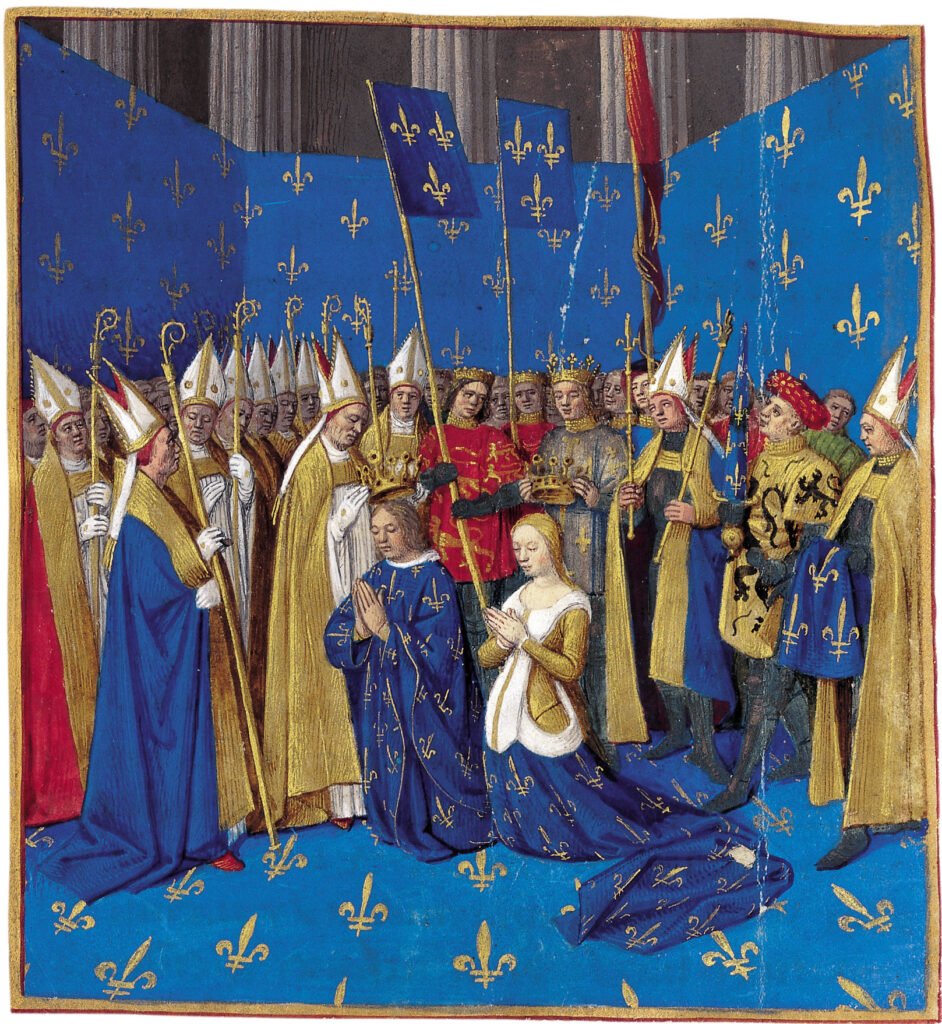
Winning a throne was one thing. Being accepted as its rightful holder was another, and that was the purpose of the coronation. A public ceremony in a great church, led by a senior churchman, announced that this man ruled with God’s approval.
The most influential coronation of the early Middle Ages took place on Christmas Day in the year 800. Charlemagne, who had ruled the Franks since 768, was made emperor by Pope Leo III. By then his lands reached north from Italy to the North Sea and east from the English Channel as far as the River Elbe. The ceremony gave that power a sacred stamp.
In England, every coronation since 1066 has been held in Westminster Abbey. William the Conqueror’s own ceremony there shows how tense these occasions could be. Norman soldiers standing guard outside heard the noise from within, took it for an attempt on their leader’s life, and reacted with violence. Rioting broke out and nearby houses were set on fire.
What medieval kings actually did
A medieval king was expected to do three things above all: lead his people in war, see that justice was done, and reward the men who served him. All three cost money, and the search for money shaped much of medieval politics. The UK Parliament’s own history traces its growth in the 1200s and 1300s mainly to this: Edward I and the kings after him wanted to fight wars, and they needed their subjects to pay. The peasants who paid those taxes saw none of this, and daily life in the Middle Ages looked nothing like life at court.
To tax a country, a king first had to know what was in it. In 1086 William the Conqueror ordered a great survey of his new kingdom to find out who held the land. The result, known as Domesday Book, covers nearly the whole of England and names over 13,000 places. Few medieval rulers ever had such a detailed picture of what they ruled.
Castles: royal power in stone
Kings also needed to be seen and feared, and nothing did that better than a castle. The Tower of London dates from the 1070s, when William the Conqueror ordered it built. The work took around twenty years, and it served both as a stronghold and as a statement of who was now in charge. In the same century he founded Windsor Castle. Forty monarchs have lived there since, and no occupied castle in the world is older or larger.
Castles could also be turned against the crown. When barons rebelled, they shut themselves inside their strongholds, and the king had to dig them out. King John spent the autumn of 1215 besieging rebels in Rochester Castle. His son Henry III needed six months to starve out the garrison of Kenilworth in 1266. Both campaigns were classic examples of medieval siege warfare.
The limits of royal power
No medieval king ruled alone. Three forces in particular could stand in his way.
The barons
Great landowners supplied the king’s soldiers and governed the regions in his name. If enough of them turned against him, he was in serious trouble. In June 1215, at Runnymede beside the River Thames, rebel barons forced King John to accept Magna Carta. For the first time, a written document set down the idea that even the king and his officials had to obey the law.
Agreeing to a charter and keeping to it were different things. John soon went back on his word, and the war resumed. Prince Louis of France invaded England in support of the rebels and laid siege to Dover Castle, which was where a garrison of only a few hundred men held out for the king.
Rebellions usually ended in a bargain rather than a massacre. When Henry III finally broke the resistance at Kenilworth in 1266, he did it with peace terms as well as siege engines. Under the settlement known as the Dictum of Kenilworth, issued on 31 October that year, rebels were allowed to buy back their confiscated estates, at a steep price.
.jpg?width=1200)
The Church
The Church crowned kings, and it could also defy them. The best-known clash is the quarrel between Henry II of England and Thomas Becket. Becket had been the king’s chancellor and close friend before he became Archbishop of Canterbury. The two then fell into a bitter dispute. On 29 December 1170, four knights closely connected to Henry killed him inside Canterbury Cathedral. After his death Becket was venerated as a saint, and pilgrims came to Canterbury to visit his shrine.
Parliament
The third check on a king’s power came from his constant shortage of money. In 1265, during a rebellion against Henry III, Simon de Montfort summoned an assembly that included men sent by the counties and by the towns, called to talk over national business. Historians treat it as the first ancestor of today’s Parliament. Thirty years later, in 1295, Edward I called what became known as the Model Parliament. Each county sent two knights and each town two representatives, and later Parliaments kept that pattern.
When medieval kings lost their crowns
A king who failed badly enough could be removed, and in England it happened more than once.
Edward II reigned from 1307 to 1327. In September 1326 his own queen, Isabella, invaded England with her ally Roger Mortimer. Edward lost his throne to his own son, who was crowned as Edward III in January 1327 at the age of fourteen. Parliament took part in removing the old king.
Richard II, the boy crowned at ten, ruled from 1377 until 1399. In that year his cousin Henry Bolingbroke removed him and reigned in his place as Henry IV. Richard died in February 1400 at Pontefract, in Yorkshire.
.jpg?width=1200)
Other kings lost everything in a single afternoon. On 22 August 1485, Richard III faced Henry Tudor at the Battle of Bosworth Field. Richard lost his horse and then his life, and Henry’s victory began the rule of the Tudors. No English king since has died in battle. His grave was lost for centuries, until a skeleton dug up in Leicester was announced in February 2013 to be his.
Queens and power
Medieval politics was dominated by men, but royal women could hold real influence. Eleanor of Aquitaine, born around 1122, was queen consort of two rival kingdoms in turn: she was married first to Louis VII of France and then to Henry II of England. She died in 1204, having lived to about eighty-two. Isabella, the queen of Edward II, went further still. As we have seen, she led the invasion that cost her husband his throne.
Kings beyond Europe
The same struggle to build and hold power was playing out across the medieval world, sometimes on a far larger scale. The Mongol Empire dates from 1206, the year Genghis Khan established it. At its height it covered about nine million square miles. No other land empire in history has formed a larger unbroken territory.
What the story of medieval kings tells us
Put together, these examples show a pattern. A medieval king was powerful, but his power rested on other people: the churchmen who crowned him, the barons who fought for him, and the subjects who paid his taxes. The rulers who lasted were the ones who kept those groups on their side. The ones who forgot it, like John, Edward II and Richard II, discovered how quickly a crown could slip.
Frequently asked questions
Who was the youngest medieval king of England?
Henry VI. He was nine months old when he became king, and nobody younger has ever inherited the English throne.
Were medieval kings above the law?
Many behaved as if they were, but the idea was challenged. Magna Carta, issued in June 1215, was the first written text to say that the law applied to the king and his government too.
Where were English kings crowned?
At Westminster Abbey. Every coronation since 1066 has taken place there, beginning with William the Conqueror’s on Christmas Day that year.
Could a medieval king be removed?
Yes. England saw it happen twice in the 14th century: Edward II was forced out in 1327 and Richard II in 1399. Each time, a rival took the throne in his place.
Who chose the Holy Roman Emperor?
From 1356, under the Golden Bull of Charles IV, seven electors made the choice: three senior churchmen and four secular princes.
Sources
- Westminster Abbey, “History of Westminster Abbey”
- Westminster Abbey, “Coronation stories”
- The Metropolitan Museum of Art, “Carolingian Art”
- Encyclopaedia Britannica, “Golden Bull of Emperor Charles IV”
- UK Parliament, “Magna Carta”
- UK Parliament, “Simon de Montfort’s Parliament”
- UK Parliament, “Edward I and Parliament”
- The National Archives, “Domesday Book”
- Historic Royal Palaces, “The story of the Tower of London”
- Royal Collection Trust, “Windsor Castle”
- The British Museum, “Thomas Becket: murder and the making of a saint”
- English Heritage, “History of Rochester Castle”
- English Heritage, “Dover Castle: History and Stories”
- English Heritage, “The Siege of Kenilworth Castle”
- Encyclopaedia Britannica, “Edward II”
- Encyclopaedia Britannica, “Richard II”
- Encyclopaedia Britannica, “Battle of Bosworth Field”
- University of Leicester, “Richard III”
- Encyclopaedia Britannica, “Eleanor of Aquitaine”
- Encyclopaedia Britannica, “Mongol empire”