

The Canterbury Tales Explained
Some school set texts deserve their dusty reputation. The Canterbury Tales doesn’t. Geoffrey Chaucer’s great poem is packed with cheating millers, lusty students, a much-married businesswoman, a con-artist selling pig bones as holy relics, a talking rooster and more toilet humour than you’d expect from a book written more than 600 years ago. It’s also one of the first great works written in English rather than French or Latin. If you’ve only ever heard of it, or were forced to read three pages at school, this is the Canterbury Tales explained in plain modern English.
Jump to a section:
Who was Geoffrey Chaucer?
Chaucer wasn’t a starving poet in an attic. He was a busy royal servant who wrote in his spare time. Born in London in the early 1340s, he was the son of John Chaucer, a wine merchant. As a young man he went to war in France, and in 1360 he was captured during the siege of Reims. King Edward III paid £16 towards his ransom, which tells you he was useful but not, at that stage, terribly important.
Over the following decades he worked as a diplomat, a courtier and an official. In 1374 he became Comptroller of the Customs for the port of London, checking the taxes on goods passing through, and in 1389 he was made Clerk of the King’s Works, in charge of royal building projects. Somehow, in between, he wrote some of the finest poetry in the language.
He is thought to have died in October 1400, though the date comes from a tomb made over a century later. He was buried in Westminster Abbey, the first writer to be laid there, and the spot later grew into Poets’ Corner. Thanks to his influence on the language and its literature, he is often called the father of English literature, or the father of English poetry.
What are the Canterbury Tales about?
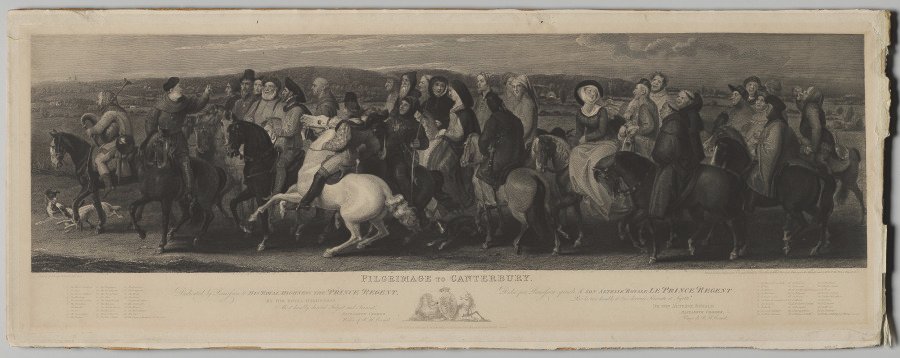
The idea is beautifully simple. A group of pilgrims, from every level of society below the nobility, sets off from Southwark to pray at Becket’s tomb in Canterbury. To pass the time, the innkeeper, Harry Bailey, proposes a storytelling contest. Whoever tells the best tale wins a free dinner when they get back. Each pilgrim is supposed to tell four stories, two on the way there and two on the way home. That would have made around 120 tales.
Chaucer never got close. The Canterbury Tales contains twenty-four stories, some of them unfinished, and most scholars think he was still working on it when he died. The pilgrims never reach Canterbury, and nobody ever wins the dinner. If you want the real-life background to the journey, from relics to souvenir badges, read about medieval pilgrimage.
Meet the pilgrims
The real genius of the poem lies in its General Prologue, a gallery of sharply observed portraits. Chaucer pretends to be a naive fellow pilgrim, praising everyone, while slipping in details that let you see exactly what they’re like. Among the most memorable:
- The Knight, a veteran of crusades and foreign wars, so modest that his tunic is still stained from his armour.
- The Prioress, a nun with perfect table manners and lapdogs she feeds with roast meat, which wasn’t quite the point of being a nun.
- The Miller, a brawny bruiser who can break a door off its hinges by running at it with his head.
- The Wife of Bath, a cloth-maker who has had five husbands, travelled to Jerusalem three times and has very firm opinions about who should be in charge in a marriage. Her own tale is set in the days of King Arthur.
- The Pardoner, who sells forgiveness and fake relics, and whose cheerful dishonesty is the subject of our article on indulgences.
Chaucer gives you a nun who loves her dogs more than the poor, a monk who’d rather go hunting than pray, and a ploughman and a parson who are genuinely good. It’s satire, but it’s affectionate, and it captures a whole society in motion.

Romance, sermons and very rude jokes
The stories themselves are as varied as the people telling them. That variety is part of the fun. The Knight opens the contest with a long, noble romance about two cousins in love with the same woman. Then the drunken Miller barges in and insists on telling a story of his own, about a carpenter, his young wife, a lodger and a bottom stuck out of a window in the dark. It’s one of the dirtiest jokes in English literature, and it comes immediately after the most respectable story in the book. The contrast is completely deliberate.
Elsewhere you’ll find saints’ lives, moral fables, a sermon, a tale of magic and fairies, and the Nun’s Priest’s story about a vain rooster called Chauntecleer who is nearly eaten by a fox because he can’t resist showing off. The tales borrow from French fabliaux, Italian writers such as Boccaccio, classical myth and popular sermons, but Chaucer bends everything to his own sense of humour. He even ends the whole work with a “Retraction”, asking forgiveness for any of his writings that might lead readers into sin. Whether he meant it, or was covering himself, is still debated.
Why the language looks so strange
Chaucer wrote in Middle English, the form of the language spoken between roughly the Norman Conquest and the late 1400s. It’s mostly the London dialect of his own day. At a time when much serious literature in England was still in Latin or French, his choice to write such an ambitious work in English helped show what the language could do.
Middle English looks odd but is easier than it seems. Read it aloud and many words make sense: “Whan that Aprill with his shoures soote” simply means “When April with its sweet showers”. Many lines now read as half-familiar, half-foreign, which is exactly why teachers love and students fear it.

From manuscript to printed bestseller
The Canterbury Tales was hugely popular from the start. Eighty-four manuscripts of it survive, a remarkable number for a medieval English work. The two earliest and most important, the Hengwrt and Ellesmere manuscripts, appear to have been copied by the same scribe, who has been identified, though not without dispute, as the London scrivener Adam Pinkhurst.
Then came the printing press. William Caxton, who brought printing to England, published Chaucer’s poem around 1476, and it became one of the first major books printed in the country. Ever since, it has been reprinted, illustrated, modernised and retold, from William Blake’s engraving of the pilgrims to modern films and novels.
The Canterbury Tales still works because Chaucer was writing about people, and people haven’t changed much. Curious about what else people were painting and writing back then? Wander through medieval art, or meet the murdered archbishop who started the whole pilgrimage craze in Thomas Becket: murder in the cathedral.
Frequently asked questions
How many Canterbury Tales are there?
Twenty-four, some unfinished. Chaucer’s original plan would have produced around 120.
Did the pilgrims ever reach Canterbury?
Not in the poem. The work breaks off before they arrive, and the storytelling contest is never judged.
Is the Canterbury Tales hard to read?
In the original Middle English it takes some practice, but reading it aloud helps a lot. Plenty of modern translations make the stories easy to enjoy.
Why is it called the Canterbury Tales?
Because the storytellers are pilgrims heading for Canterbury Cathedral, where Becket was buried and venerated.
Sources
- Wikipedia, The Canterbury Tales
- Wikipedia, Geoffrey Chaucer
- The Cleveland Museum of Art, Pilgrimage to Canterbury, after Thomas Stothard
- The Cleveland Museum of Art, Plaque from a reliquary chest of Saint Thomas Becket