

How Were Castles Defended? Moats, Murder Holes and Arrow Slits
A medieval castle was not just a big stone house with a nice view. It was also a home, as you can see in what life in a medieval castle was really like. It was a machine built for one job: keeping unwelcome guests out, and making them very sorry they had tried. Every ditch, door and dark little slit in the wall had a purpose, and most of those purposes were unpleasant. So how were castles defended? Let’s walk up to the front gate and find out the hard way. Try not to stand under any holes.
Jump to a section:

How were castles defended? It started with the ground
Before any stone went up, builders chose a spot that did half the work for them. World History Encyclopedia’s Mark Cartwright lists the favourites: a natural rise, the edge of a cliff or the bend of a river. Then they dug.
The ditch was the first serious obstacle. A guide to Herefordshire’s castles, published by the county council, describes it as among the most important defences a castle had, and says ditches filled with water worked best. Cartwright adds that dry ditches could be lined with wooden stakes. Attackers who waded across ended up soaked, slow and weighed down by wet clothes. You did not even need a deep lake. According to Cartwright, half a metre of water was enough to cause trouble for an attacking army.
Some lords went much further. At Caerphilly in South Wales, Gilbert de Clare began a huge new castle in 1268 and surrounded it with artificial lakes, made by damming the river. Cartwright explains that the water left the castle almost impossible to tunnel under or batter with siege engines. Miners, it turns out, hate swimming.
The gate: the weakest spot, so the deadliest
Walls are hard to break, but a gate has to open. That made it the obvious target, and builders packed it with nasty surprises.
- The drawbridge. It could be hauled up on chains, or on some designs swung round by 90 degrees, leaving attackers staring at a ditch.
- The barbican. An extra fortified gateway built in front of the main one. At Goodrich Castle in Herefordshire, attackers had to cross two bridges with a sharp 90-degree turn between them, so nobody could charge straight in.
- The portcullis. A heavy grid of timber and iron that dropped down to seal the passage. Some gates had two, so a whole group of attackers could be shut in between them.
- The murder holes. Openings in the ceiling of the gate passage. Anyone trapped below became a target for whatever the defenders had to hand.
Goodrich shows how all this worked together. Its gate passage ran for about 50 feet, guarded by two portcullises, and the murder holes sat in the vaulted roof between them. According to the Herefordshire guide, defenders could pour molten lead or boiling water through them.
And what about boiling oil? It makes a great film scene, but oil was expensive. Hot sand, scalding water, stones and quicklime were cheaper choices. Murder holes had a more practical job too. Attackers often tried to burn the wooden gates, so defenders used the openings to pour water and put the fire out. Caerphilly’s main gatehouse had a double row of murder holes, plus a sloping chute above the gate for soaking anyone who tried to set it alight.
Walls and towers: why round beat square
The curtain wall was the long stone wall that ran around the whole castle. Cartwright gives an average thickness of about 2.5 metres, roughly as thick as a room is high. Many walls also had a sloping base. It made the wall harder to climb and harder to undermine, and stones dropped from above would bounce off it at awkward angles into the crowd below.
Towers stuck out from the wall so that archers could shoot sideways along it, picking off anyone trying to climb up. Early towers were square. From the 1180s, D-shaped towers became popular, and later many were fully round. There were good reasons. Round towers removed the blind spots at the corners, gave archers a wider field of fire, deflected missiles better and were more stable. And, as Rochester was about to discover, a square corner was a tempting target for miners.
Rochester Castle in Kent learned that lesson the hard way. During King John’s siege of 1215, one corner tower of its great keep came crashing down after his miners set fire to their tunnel. English Heritage notes that it was rebuilt in the 1220s, this time round, and you can still see the odd one out today among the three square corners.
Arrow slits and battlements: shoot, but don’t get shot
The top of the wall was lined with battlements, the zigzag pattern every child draws on a castle. The tall stone blocks, called merlons, gave cover. The gaps between them, called crenels, gave archers somewhere to shoot from. Some gaps even had hinged wooden shutters.
Lower down, the walls were pierced by arrow slits, also called arrow loops. From outside, each one looked like a thin vertical crack, almost impossible to hit. Inside, it widened out, giving the archer room to move and aim. Later builders added a short horizontal slit across the middle for an even wider view. Beaumaris Castle, on the island of Anglesey, had 164 of them on its outer walls alone.
Hoardings and machicolations: dropping things on people
The base of a wall was a blind spot. To hit someone standing right against it, a defender had to lean out over the edge, which was a quick way to collect an arrow in the face.
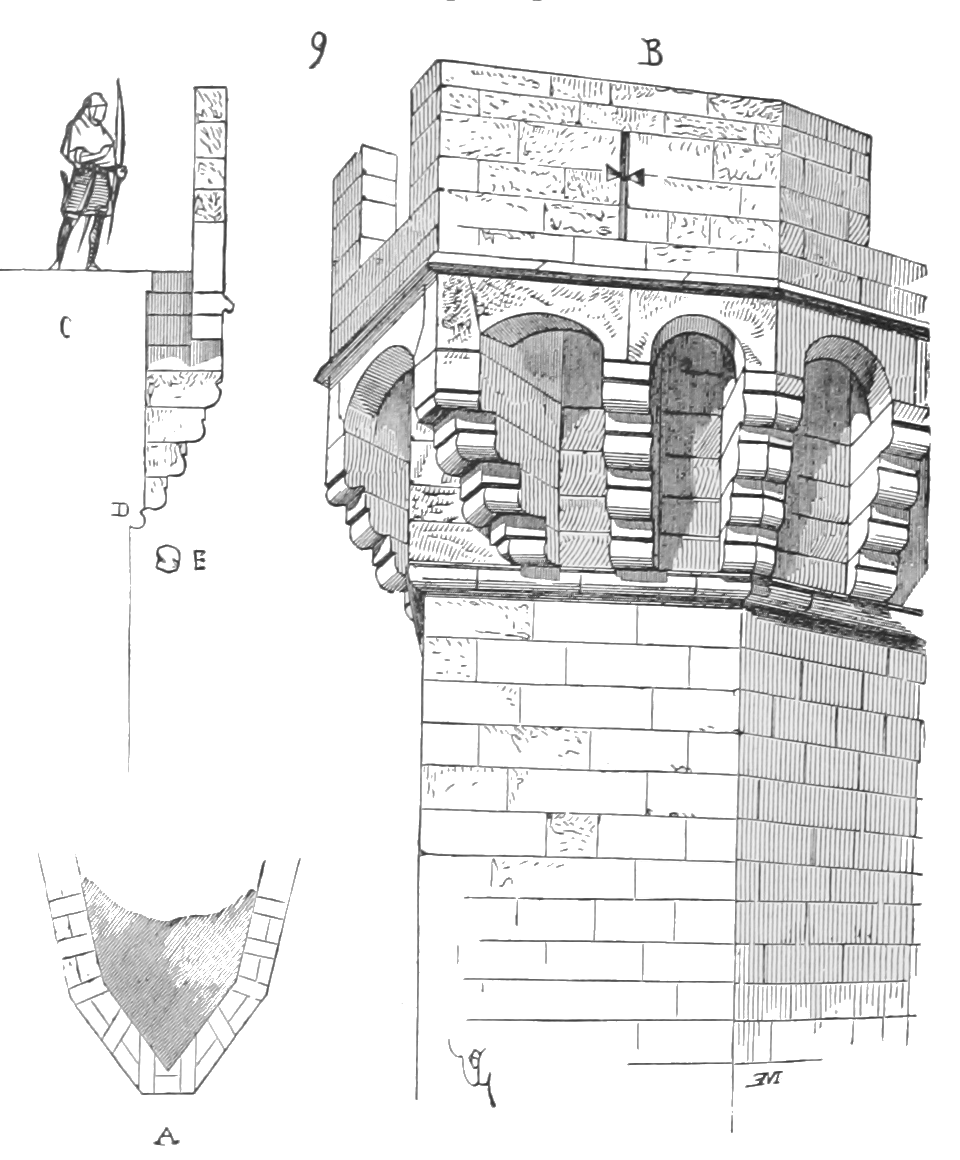
The answer was to build out. Hoardings were covered wooden galleries fixed to the top of a wall or tower, with gaps in the floor. Defenders could stand inside, safely hidden, and drop stones or hot liquids straight down. The stone version, called a machicolation, stuck out from the wall on brackets and did the same job.
Walls within walls: the concentric castle
Why build one wall when you can build two? In a concentric castle, a lower outer wall surrounded a taller inner one. Attackers who broke through the first wall found themselves in a narrow strip of ground, with archers on both walls shooting at them.
Caerphilly was the first castle in Britain designed this way from scratch. Cartwright suggests the design drew on French castles and on Gilbert de Clare’s experience of the siege of Kenilworth in 1266, where water defences helped the castle hold out against a royal army for six months.
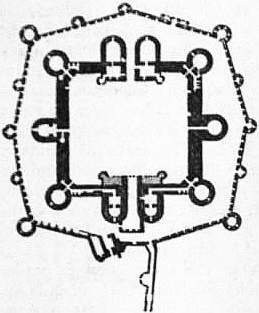
Beaumaris took the idea to its extreme. King Edward I began it in 1295, with James of St George as his chief architect and engineer. Its two main gates were set out of line with each other, so attackers could not run straight through both. A tidal dock let small ships sail right up to the castle and bring in supplies during a siege. The historian N. J. G. Pounds called it “geometrically the most perfect of the Edwardian castles”. It cost at least £13,000, and yet it was never entirely finished.
The keep: the last stand
If everything else failed, the defenders fell back to the keep, the great central tower. The entrance was usually on the first floor, reached by an outside staircase, so there was no ground-level door to batter down. Inside, narrow spiral staircases meant attackers had to fight their way up one floor at a time. Rochester’s keep, a whopping 38 metres high, is among the finest surviving keeps in England.
Food, water and a few dirty tricks
Walls are useless if the people behind them starve. Castles needed a deep well, often backed up by tanks for rainwater, and store rooms full of food. Some kept gardens, poultry and animals inside the walls. The Herefordshire guide points out the dangers when supplies ran low: fuel ran out, stale water spread disease, and the weak and sick were sometimes sent out of the gates.
Defenders did not just sit and wait, either. Hidden side gates and tunnels, called sally ports, let small groups slip out and attack the besiegers from behind. And then there was bluff. In one story told by the Herefordshire guide, a starving garrison stuffed a pig’s carcass with its last grain and hurled it over the battlements. The besiegers concluded that the castle had food to spare and went home.
Dover, 1216: the castle that refused to fall
For a real test of everything above, look at Dover. In July 1216, Prince Louis of France, invited by English barons rebelling against King John, laid siege to it. English Heritage tells the story. Louis brought stone-throwers, a siege tower and miners. His men captured the barbican outside the north gate, then tunnelled under the gatehouse until one of its two towers came down.
It should have been over. But Hubert de Burgh, who commanded the castle, had about 140 knights and other soldiers, and they had built a barrier of boulders, timber and oak posts behind the gate. When the French rushed the breach, they were thrown back with heavy losses. Dover held out until a truce in October.
Hubert then made sure it could never happen again. The damaged gate was blocked up, a new main entrance called the Constable’s Gate was built, and a new outer defence was linked to the castle by underground tunnels, which you can still explore today. Hubert had already told his men in 1217 to hold Dover at all costs, because it was “indeed the key of England”. He had good reason.
So, how were castles defended?
With layers. A ditch slowed attackers down, a gate packed with traps funnelled them into danger, towers and arrow slits shot at them from every side, and a keep waited at the end for anyone who got that far. Behind it all stood the real secret weapons: food, water and nerve.
Even the strongest castles could fall, of course. Krak des Chevaliers in Syria, one of the mightiest fortresses of the crusades, surrendered in 1271, perhaps after its defenders received a forged letter telling them to give up. No wall can stop a good forgery.
To see things from the attackers’ point of view, discover how attackers tried to beat all these defences in medieval siege warfare. Or meet the wooden giants built to roll up to the walls by reading about the medieval siege tower, and the men who dug beneath them in the story of siege mining.
Frequently asked questions
How were castles defended once the walls were breached?
The fight moved inside. Defenders blocked gaps with timber and rubble, as Hubert de Burgh’s men did at Dover in 1216, and fell back to inner walls, towers and finally the keep, where every staircase had to be won floor by floor.
What was the hardest part of a castle to attack?
Usually the gate, even though it was the obvious target. Attackers had to deal with a drawbridge, often a barbican, one or two portcullises and murder holes overhead, all while archers shot at them from the towers on either side.
What did defenders drop through murder holes?
Stones, quicklime, hot sand and boiling water were the normal ammunition. At Goodrich Castle, molten lead may also have been used. Hot oil was rare because it cost too much. The holes were also handy for pouring water onto fires set against the gate.
Why are arrow slits so narrow?
To make the archer almost impossible to hit. The slit was thin on the outside but widened on the inside, so the defender had room to move and aim while an enemy outside saw only a tiny gap.
What is a concentric castle?
A castle with two rings of walls, the inner one higher than the outer. Attackers who broke through the first wall were caught between the two and shot at from both. Caerphilly and Beaumaris in Wales are famous examples.
Did castle moats always contain water?
No. Many were dry ditches, sometimes lined with stakes. Water was more effective, though, and even half a metre of it was enough to slow attackers down.
Sources
- Mark Cartwright, World History Encyclopedia, Medieval Castle (2018, updated 2024)
- Mark Cartwright, World History Encyclopedia, Caerphilly Castle (2020)
- Mark Cartwright, World History Encyclopedia, Beaumaris Castle (2019)
- Mark Cartwright, World History Encyclopedia, Krak des Chevaliers (2018)
- Herefordshire Through Time, Herefordshire Council, The castle under siege: defence
- Herefordshire Through Time, Herefordshire Council, Goodrich Castle
- English Heritage, How Dover Castle became the Key of England: the Great Siege of 1216 (2016)
- English Heritage, Description of Rochester Castle
- English Heritage, History of Rochester Castle
- University of Pittsburgh, Glossary of Medieval Art and Architecture, Hoarding and Machicolation
- Wikipedia, Murder hole