
How Did a Trebuchet Work? The Medieval Machine That Smashed Castle Walls
Imagine you are a medieval king. In front of you stands a castle with walls three metres thick, and behind those walls is a garrison that has politely declined to come out. You have no cannon, because nobody has got round to inventing a useful one yet. What you do have is timber, rope, a lot of rocks and some very good carpenters. So how did a trebuchet work, and why did the sight of one being built make grown soldiers reconsider their life choices? Pull up a chair. No engineering degree needed.
Jump to a section:

The short answer: a giant seesaw with a grudge
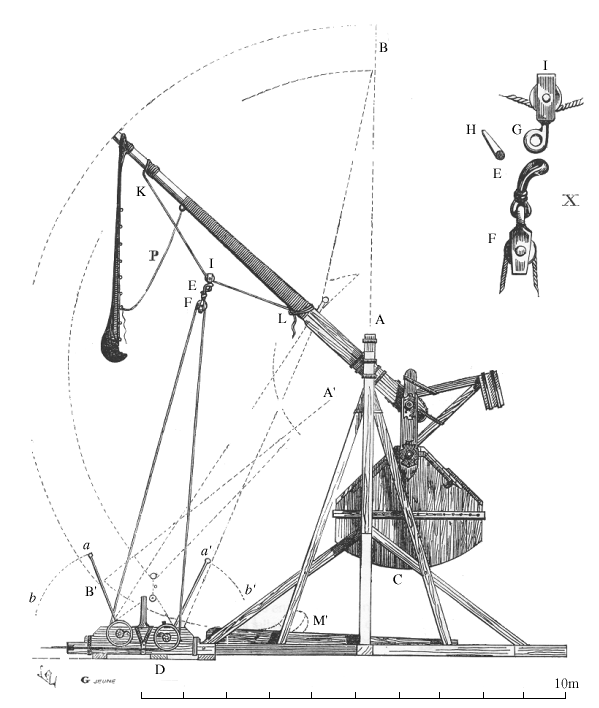
Strip away the size and a trebuchet is a seesaw built by someone with a problem to solve. A long wooden beam sits on a pivot, but not in the middle. One end is short, the other is long. Hang something very heavy from the short end, tie a sling to the long end, and you have the whole idea.
Britannica describes the sequence neatly. The crew hauls or winches the long end down to the ground and locks it. When the catch is released, the heavy weight on the short end drops, and the long end flies up through a great arc. Whatever is in the sling goes with it.
That makes the trebuchet the odd one out among old throwing machines. Nearly every other catapult got its power from something bent or twisted, such as a springy beam or a tight bundle of sinew and hair. The trebuchet ran on gravity alone. Gravity, as you may have noticed, never gets tired and never snaps in wet weather.
How did a trebuchet work, step by step?
Let’s fire one. Stand well back.
- Wind it down. The throwing arm has to be dragged to the ground against the pull of the weight. On big machines this was done with winches or with treadwheels. At the Medieval Centre in Denmark, which runs a full-size reconstruction, two people walk inside each wheel like very determined hamsters.
- Load the sling. A stone goes into a pouch on the end of a long rope. The sling lies in a trough under the machine, pointing backwards. This looks wrong. It is not.
- Let go. Someone knocks out the catch. The weight falls, the arm swings up, and the stone is dragged along the trough and then whipped into the air.
- The sling opens. One end of the sling is fixed to the arm. The other is only looped over a prong. Near the top of the swing, the loop slides off, the pouch opens, and the stone leaves on its own.
- Someone on the wall has a bad day.

Why bother with the sling?
Good question. Why not just put the rock in a spoon on the end of the arm?
Because the sling is where the magic happens. It works like an extra length of arm that weighs almost nothing. As the beam comes up, the sling swings round even faster than the beam itself, so the stone is moving far quicker than the wood that is throwing it. If you have ever flicked a wet towel at a sibling, you already understand the principle. Please do not tell your sibling you learned it here.
Modern physicists have done the sums. One recent analysis of a large machine with a hinged, swinging weight found that, on paper and ignoring friction, more than 90 per cent of the energy stored in the raised weight could end up in the stone. For something made of oak and rope, that is astonishingly efficient.
Before the big weight: people power
The earliest trebuchets had no counterweight at all. They had a crowd. Instead of a box of stones, the short end of the beam carried a bunch of ropes, and a team of people all yanked at once.
This “traction” trebuchet came from China, where such machines were common by the second century AD, according to the engineer and historian John Lienhard. It travelled west over the following centuries. By the late 500s one was being described, unmistakably, at the city of Thessalonica in Greece.
Do not picture something feeble. Experimenters who rebuilt a small one found that six people on the ropes, plus a seventh to load, could get off four shots in a little over a minute, throwing stones of two to four kilograms about 80 metres. That is a medieval machine gun, if machine guns threw rocks the size of a melon.
Enter the counterweight
The version you are probably imagining, with the great hanging box, turned up later. The oldest records of counterweight trebuchets are Italian and date from the 1100s. Swap the pulling crew for several tonnes of dead weight and two things change. The machine can throw something much heavier, and it throws it the same way every time, because a box of rocks never has an off day.
How heavy? Britannica gives a useful benchmark: with a ten-ton counterweight, a large trebuchet could send a boulder of about 135 kilograms roughly 275 metres. Other estimates put the missiles of the biggest machines anywhere between 50 and 250 kilograms. For comparison, 135 kilograms is roughly a large fridge-freezer. Now imagine it arriving through your roof.
Accuracy mattered as much as power. The team in Denmark describes their machine as remarkably accurate, and that was the whole point. A trebuchet did not need to flatten a castle in one go. It needed to hit the same patch of wall again and again until the wall gave up.
What did trebuchets throw?
Stones, mostly. But medieval commanders were creative people with a dark sense of humour. The list of things known to have been launched includes:
- missiles coated in pitch and set alight, to burn the wooden buildings inside;
- pots of flammable liquid that shattered on landing;
- dead animals;
- beehives, which is frankly unsporting;
- and, now and then, the severed heads of prisoners or messengers.
The aim was not always to break stone. Sometimes it was to break nerves. If you want the full menu of ways to take a fortress, from tunnelling to simple starvation, we cover them in our piece on how medieval sieges were fought.
The War Wolf: when the king wants his toy
The most famous trebuchet of all belonged to Edward I of England, a man who features in any honest account of how medieval kings held on to power. In 1304 he besieged Stirling Castle in Scotland. Inside were Sir William Oliphant and, according to Historic Environment Scotland, only about 25 men.
Edward had 13 throwing machines pounding the place day and night. After three months the castle was still standing, so he ordered something bigger. A team of five master carpenters, with fifty labourers under them, set about building a monster that became known as the War Wolf.
Here comes the part that tells you everything about Edward. When Oliphant saw the thing nearing completion, he offered to surrender. The king was not in a generous mood. The War Wolf got its shot anyway, and its 140-kilogram missile is said to have smashed the castle’s curtain wall. You do not spend that much on a new machine and then not press the button.
There is a grim footnote. In 1997, archaeologists found the skeleton of a man in his twenties in the castle chapel. His bones had 167 fractures. In 2026, a team led by Jo Buckberry of the University of Bradford reported that he was probably killed by a siege engine. They cannot prove it was the War Wolf itself, only that a machine of that kind is the likely cause.
So why did trebuchets disappear?
One word: gunpowder. During the 1300s European armies began to adopt firearms, and over time cannon did the same job with a smaller crew and a flatter, harder punch. The trebuchet hung on for a while, then quietly retired.
Not a single medieval trebuchet survives today. The ones you can visit are reconstructions, built from old drawings and descriptions. Which is a pity, but also understandable. Nobody keeps a 20-tonne wooden rock-thrower in the garden once the war is over.
Still, give the engineers their due.
Trebuchets battered walls from a distance. To get soldiers over them, armies wheeled in a medieval siege tower. They had no equations and no computers, and they built a machine that modern physicists admire. It is one more reason not to believe the old line about the period being stupid, a habit we take apart in our list of myths about the Middle Ages.
Frequently asked questions
How far could a trebuchet throw?
A large counterweight trebuchet could throw a 135-kilogram stone about 275 metres, according to Britannica. Small hand-pulled machines managed around 80 metres with stones of a few kilograms.
What is the difference between a trebuchet and a catapult?
“Catapult” is the general word for a machine that throws things. Most catapults used twisted rope or a bent beam as a spring. A trebuchet used a falling weight, or a team of people pulling, together with a sling.
Who invented the trebuchet?
Nobody knows the name of the inventor. The hand-pulled type was developed in China and was common there by the second century AD. The counterweight type first appears in Italian records of the 1100s.
How many people did it take to fire a trebuchet?
It depended on the size. A small traction machine could be worked by seven people: six on the ropes and one loading. A giant such as the War Wolf needed a team of 55 carpenters and labourers just to build it.
Sources
- Encyclopaedia Britannica, Catapult
- World History Encyclopedia, Siege Warfare in Medieval Europe
- John H. Lienhard, University of Houston, The Engines of Our Ingenuity, No. 458: About Trebuchets
- EXARC Journal, Traction Trebuchet
- Middelaldercentret (The Medieval Centre, Denmark), The Trebuchet
- E. Horsdal, The swinging counterweight trebuchet: on internal forces (arXiv)
- Historic Environment Scotland, The War Wolf at Stirling Castle
- Live Science, Skeleton with 167 fractures discovered at Scottish castle