
What Was Magna Carta? The Day the Barons Sent King John the Bill
Think of the most unbearable manager you ever worked for. Now give him an army, a crown and the legal right to charge you whatever he fancies, whenever he fancies. That, roughly, was life as an English baron under King John. In June 1215 the barons finally cornered him in a meadow and made him put his seal on a long list of promises. So what was Magna Carta, exactly? A bill of rights? A peace treaty? A very angry letter of complaint? It was a little of each, and it very nearly failed to outlive the summer.
Jump to a section:
.jpg?width=1000)
What was Magna Carta, in one breath?
It was a charter, meaning a formal written grant, in which the king of England promised to stop doing a long list of things his most powerful subjects were sick of. The name is Latin for “great charter”. “Great” here means big, not wonderful. It is a long document.
The UK Parliament sums up why it matters: this was the earliest document to set down in writing that the law applied to the crown and its officials too. Let that sink in for a second. In 1215 almost nobody dared to put such an idea into words. Kings were supposed to answer to God, not to a committee of irritated landowners.
Meet King John, a man with a gift for making enemies
To understand the charter you need to understand the man it was aimed at. John was king from 1199 to 1216, and he had a talent that every ruler should avoid: he annoyed absolutely everyone.
First, he lost. By 1206 his wars with France had cost him Normandy and Anjou, lands his family had held for generations. Second, he quarrelled with the pope over who should be Archbishop of Canterbury, a feud that got England placed under a papal ban in 1208 and John himself excommunicated in 1209. Third, and here is what stung the most, he never stopped demanding cash. Years of failed campaigns had to be paid for, and after yet another defeat he demanded scutage from his barons, a payment made in place of military service.
Put yourself in a baron’s boots for a moment. Your king loses the war, comes home and sends you the bill. Then he does it again. How long before you start writing things down?
A meadow, some barons and a very bad day
Talks dragged on into early 1215 and went nowhere. Then the rebels, led by a baron called Robert FitzWalter, took control of London. Lose your capital and you tend to become more reasonable.
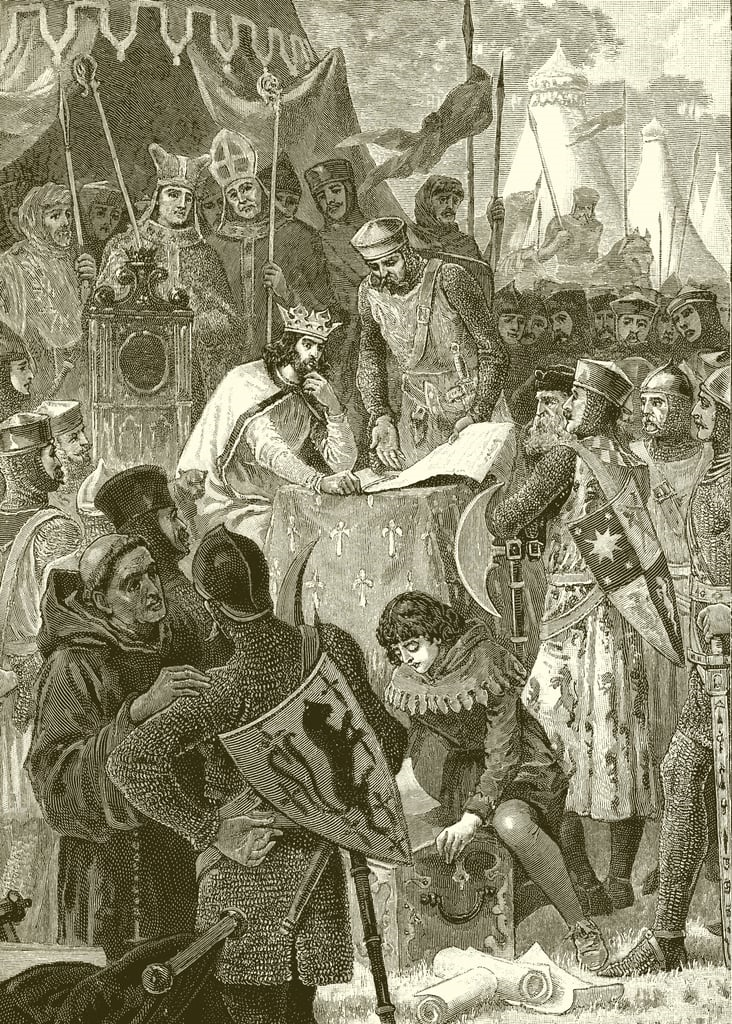
On 15 June 1215 John met his opponents at Runnymede, a field beside the River Thames between Windsor and Staines. Parliament’s own history calls it “otherwise obscure”, which is a polite way of saying nobody had ever heard of it. The US National Archives puts the number of rebel barons at about forty. Faced with them, John agreed to their terms and attached his seal.
Notice the word. He sealed it. He did not sign it, whatever the paintings show. Kings of the time proved a document was genuine with a lump of wax, not an autograph.
.jpg?width=1200)
So what did it actually say?
The charter has 63 clauses, and here is a secret: most of them are quite dull. They deal with inheritance, debts, forests and who owes what to whom. Nobody at Runnymede was thinking about human rights. As Parliament’s historians put it, the barons drew it up to shield their own rights from the king, not to free the nation.
Still, a few clauses are worth your time.
The famous ones
Clause 39 told the king he could not arrest a free man, take his land, outlaw him or drive him abroad on a whim. First there had to be a lawful verdict from the man’s equals, or clear backing in the law. Clause 40 is shorter and sharper. In it the king swears that justice will never be sold, refused or kept waiting for anybody.
If that sounds familiar, it should. The idea that a ruler cannot simply lock you up because he feels like it has travelled a long way from that meadow.
The ones nobody quotes at dinner parties
Now for my favourites. Clause 33 ordered that all fish-weirs be removed from the Thames, the Medway and every other river in England. Fish-weirs. In the founding document of English liberty. Clause 35 demanded one standard measure for wine, one for ale and one for corn across the whole kingdom. Whatever else you say about the barons, they wanted a fair pint.
And clause 7 protected widows, who were to receive their inheritance at once and without paying for it. Small details like these tell you more about what everyday life was really like than any battle does.
Did it work? Not even slightly
Here is the twist. Magna Carta, the great turning point, was a flop.
John had no intention of keeping his word. The UK National Archives notes that he saw the charter as a peace treaty, not a set of laws, and he quickly persuaded the pope to condemn it. Yes, the same pope he had been feuding with. Medieval politics moved fast, and the tangled relationship between crown and papacy is a story we tell in our article on the Church’s power in the Middle Ages.
With the charter cancelled, the country slid into civil war. By the autumn John was besieging rebel barons in Rochester Castle, using every method described in our account of how castles were attacked. A year later he was dead. He died in October 1216 at Newark, leaving the throne to a boy of nine.
Then why do we still talk about it?
Because of what happened next. The men governing for the boy king, Henry III, needed the barons back on their side. So they did something clever: they reissued the charter in the new king’s name. Two more editions followed, in 1217 and in 1225.
From then on it became a habit. Whenever a king needed money for a war, his subjects asked him to confirm the charter first. A failed peace deal slowly turned into a promise that every ruler was expected to renew. That long tug of war between crown and subjects is the main thread running through the story of medieval kings.
What was the 1297 Magna Carta?
The most important of those renewals came in 1297. King Edward I had loaded his subjects with heavy new taxes to pay for wars abroad, and once again the barons pushed back. The price of their support was yet another reissue of the charter. According to the US National Archives, this time it was entered in England’s official Statute Rolls for the very first time, turning a hard-won bargain into part of the law of the land. That is why the 1297 version, not the famous one from 1215, is the text English law still relies on today.
Only four original copies of the 1297 charter survive, and one of them is not in England at all. In 2007 the American businessman David Rubenstein bought it at auction for $21.3 million and lent it to the National Archives in Washington, D.C., where it is on public display.
The idea also crossed the ocean. The Fifth Amendment to the US Constitution guarantees that nobody can lose life, freedom or possessions unless the proper legal process has been followed. The US National Archives calls that line a direct descendant of the charter’s guarantee.
Is any of it still law?
A little. According to the UK Parliament, only four of the original 63 clauses remain valid: part of clause 1, on the freedom of the English Church; clause 13, on the liberties of London; and our old friends 39 and 40. They survive through the version confirmed by Edward I in 1297, which is still on the statute book.
The fish-weirs, sadly, are no longer protected by the constitution.
As for the document itself, four copies from 1215 still exist. They are shared between the British Library, Lincoln Castle and Salisbury Cathedral, which describes its copy as the best preserved of the four. Not bad for a peace treaty that lasted about as long as a summer holiday.
Frequently asked questions
What does Magna Carta mean?
It is Latin for “great charter”. “Great” refers to its size: it is a long document.
Did King John sign Magna Carta?
No. He authenticated it with his royal seal on 15 June 1215. Signing documents by hand was not how kings did business at the time.
How many clauses did Magna Carta have?
The 1215 charter has 63 clauses. Only four of them, one of those in part, are still valid in English law today.
Where can you see Magna Carta?
The four surviving copies from 1215 are held by the British Library in London, Lincoln Castle and Salisbury Cathedral.
Sources
- UK Parliament, Magna Carta
- UK Parliament, The contents of Magna Carta
- The National Archives (UK), Magna Carta
- US National Archives, Magna Carta
- US National Archives, Magna Carta translation
- The Magna Carta Project, Clause 33 and Clause 35
- History.com, Magna Carta
- Encyclopaedia Britannica, John, king of England
- Salisbury Cathedral, Magna Carta
- legislation.gov.uk, Magna Carta (1297)
- US National Archives, 1297 Magna Carta returns to display (2008)
- National Institute of Standards and Technology, Protecting the Law of the Land, Literally