
Killer Rabbits and Fighting Snails: Medieval Marginalia
Picture a monk bent over a page of holy text. Candle flickering, quill scratching, total devotion. Now picture what is happening at the bottom of that same page: a rabbit with an axe is marching towards a king, and the king does not look ready for it. Welcome to medieval marginalia, the strangest, funniest and least explained corner of medieval art. If you have ever doodled in the edge of a school notebook, congratulations. You are part of a very old tradition. You just never drew a snail in a duel with a knight. Probably.
Jump to a section:
What is medieval marginalia, anyway?
The word comes from the Latin for “margin”, and it simply means anything added around the edges of the main text. Notes, corrections, little faces, the odd complaint about a cold hand. In art history, though, the word usually points to something much bolder: the pictures painted along the borders of expensive handmade books, mostly in the 1200s and 1300s.
And these were not quick scribbles. They were planned, painted in costly colours and often finished in gold, in books that took months to make. The centre of the page held prayers, psalms or law. The edges held, well, chaos. Monkeys play music. Strange creatures, half human and half beast, wander about looking very pleased with themselves. If you want to know how those books were made in the first place, the overview of medieval art walks through the whole process, from parchment to paint.
Exhibit A: the killer rabbits
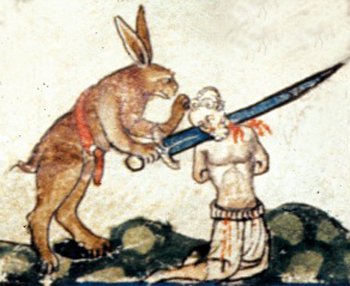
Let us start with the bunnies, because the bunnies of medieval marginalia are terrifying.
In real life, medieval rabbits were the hunted. Nobles chased them with hounds for sport and for dinner. In the margins, the roles flip. The British Library points to a German book made around the 1170s, the Arnstein Passional, where two rabbits have caught a hunter and are hanging him from the letter T. Yes, from a letter of the alphabet. Medieval artists used every inch of space.
It gets darker. In the Smithfield Decretals, a book of church law decorated in London in the 1340s, a run of pages tells a full crime drama. A rabbit archer shoots a hunter. The hunter is put on trial. Then he is beheaded. A few pages later a hound gets the same treatment: shot, tried and hanged. Somewhere, a medieval scribe was laughing very hard.
The Gorleston Psalter, from East Anglia, adds two of my favourites. In one scene a knight swings his sword at a rabbit with every bit of strength he has. In another, a rabbit armed with an axe walks up to a king. Given what most medieval kings spent their days worrying about, a heavily armed bunny was probably not near the top of the list. Maybe it should have been.
The Library of Congress has its own example: a leaf from a 15th-century breviary in which a rabbit, armed with a green club, is about to whack a smartly dressed man. As Marianna Stell explains on the Library’s Bibliomania blog, these warrior rabbits are not only found on parchment. They pop up in stained glass, carved stone and even on the small wooden seats in church choir stalls known as misericords. Strange borders weren’t only for books, either: the edges of the Bayeux Tapestry are crowded with dragons, griffins and even stranger company.
Exhibit B: the war against the snails
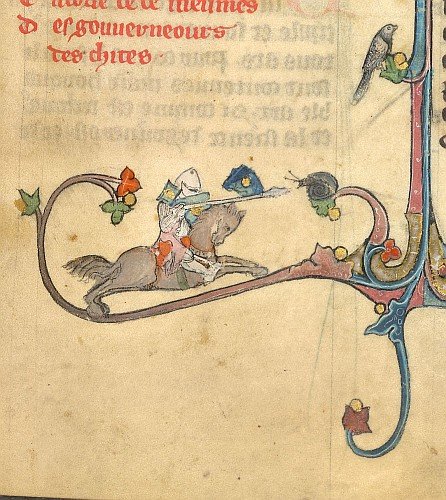
Now for the true mystery of medieval marginalia. Why on earth are knights fighting snails?
This is not one odd drawing. It is a whole genre of medieval marginalia. A 2023 article in the journal Different Visions, by Emily Shartrand of the University of California, Irvine, pulls together the counts made by earlier researchers. One list counts 51 manuscripts where a snail turns up somewhere on the edges of the page, and 31 where it is clearly squaring up to a knight. An earlier study by Lilian Randall found that most of these books were made between about 1290 and 1310, in northern France, Flanders and England.
And here is the funny part. The knight almost never wins. He is shown terrified, or wearing far too much armour for an opponent that could lose a race to a lettuce, or simply running away. Gizmodo summed up the score nicely: the snails generally seem to be on top. Anyone who has read about how real armies attacked and defended castles knows that knights faced plenty of genuine danger. The margins are the place where the danger is a slug with a house.
So why the snails? Pick your theory
Here is the honest answer: nobody knows for sure. But historians have had a lot of fun guessing. These are the main candidates.
- The Lombards. In 1962 Lilian Randall argued that the snail was a stand-in for the Lombards, outsiders from Italy who worked as merchants, moneylenders and pawnbrokers and were widely resented in northern Europe. A slimy dig at the bankers, in other words. It is the most famous theory, though the British Library notes one awkward gap: it never really explains why the knight keeps losing.
- The Resurrection. Back in 1850 a French scholar, the Comte de Bastard, connected one snail with the scenes of the Raising of Lazarus painted next to it. A snail hides in its shell and comes out again, much like a soul rising from the grave.
- Social satire. Perhaps the snail is a poor person standing up to a bullying aristocrat. Or perhaps it mocks people trying to climb above their station.
- Garden pests. Maybe it is just a joke about the war every gardener fights. Snails eat your lettuces, so you bring a lance.
- A parody of knighthood. A shell looks rather like armour, so a snail makes a perfect pretend knight. A fight between the two is chivalry turned into slapstick.
The British Library also mentions a theory linking snails to female sexuality, which shows how far scholars will go once they start. The art historian Michael Camille made the most useful point of all: marginal images simply do not hold one fixed meaning the way a painting of a saint does. The same snail could be a joke for one reader and a lesson for another. That is part of their charm.
Who was laughing, and why was it allowed?
A fair question. Why would anyone put medieval marginalia like fighting rabbits right next to the Psalms?
First, think about who owned these books. Many were made for wealthy lay people, nobles and knights, not only for monks. The Gorleston Psalter may have been commissioned by John de Warenne, Earl of Surrey, who was himself a knight and served Edward I in his Scottish wars. So when a knight runs from a snail, the joke may have been aimed at the very person turning the pages. One scholar, Sarah J. Biggs, has even wondered whether all those hares running around the book are a pun on his name, since a warren is where rabbits and hares live. Medieval nobles, it seems, could laugh at themselves.
Second, the idea of a “world turned upside down” was hugely popular. The British Library uses exactly that phrase for its rabbits. Hunted becomes hunter, servant becomes master, snail becomes champion. Showing the world the wrong way round was a way of reminding readers what the right way looked like. The Library of Congress lists other ideas too, from memory aids to theories about balancing the humours of the body, but it is careful to say that there is no agreement.
And third, the people who painted these books were human. Long hours, tiny brushes, endless text. A little mischief in the margins must have been irresistible. Churchmen commissioned and used plenty of these books, so clearly not everyone found the jokes shocking. For the bigger picture, see the overview of religion in the Middle Ages. Some of the rudest marginal images are found in the holiest books.
The Macclesfield Psalter: a treasure found in a castle library
One of the best places to see medieval marginalia at full strength is a book that was hidden for centuries. The Macclesfield Psalter was made around 1330 to 1340 in East Anglia, probably in Norwich. Then it vanished from view, sitting in the library of the Earls of Macclesfield at Shirburn Castle, until it was rediscovered in the early 2000s.
In 2004 it came up for sale at Sotheby’s and looked set to leave the country. Britain was not having that. The government stopped its export, and in 2005 the Fitzwilliam Museum in Cambridge bought it. The museum calls it “the most remarkable English illuminated manuscript to be discovered in living memory”, which is quite a compliment for a book full of jokes. Today you can admire its margins, where nearly every page has little figures along the bottom. One shows St Dunstan grabbing a devil by the nose with a pair of tongs. Someone later scratched out the devil’s face, which suggests at least one reader took the joke a bit too personally.
Medieval marginalia: weird, not stupid
It is tempting to look at a rabbit with a crossbow and think medieval people were simply a bit odd. Resist that temptation. These books were luxury objects, planned with care and painted by skilled professionals. The humour was deliberate, layered and often sharp. It is one more reason to drop the old idea that the period was dull or backward, one of several myths about the Middle Ages that refuse to die.
So the next time you doodle in the margin of a meeting agenda, remember: you are not wasting time. You are continuing a 700-year-old artistic tradition. Just maybe leave out the beheadings.
Frequently asked questions
What does marginalia mean?
Marginalia are notes or pictures added in the margins of a book. In medieval art the term usually refers to the painted figures, scenes and creatures along the edges of illuminated manuscripts.
Why are there killer rabbits in medieval manuscripts?
Scholars are not certain. The most popular explanation is the “world turned upside down”: rabbits, normally the prey, become the hunters. It was a source of comedy and sometimes of social comment.
Why do knights fight snails in medieval art?
No one knows for sure. Theories include a jibe at Lombard merchants, a symbol of resurrection, satire of the nobility and a joke about garden pests. Most of these scenes come from manuscripts made between about 1290 and 1310.
Where can I see medieval marginalia?
Many manuscripts are digitised online. The British Library, the Library of Congress and the Fitzwilliam Museum in Cambridge all hold famous examples, including the Gorleston Psalter, the Smithfield Decretals and the Macclesfield Psalter.
Sources
- The British Library, Knight v snail
- The British Library, Medieval killer rabbits: when bunnies strike back
- Marianna Stell, Library of Congress, Behind the Rabbit: A Short Tale (2026)
- Emily Shartrand, Different Visions: New Perspectives on Medieval Art 9 (2023), “I Have the High Ground”
- Gizmodo, Why do knights fight snails in illuminated manuscripts?
- The Fitzwilliam Museum, The Macclesfield Psalter