
Bayeux Tapestry Facts: 9 Secrets of the World’s Most Famous Embroidery
Long before superhero films and the modern streaming services, someone in the eleventh century told the story of a royal betrayal, a comet, a sea crossing and a bloody battle in one continuous picture strip. It was roughly the length of a jumbo jet. It had captions, cameo appearances, comic side panels and a cliffhanger ending, because the last part has gone missing. Yes, it’s the Bayeux Tapestry we’re on about. Get comfortable, because these Bayeux Tapestry facts include a misleading name, a mystery woman, a possibly fake arrow and a wartime escape from the SS.
Jump to a section:
Bayeux Tapestry facts: the basics in 30 seconds
The subject is the Norman Conquest: William of Normandy’s successful grab for England’s crown in 1066. The action opens while Edward the Confessor is still on the throne and builds up to the fighting at Hastings.
- Length: about 68 metres, according to the Bayeux Museum. The British Museum rounds it up to 70.
- Height: only about 50 centimetres. Think long and thin, like a very ambitious scarf.
- Cast: 58 scenes and 626 characters, says World History Encyclopedia, plus horses, dogs, ships, trees and buildings.
- Date: stitched not long after the battle. The British Museum dates it to about 1072 to 1077.
If you’d like to see where it fits among the manuscripts, cathedrals and stained glass of the period, the pillar article on medieval art sets the scene. Right, on to the surprises.
1. The world’s most famous tapestry is an embroidery
Let’s get the awkward bit out of the way first. The most famous tapestry in the world is not a tapestry.
A true tapestry has its picture woven in on a loom as the cloth is made. Here, the Bayeux Museum explains, the design was stitched onto linen with wool thread, which makes it an embroidery. The backing is nine strips of linen sewn end to end. The stitchers had just ten shades of wool to play with, coloured using plant dyes including woad, madder and weld.
So why does everyone call it a tapestry? Habit, mostly. “The Bayeux Embroidery” just never caught on. Feel free to correct people at parties. Then feel free to stop being invited to parties.
2. A French treasure that was probably made in England
Here’s a twist that still makes people on both sides of the Channel twitch. The tapestry lives in Normandy, it celebrates a Norman victory, and it was probably sewn by English hands.
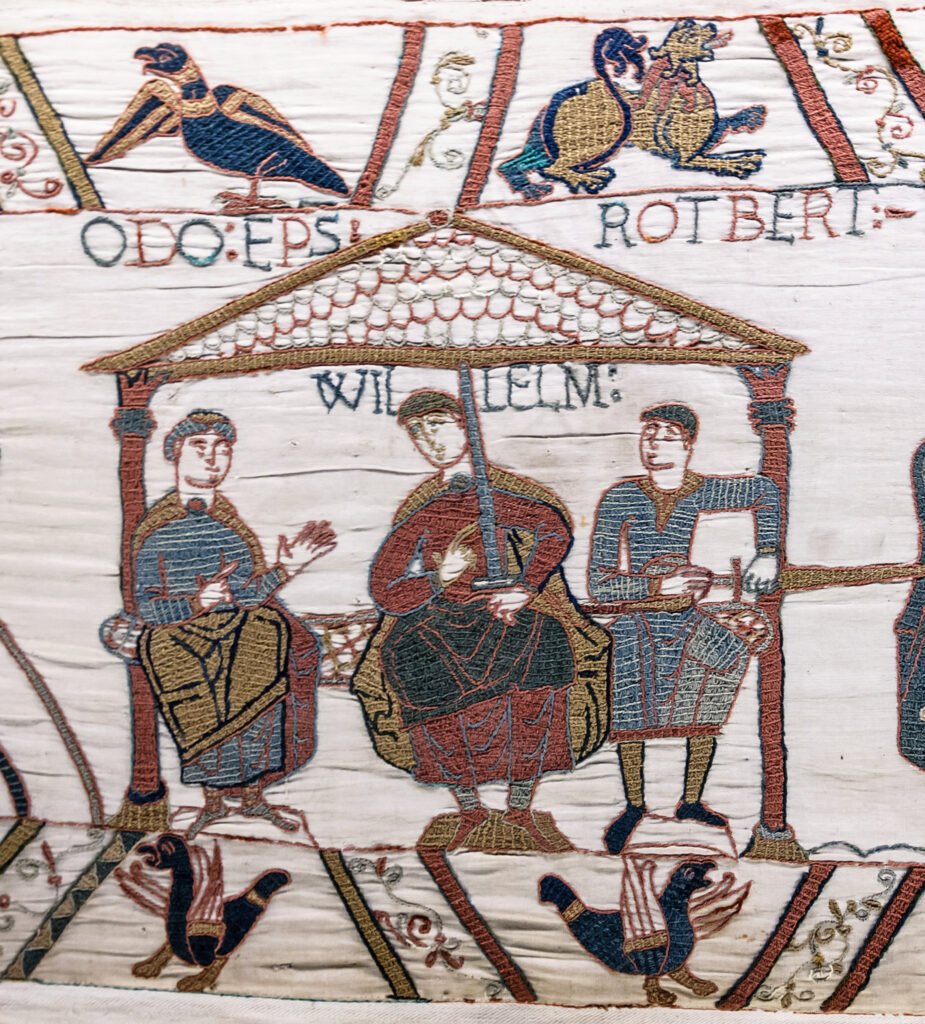
The British Museum describes it as likely commissioned by a Norman patron, made by English embroiderers and based on designs drawn from manuscripts in Canterbury. For the Bayeux Museum, the prime suspect as patron is Odo: bishop of Bayeux, and William’s half-brother into the bargain. He probably wanted it for his new cathedral in Bayeux, which was consecrated on 14 July 1077.
And the old story that Queen Matilda, William’s wife, stitched it with her ladies? The Bayeux Museum says that probably wasn’t the case. A lovely legend, but a legend.
3. It’s a comic strip with Latin captions
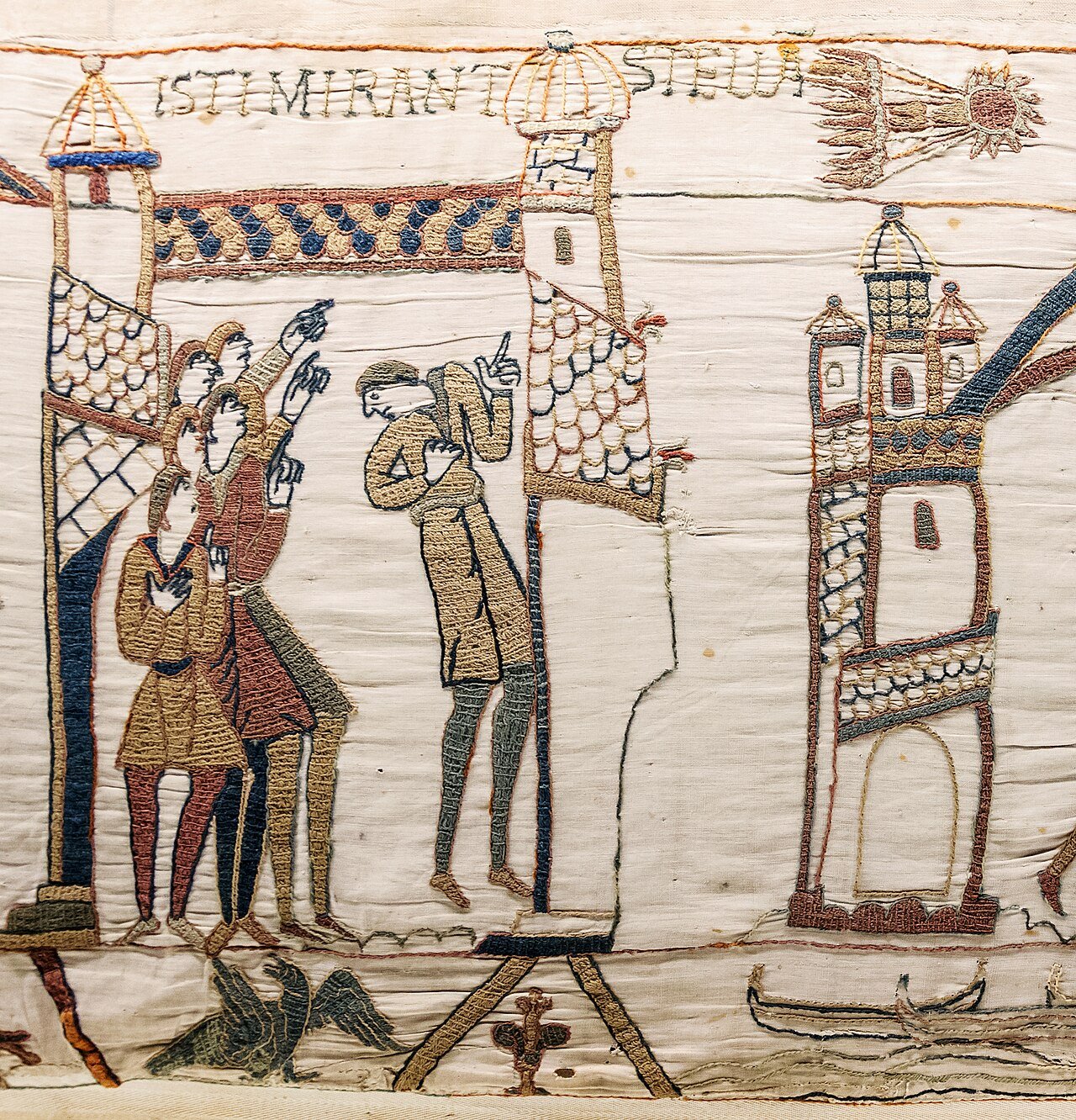
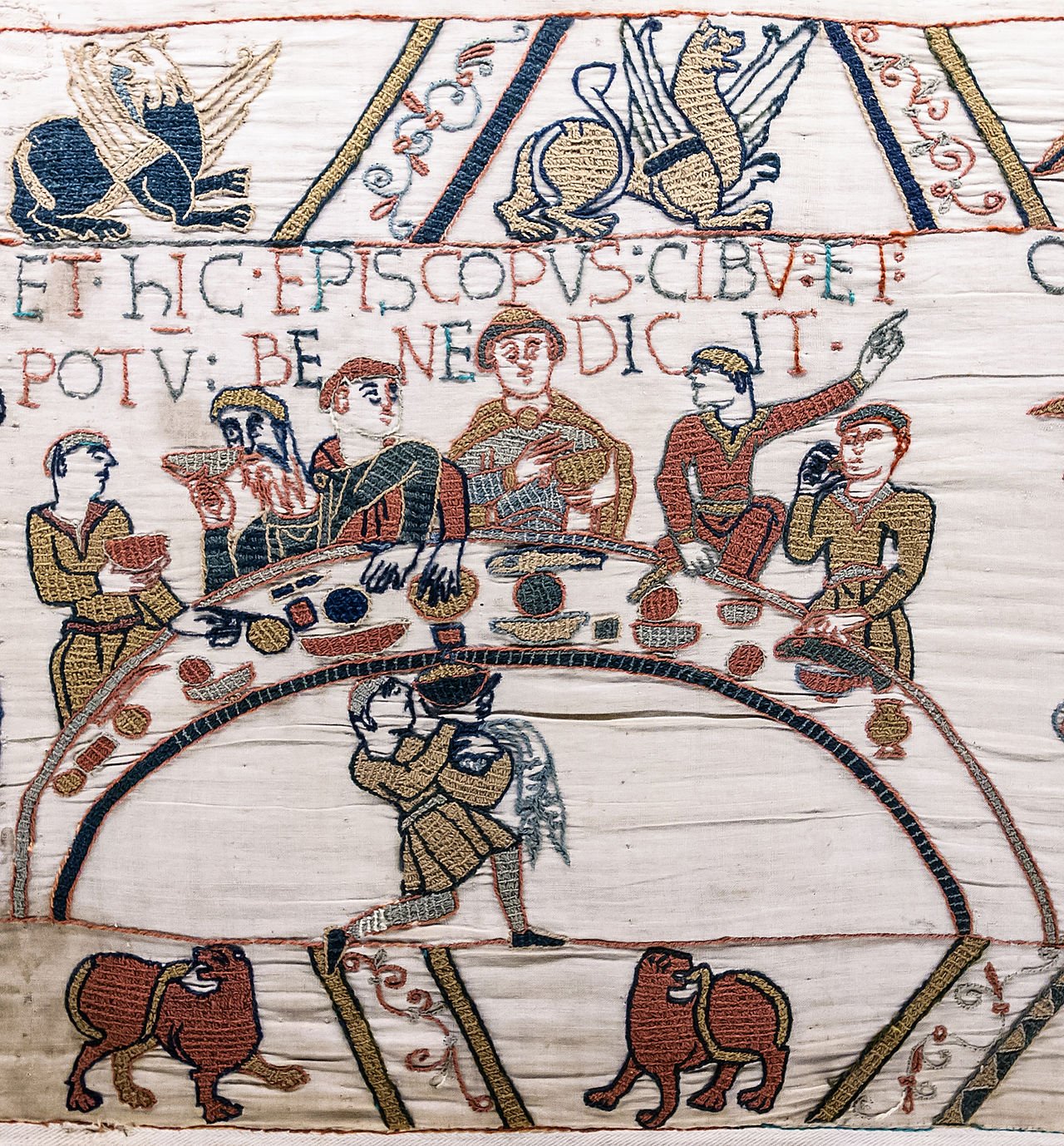
You follow the action from left to right, panel after panel, just as you would in a graphic novel. Above the action, short Latin captions tell you who is who and what is happening, as World History Encyclopedia notes.
One of the best-loved scenes shows a group of men pointing at the sky. The caption reads Isti mirant stella, which Atlas Obscura translates as “They marvel at the star”. That “star” is Halley’s Comet, which appeared in the spring of 1066. English observers read it as a warning of trouble. Harold would soon discover they had a point.
4. Spot the women (it won’t take long)
Here’s one of the stranger Bayeux Tapestry facts, and a challenge for your visit. Count the women. You can stop at six.
According to the British Museum, only three women appear in the main story, and three more, all unnamed, turn up in the decorative borders. Just one woman is named in the captions: a figure called Ælfgyva, who appears in a scene nobody has ever fully explained. Historians have suggested several possible identities for her, and the British Museum counts her identity among the biggest puzzles in the whole embroidery. A medieval whodunnit, stitched in wool.
5. The borders are where things get weird
If the main strip is the official story, the borders are the comments section. World History Encyclopedia describes strips filled with fantastic beasts such as dragons and griffins, scenes that may come from fables, and, during the battle, a grim parade of corpses and body parts. There are even a few small naked figures, one of them swinging an axe. Nobody is entirely sure why.
Sound familiar? Medieval artists loved to let their imaginations run riot around the edges of serious work. If that’s your sort of thing, you will enjoy the killer rabbits and fighting snails of medieval marginalia.
6. That famous arrow in the eye might be a later addition
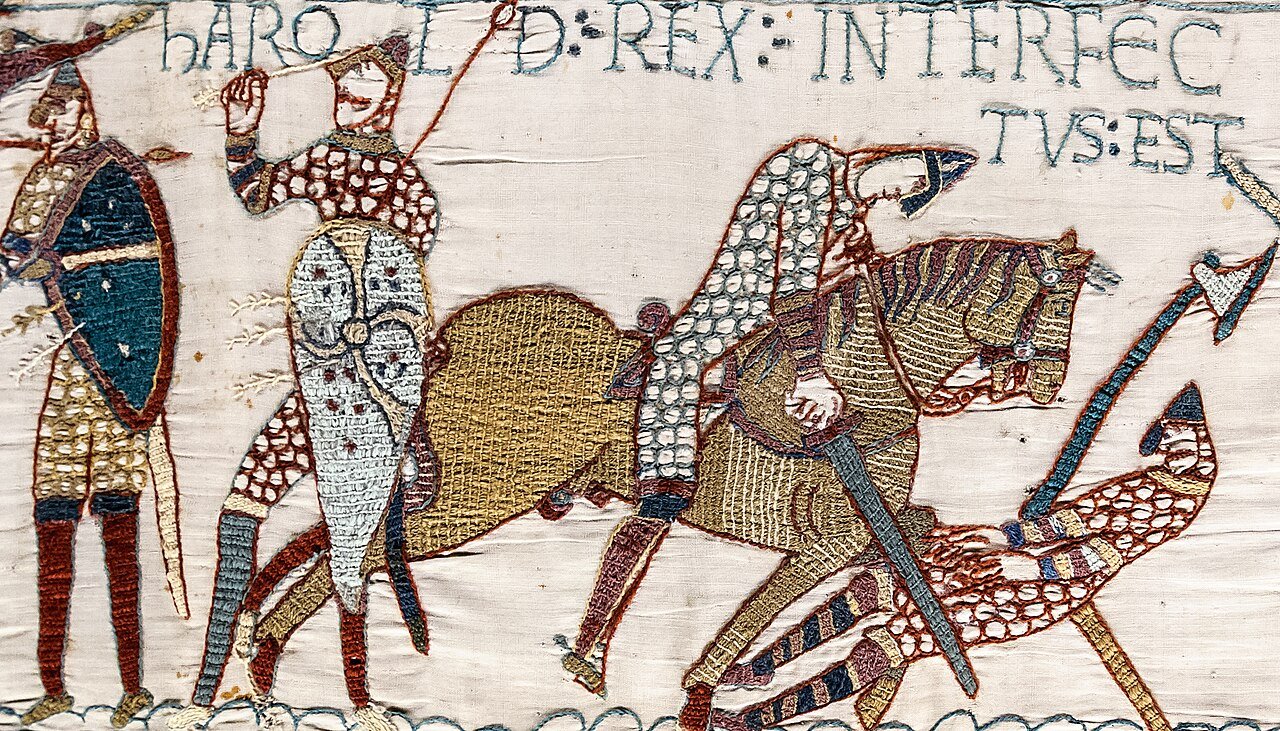
Ask anyone how King Harold died at Hastings and they will point at their eye. The tapestry is the reason. But look closer and the story gets wobbly.
Martin Foys, a professor at the University of Wisconsin-Madison, has studied the scene in detail. Writing for History Today, he explains that drawings of the tapestry made in the 1700s show the soldier holding a spear, not an arrow. The arrow seems to take shape in later copies and in French repairs carried out in the 1800s. World History Encyclopedia agrees that there is evidence the arrow was added during those nineteenth-century restorations.
The written sources don’t settle it either. Foys points out that the earliest accounts mostly just say that Harold died in battle. The arrow in the eye becomes a firm part of the story only in chronicles written decades later. So the most famous death in English history may owe part of its fame to a restorer with a needle. Add it to our collection of medieval myths that turned out to be more complicated than they look.
7. The ending is missing
Every great series needs a cliffhanger, and this one has a literal one. World History Encyclopedia notes that the final stretch of the strip, and only that stretch, has been lost. The surviving strip breaks off with the English fleeing the battlefield.
What was on the missing piece? Nobody knows. Many people guess it showed William’s coronation as king of England on Christmas Day 1066, which would be a fitting finale for a story about how medieval kings won their crowns. But that’s a guess, not a fact.
8. It survived revolutions, Napoleon and the SS
For a strip of linen almost a thousand years old, the Bayeux Tapestry has had a remarkably action-packed life.
- The Revolution: after 1792, World History Encyclopedia says, the French state took ownership of it.
- Napoleon: in 1803, while planning an invasion of England, Napoleon had it put on show in Paris, at what was then called the Musée Napoléon, now the Louvre. HistoryNet explains he hoped it would whip up support for his own cross-Channel invasion. It didn’t happen.
- The Second World War: under German occupation it was moved to an abbey and then to the Château de Sourches, in the countryside of the Sarthe. After D-Day in 1944, according to HistoryNet, an SS guard took it to the Louvre. Heinrich Himmler tried to have it moved to Berlin, but by then the French Resistance had taken control of the Louvre. It stayed put.
So the tapestry has outlived kings, an emperor and a Nazi plan to steal it. Not bad for some wool.
9. In 2026, it came back to England
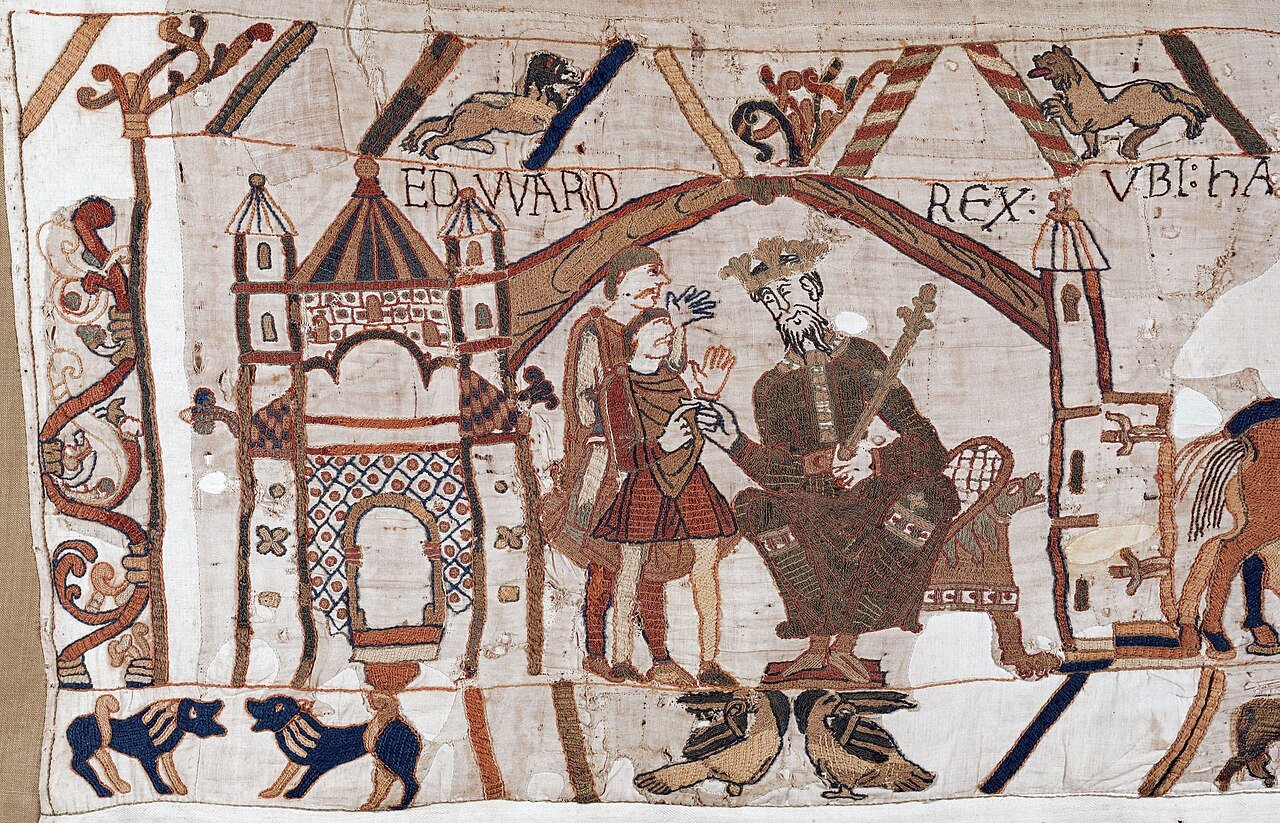
And now for the newest chapter. Thanks to a loan deal struck between Britain and France, the embroidery opened to visitors at London’s British Museum on 10 September 2026. The museum says the exhibition runs until 11 July 2027, and points out that the embroidery had not been back on English soil since the day it was finished.
Moving it was no small job. The Museums Association reports that the journey had to stay below a vibration limit of two millimetres per second, and that the team carried out two dry runs with a facsimile tapestry first. Now that’s careful packing. At the museum it is shown flat in a single continuous case, and the British Museum says the whole experience takes about 40 minutes.
Tickets have been in high demand, so if you’re planning a visit, book early and check the museum’s own website for the latest details.
So, is it worth the hype?
Absolutely. If these Bayeux Tapestry facts prove anything, it’s that the thing is propaganda, a history book, a fashion catalogue and a comic all at once. It shows you castles, ships, feasts, armour and horses exactly as people of the eleventh century imagined them. And it does it with jokes in the margins and mysteries in the middle.
Impressive work for a “tapestry” that turns out to be an embroidery.
Frequently asked questions
What size is the Bayeux Tapestry?
Roughly 68 metres from end to end, according to the Bayeux Museum, and only around half a metre high. The British Museum gives the length as 70 metres.
Is the Bayeux Tapestry woven or embroidered?
Embroidered. Its scenes were sewn onto linen in wool, which is why experts insist it isn’t a true tapestry.
Who created the Bayeux Tapestry?
The individual stitchers are anonymous. The likeliest patron is Bishop Odo, William’s half-brother, and the needlework was probably done in England, with designs that seem to come from Canterbury.
Where can I see the Bayeux Tapestry?
Its usual home is the museum in Bayeux, Normandy. Until 11 July 2027, though, you’ll find it on loan in London at the British Museum, where it went on show on 10 September 2026.
Sources
- The British Museum, The Bayeux Tapestry (exhibition page)
- The British Museum, Women of the Bayeux Tapestry (event page)
- Bayeux Museum, Tapestry or embroidery?
- Mark Cartwright, World History Encyclopedia, Bayeux Tapestry (2018)
- Martin Foys, History Today, King Harold: Shot through the Eye and Who’s to Blame?
- Rebecca Boyle, Atlas Obscura, Comets are omens (2024)
- Jennifer E. Berry, HistoryNet, The war-torn history of the Bayeux Tapestry (2018)
- Geraldine Kendall Adams, Museums Association, First look at the British Museum’s Bayeux Tapestry exhibition (2026)
- NPR, Bayeux Tapestry goes on display at British Museum (2026)