
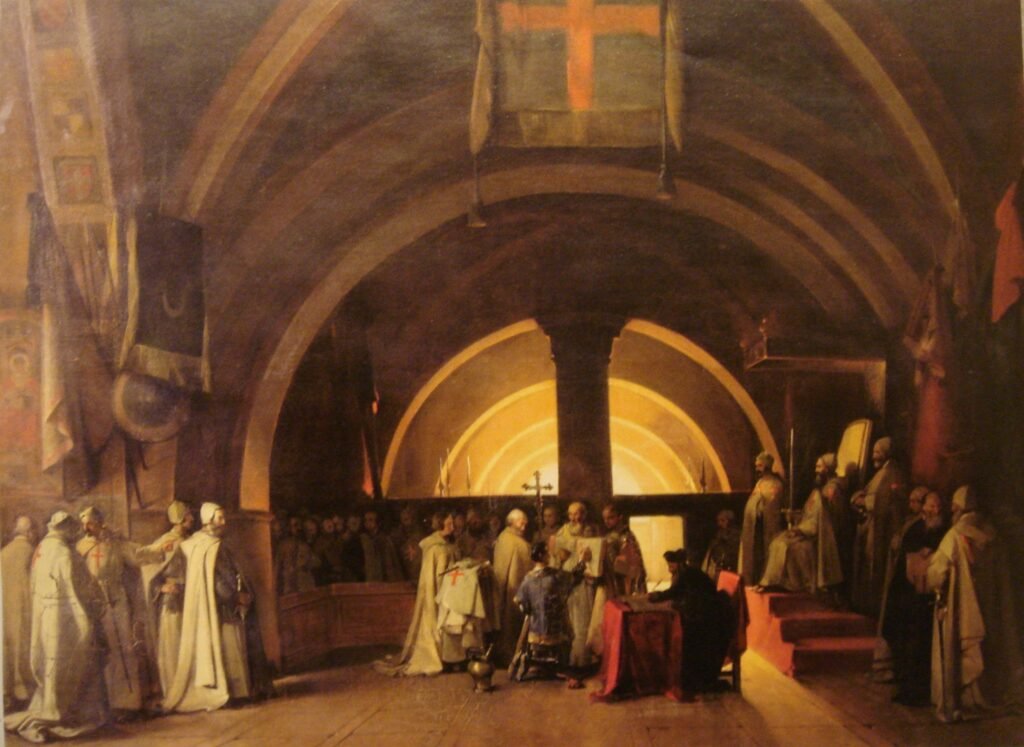
Who Were the Knights Templar? Monks, Money and Myths
Few groups in history have had a stranger afterlife than the Knights Templar. In films they guard the Holy Grail. In novels they run secret societies. On the internet they are blamed for Friday the 13th, hidden treasure and roughly half of all conspiracy theories. So let’s do something the internet rarely bothers with. Let’s ask who were the Knights Templar really, and look at what the records say. Spoiler: the true story has monks with swords, a medieval banking network, a king drowning in debt and a dramatic fall. No Grail required.
Jump to a section:
Who were the Knights Templar? The short answer
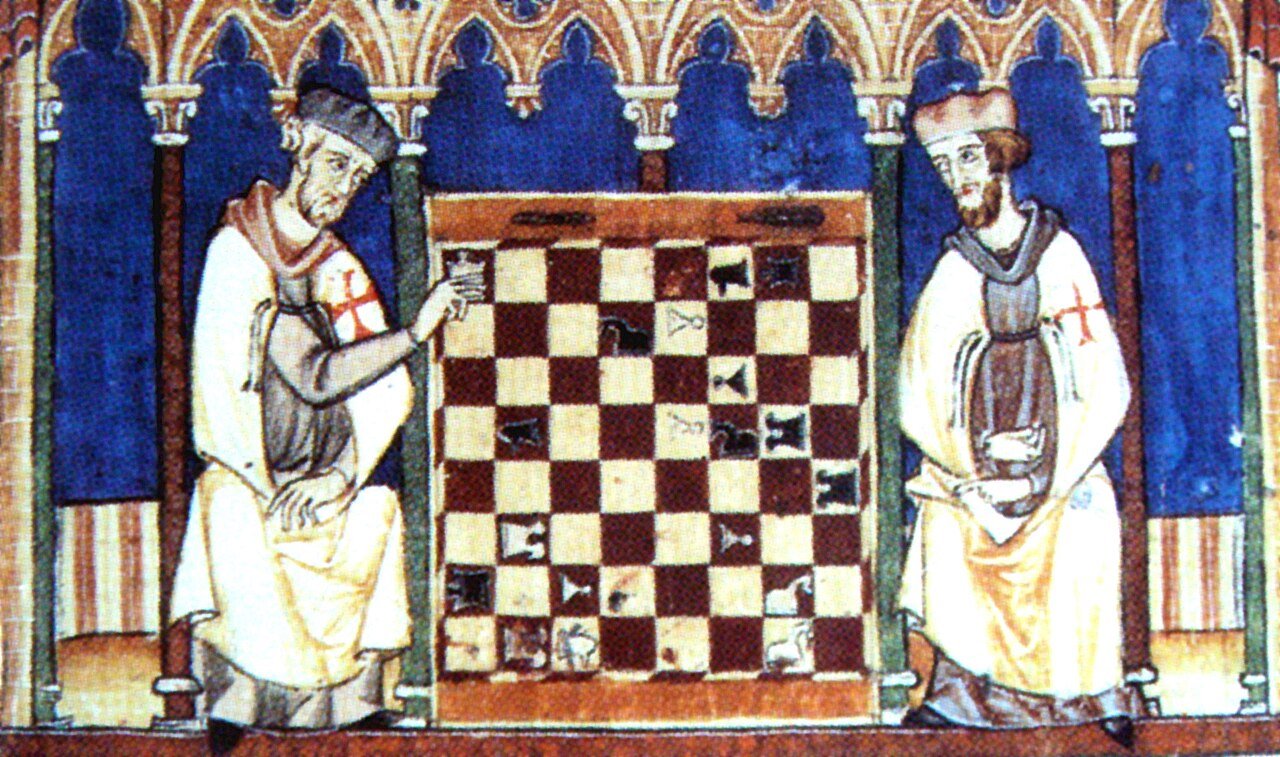
The Knights Templar were a military religious order. In plain English, they were monks who fought. They took religious vows like any monk, but instead of spending their days copying books, their main job was to protect Christian pilgrims travelling to the Holy Land.
Their official name was a bit of a mouthful: the Poor Fellow-Soldiers of Christ and of the Temple of Solomon. History.com notes that they wore a white habit marked with a red cross, and that they vowed poverty, chastity and obedience. They lasted about two centuries, from around 1119 until 1312, and they ended very badly indeed.
How it started: nine knights and a famous address
Our story begins just after the First Crusade. Christian armies had captured Jerusalem in 1099, and pilgrims were now pouring in. The roads, however, were dangerous. If you want the background on how Jerusalem changed hands in the first place, the story of the Crusades fills it in.
Around 1118 or 1119, a knight from Champagne in France named Hugh of Payns decided to do something about it. According to History.com, he and eight companions formed a small brotherhood. The Temple Church in London, which the Templars later built, explains that they took the usual monastic vows plus a fourth one: to protect pilgrims in the Holy Land.
Their headquarters came with a spectacular address. Their base was handed to them on Jerusalem’s Temple Mount: the Aqsa Mosque, a site that Christians at the time linked with the Temple of Solomon. That is where the name “Templars” comes from. Not bad for a group that officially called itself “poor”.
From nine knights to an international brand
Nine knights do not make an empire. What made the Templars grow was support from the very top.
In 1129, the Church formally approved the order, helped by Bernard of Clairvaux, a famous and very persuasive abbot. Bernard even wrote a short work praising them, In Praise of the New Knighthood. Then, in 1139, Pope Innocent II issued a papal bull that, as History.com puts it, freed the Templars from paying taxes, let them build their own places of worship and made them answer to nobody but the pope.
No taxes and no boss except the pope. You can see why kings might start to feel a little uneasy.
Donations of land and money poured in from all over Europe. The Templars spread far beyond the Holy Land. In London, for example, the Temple Church website says they first set up in Holborn by the 1140s, then moved to a new site, the New Temple, in the 1160s. Their round church there was consecrated in February 1185 by Heraclius, the patriarch of Jerusalem, and its round shape deliberately echoed the Church of the Holy Sepulchre. It still stands in central London today.
Two knights, one horse
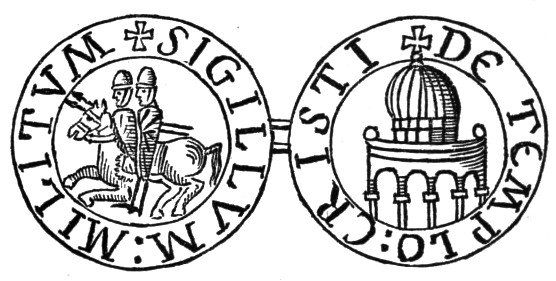
Here’s one of the most famous images of the order. The Templars sealed their documents with a picture of two armoured men perched on the same horse. Cosy.
What did it mean? Nobody knows for sure. Andrew Latham, a professor at Macalester College, explains that the most popular reading links it to their vow of poverty: knights so poor they had to share a horse. As he points out, though, the order was not actually short of money, so the image was more likely a statement of how seriously they took their vow. Others see it as a symbol of brotherhood. His verdict: the exact meaning remains a riddle.
Warrior monks and medieval bankers
The Templars were famous fighters, and their whole reason for existing was war in defence of the Holy Land. But their most surprising talent was handling money.
Travelling to the Holy Land with a bag full of coins was an excellent way to get robbed. So the Templars offered a better option. History.com describes how pilgrims could deposit their valuables with the order at home and then withdraw funds once they arrived in the Holy Land. Think of it as a medieval cash machine, but with more chain mail.
The order grew rich. At its height, according to History.com, it owned a fleet of ships and even, for a time, the island of Cyprus. That wealth would turn out to be a problem.
The fall: a king, a debt and a Friday
In 1291 the last major Crusader city, Acre, fell. The Templars had lost the very thing they were created to defend. By 1303, History.com says, the order was based in Paris.
That put them right next to King Philip IV of France, a ruler who owed huge sums of money and was, possibly, annoyed that the Templars had refused to lend him more. On Friday, 13 October 1307, Philip had the Templars in France arrested in a single coordinated swoop, including their grand master, Jacques de Molay.
The charges were shocking: heresy, spitting on the cross, financial corruption and more. Many knights confessed, but History.com notes that torture was used to force admissions of crimes they had not committed. Britannica records that Molay himself admitted some of the charges on 24 October 1307, very likely because of torture, and later took his confession back.
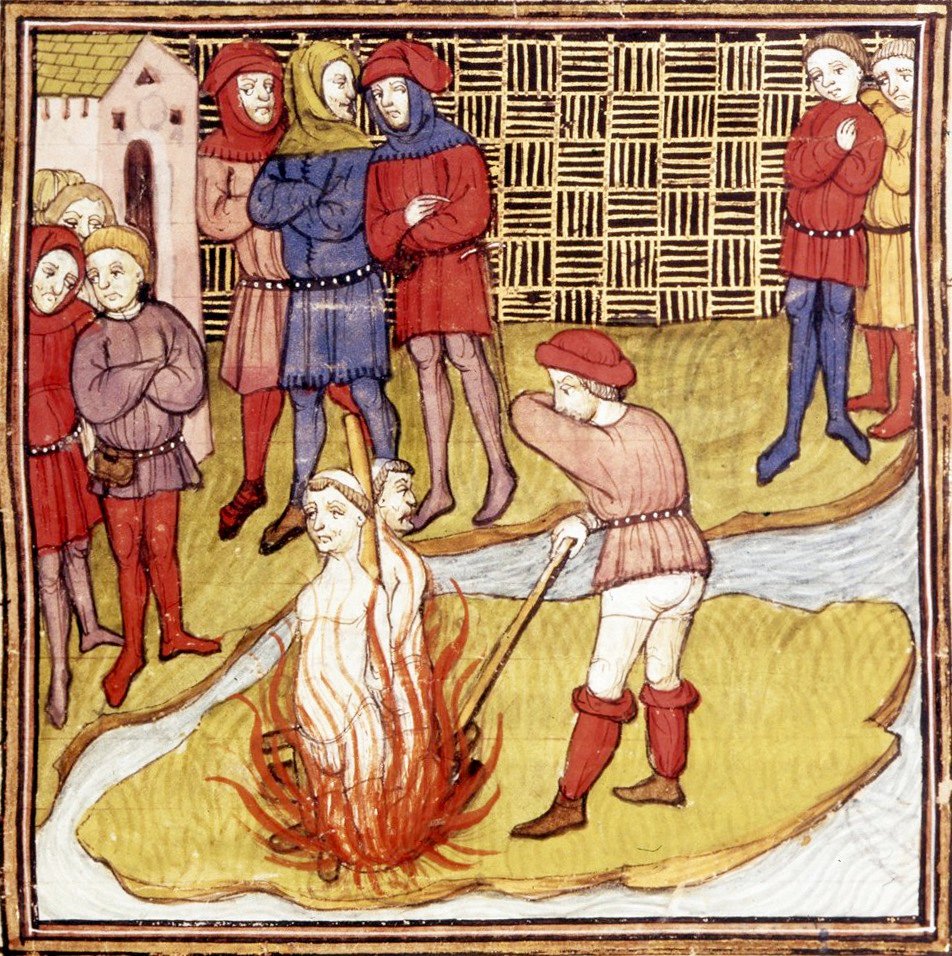
Under heavy pressure from Philip, Pope Clement V dissolved the order in 1312, and its property was handed to its rivals, the Knights Hospitallers. Dozens of Templars were burned in Paris. Molay’s turn came in March 1314, when, according to Britannica, the king’s officers burned him that same afternoon as a “relapsed heretic”, after he had once again retracted his confession.
The secret the Vatican kept in a drawer
Here’s a twist worthy of a novel, except it’s true.
Around 2001, the historian Barbara Frale found a remarkable document in the Vatican’s Secret Archive. Known as the Chinon Parchment, it records a papal inquiry into the Templars. The Law Library of Congress explains what it revealed: the pope’s investigators had absolved the leading Templars, including the grand master, and readmitted them to the Church, before Philip had them executed.
In 2007 the Vatican published the trial documents in a limited edition of just 800 copies, one of which was reserved for the pope himself. So, after seven centuries, the paperwork finally caught up with the rumours. History.com adds that the Catholic Church has since accepted that the order was treated unjustly.
Clement and Philip were not the only rulers to lean on the Church when it suited them. For the bigger picture of how much power popes, bishops and monks held, take a look at the medieval Church.
Myth check: Friday the 13th, the Grail and the treasure
Now for the fun part. Let’s put a few popular legends on trial.
- Friday the 13th: Yes, the arrests happened on Friday, 13 October 1307. No, that is probably not why Friday the 13th is considered unlucky. National Geographic points out that the link was popularised by Dan Brown’s novel The Da Vinci Code, and that the date may not have been tied to bad luck at all before the early 1900s.
- The Holy Grail, the Ark of the Covenant and the Shroud of Turin: History.com lists these among the legends attached to the Templars and treats most of them as fiction. No reliable evidence shows the order guarding any of them.
- The secret Templar survival society: Some modern groups, including the Freemasons, borrowed Templar symbols and traditions in the 1700s, History.com notes. Borrowing a logo, however, is not the same as being the original company.
Enjoyed that? The site’s big round-up of medieval myths busts plenty more.
The verdict: heroes, villains or bankers?
They were neither wizards nor villains. They were a religious order of fighting men who protected pilgrims, built a remarkably efficient financial network, grew rich and powerful, and then lost everything to a king who wanted their money and a pope who did not stop him.
So who were the Knights Templar, in the end? Their real story is about faith, war, money and politics, which, honestly, is more gripping than any treasure hunt. And if you ever visit the Temple Church in London, you can stand in the round church they built in the 1100s and decide for yourself. Just don’t expect to find the Grail behind a pillar.
Frequently asked questions
Who founded the Knights Templar?
A knight from Champagne named Hugh of Payns founded the order around 1118 or 1119, together with a small group of companions, to protect pilgrims in the Holy Land.
Why were they called Templars?
Their headquarters in Jerusalem was on the Temple Mount, in the Aqsa Mosque, a place Christians at the time associated with the Temple of Solomon.
Why were the Knights Templar arrested?
King Philip IV of France had them arrested on 13 October 1307 on charges such as heresy. Many historians see his large debts and the order’s wealth as major motives.
Is Friday the 13th unlucky because of the Templars?
Probably not. The arrests did take place on a Friday the 13th, but the connection with bad luck appears to be much more recent.
Sources
- History.com, The Knights Templar
- Encyclopaedia Britannica, Templars
- Encyclopaedia Britannica, Jacques de Molay
- The Temple Church, London, The 12th Century (1119–87)
- Andrew Latham, Religion News Service, How a legendary Knights Templar symbol has puzzled and fascinated since the Middle Ages (2024)
- Nathan Dorn, Library of Congress, Templar Secrets at the Law Library of Congress (2011)
- Becky Little, National Geographic, Friday the 13th and the Knights Templar (2016)