

Did Castle Defenders Really Pour Boiling Oil on Attackers?
Let’s imagine for a second a siege of a medieval castle. Probably, you’ve seen the same picture in movies and TV shows. The enemy team swarms against the castle walls, ladders go up, and the soldiers are pushing the ladders and starting to climb up. The tension for the defenders keeps rising, but at the last moment the defenders tip a huge cauldron over the battlements. A wave of steaming boiling oil starts to pour down on the attackers, and they start falling, screaming in deep agony. I believe this gives you the picture of it, and maybe also gives you a memory from a movie you saw. Now the question is: did this image really happen in real life in the Middle Ages? Well, in short, yes, sometimes, but let me show you what the sources actually say, and what the defenders of the castles usually poured instead.
Jump to a section:
Was boiling oil ever used?
In some situations, oil really was used to defend a castle or a town. The thing is that the best eyewitness accounts are not even from medieval times. For example, the Jewish historian Josephus tells us what happened when the Romans besieged the Jewish town of Jotapata in Galilee, in the year AD 67. So yeah, it was in ancient times, not in the Middle Ages. When the Romans pushed against the city walls, the Jewish commander, who was Josephus himself, ordered boiling oil to be thrown down on the Roman troops. Josephus explained that because of its fat and oily nature, the oil soon heated and slowly cooled, and the soldiers could not get out of their helmets and breastplates fast enough.
If using oil was not enough, the defenders of Jotapata also had a second trick. They also poured boiled fenugreek, a plant that turns slimy when cooked, onto the planks the Romans had laid against the wall, so that nobody could keep his footing. That day was a heavy defeat for the Romans, so they pulled back with a lot of dead and wounded soldiers. In the end, the result of the siege was not what you might expect. The town still fell and the Romans got the victory, despite the clever tactics of the Jewish defenders. Josephus also watched the huge Roman ram that pounded its walls, as you can see in our article on the medieval battering ram.
Boiling oil in the Middle Ages
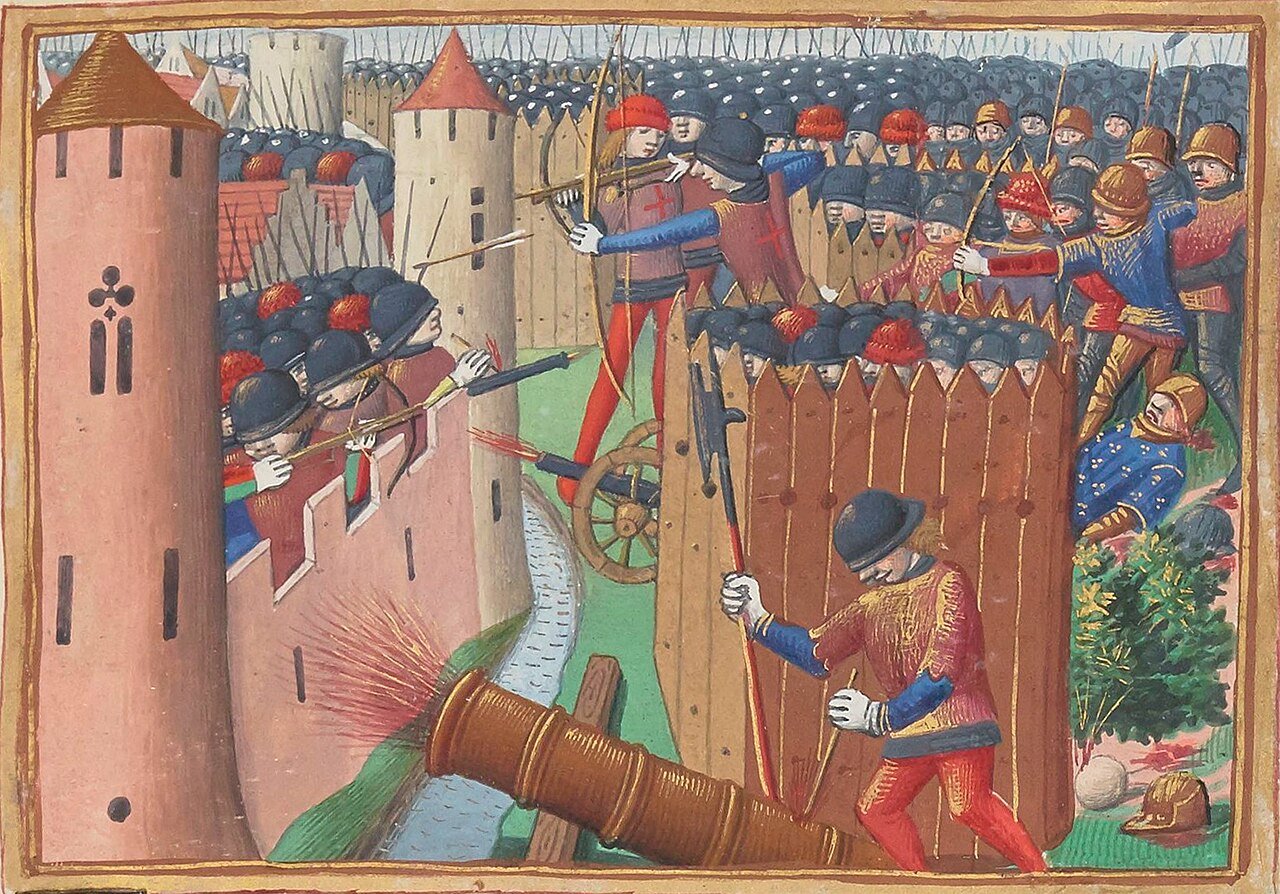
We saw the ancient evidence; now it’s the turn of the medieval evidence. Spoiler alert! It is much thinner than the ancient evidence. One of the few clear cases comes from the siege of Orléans during the Hundred Years’ War. History tells us that the English troops attacked on 21 October 1428. They were driven back by arrows and other missiles, rope nets, scalding oil, quicklime and hot coals. The city of Orléans held out for a long time, until Joan of Arc arrived and the siege was lifted in May 1429. As you can see, this was a long time and not a quick fight, as you may think. For how long such sieges could drag on, see how long medieval sieges lasted.
Orléans was just one example, and historians find only a handful of scattered references. Oil was not the common weapon. According to historical accounts, the use of boiling water, heated sand and molten lead was far more common than oil. So the boiling oil scene that we see in movies is not a pure invention, but it was the exception, not the rule. So, myth kind of debunked!
Why oil was too precious to waste
The only real problem was money. When is money not a problem? Maybe in real life you would find a different solution, but when it comes to defending a city, if money were no problem, maybe oil would have been the best weapon. Oil was used for cooking, for lamps and in the Church. Then comes the storage problem. Most cities could not easily store it in large enough quantities to make a difference in a fight. According to Sky History, oil was “too valuable a commodity to be literally thrown away”. That’s the main reason why the story of oil being the main weapon starts to fade away.
Besides that, there were also practical problems. Heating a big cauldron of oil took a lot of fuel and time, so it’s not only about oil being expensive: you also spent money on fuel, and you lost time. In the chaos of a fight, carrying it along a narrow wall was pretty dangerous, if you ask me. Another big problem was that hot oil could easily catch fire, and many parts of the wall, like gates and hoardings, were made of wood, so the risk of fire was really high.
What did defenders pour instead?
According to English Heritage, defenders “would sometimes pour hot sand, boiling water or quicklime” on attackers who were climbing scaling ladders. All of these were cheap and easy to find. Water came from the castle well, sand from the ground, and quicklime was already used for making mortar. Quicklime was especially nasty, because it burns wet skin and eyes.
Hot sand had a long history too. When Alexander the Great besieged Tyre in 332 BC, the defenders heated sand in metal shields over a fire and threw it on the Macedonians. According to the historian Diodorus, the sand got under their breastplates and burned their skin so badly that some went mad with pain. And of course, the simplest weapon of all was a heavy stone. Gravity was free.

Murder holes and machicolations
Every castle tour guide loves murder holes, the openings in the roof of a gate passage. People often say they were made for pouring boiling oil. But English Heritage points out that it was actually “more common to pour water to put out fires” than to drop unpleasant things on the enemy. Attackers often tried to burn down the wooden gates, and a bucket of water through the hole was the best answer.
Machicolations worked in a similar way. They were stone galleries built out from the top of a wall, with openings in the floor. Even a modern university glossary describes them as openings “through which to drop molten lead, boiling oil, and missiles”. Some writers on castles even argue that many murder holes were never tested in battle at all, and were partly built to make a castle look strong and important. You can see how all these features worked together in our article on how castles were defended.
Where did the myth come from?
Well, here is the part that is interesting. The story is not completely false or made up. There were a few real cases, told again and again, that were enough to make throwing boiling oil over the battlements look like the standard tactic for defending a city. Defenders really did pour hot things down from the walls, so it was easy to imagine that the hot thing was always oil.
The other part is that it looked cool on a screen. A cauldron of boiling oil is more dramatic and shocking on a screen than a man throwing a bucket of water or sand, and of course the film industry has chosen the dramatic version for decades. Like many other things that are “common knowledge” about that period, it is a mix of the truth and a lot of exaggeration. Drum roll… yes, it is an exaggeration, otherwise the cinemas wouldn’t sell so many movie tickets. Our list of medieval myths has more stories like this one.
Would I have wanted to face it?
To be honest, if I were in the shoes of a medieval soldier climbing a ladder against a castle wall, I would not really care that much whether the thing coming down was oil or water. All of them were meant to hurt me, to throw me off the ladder. Whether it was quicklime going into my eyes or hot water, it was the same idea: excruciating pain. I think that the difference really mattered to the people inside. That difference was about coins and the steward of the castle. Here I mean whether the steward of the castle could afford to buy it, or was just stingy.
So, did they really pour boiling oil?
Sometimes what the defenders of the castle threw down was oil, yes. According to Josephus, who witnessed it at Jotapata, and at Orléans in 1428, yes, it was oil. When it comes to the majority of medieval sieges, boiling oil was really too expensive and too dangerous to be the usual weapon. In an emergency, most of the defenders usually threw boiling water, hot sand, quicklime and stones down from the walls. They also used their murder holes just as often to put out fires. If you want to know more about the other side of the wall, read about medieval siege warfare, and to see what everyday life was like for the people behind those walls in peacetime, see life in a medieval castle.
Frequently asked questions
Did castle defenders really pour boiling oil on attackers?
Rarely. There are a few recorded cases, such as the siege of Orléans in 1428, but oil was expensive and hard to use in large amounts. Boiling water, hot sand, quicklime and stones were much more common.
Why was boiling oil rarely used?
Because oil was valuable and needed for cooking, lamps and churches. It also took a lot of fuel to heat, was dangerous to carry along the walls, and could set fire to the defenders’ own wooden structures.
What did defenders drop through murder holes?
Stones, hot sand, boiling water and quicklime. Very often they poured plain water, to put out fires that attackers had set against the gate.
When was boiling oil first used in a siege?
Its use goes back to ancient times. One of the clearest early accounts comes from Josephus, who ordered scalding oil to be poured on the Romans at the siege of Jotapata in AD 67.
Is boiling oil hotter than boiling water?
Yes. Water boils at 100°C, but oil can be heated far above that before it smokes or burns, and it sticks to the skin. That is why it was so feared, even though it was used so rarely.
Sources
- English Heritage, 10 Things You Probably Didn’t Know About Sieges
- Flavius Josephus, The Jewish War, Book 3, chapter 7, translated by William Whiston
- Diodorus Siculus, Library of History, Book 17, chapter 44 (Loeb translation, LacusCurtius, University of Chicago)
- Jeanne-d’Arc.info, The Siege of Orléans, 1428–1429
- Tastes of History, Dispelling Some Myths: Mediæval Murder Holes
- Sky History, Debunking the Biggest Myths About Medieval Warfare
- University of Pittsburgh, Glossary of Medieval Art and Architecture: Machicolation