
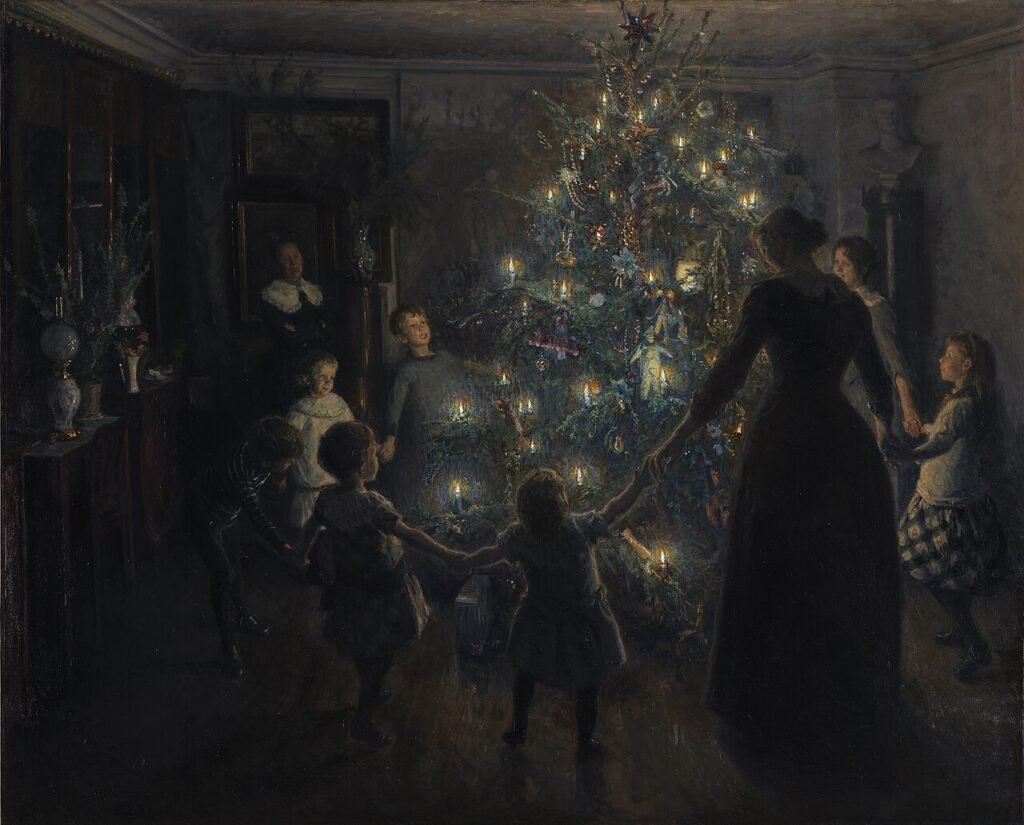
Did Medieval People Have Christmas Trees?
We all love Christmas at any age, from the kid who loves to unpack presents near a decorated tree glowing in the corner of the room, to adults who want quality time with their loved ones. The Christmas tree feels like a tradition as old as Christmas itself, so it’s easy to imagine that medieval people did the same things as us back then, right? Well, the answer is: not quite. The story takes us back to a play about Adam and Eve, to a couple of proud Baltic merchants and to a town account book from the year 1521. Let me show you what the historical sources really say.
Jump to a section:

What did a medieval Christmas look like?
The only thing that a modern Christmas and a medieval one have in common is the colour green. Yes, the colour green, because towns were full of greenery, but not the typical Christmas tree. Churches and homes were decorated with evergreen branches. There was no custom of placing a tree in the town centre, or near the local malls, right? The London historian John Stow tells us that every house and church was decked at Christmas with “holme, ivie, bayes”, in other words holly, ivy and bay. Stow also described a tree in 1444 “nailed full of holme and ivie” in London. All of this was basically public decoration for the season, the same thing your local government does to your streets when the holidays begin, and not a tree in someone’s living room as we are used to. And the last part, a sad part to be honest: the medieval Christmas also had no presents under a tree on Christmas morning. Yes, I know, sad indeed! In medieval times gifts were usually exchanged at New Year, as you can read in our article on medieval Christmas.
The paradise tree: a medieval stage prop
The first thing I found when I researched this article was that the medieval ancestor of the Christmas tree was probably a theatre prop. According to Aleteia, from the 12th century “paradise plays” were performed in church squares before Christmas. These plays told the story of Adam and Eve being thrown out of the Garden of Eden, exactly like the Bible says. They became so popular that Adam and Eve were remembered on 24 December, on Christmas Eve. In those plays, the actors were not the stars of the show. The star was actually the paradise tree, an evergreen standing for the tree of knowledge. It was decorated with apples, symbolising the forbidden fruit. According to Christianity Today, it was also decorated with unconsecrated communion wafers, which stood for redemption through Christ. Apples and wafers on an evergreen: that already starts to sound a lot like a Christmas tree. This might take us a bit down memory lane.
Freiburg 1419: a famous claim with a problem
You have probably read about the Freiburg tree, which may be the first ever evidence of a “kinda” Christmas tree. The story says that the bakers’ apprentices of Freiburg, in Germany, decorated a tree in the town hospital in 1419 with apples, wafers, gingerbread and tinsel. Sounds like a Christmas tree, right? Yes, but the sources tell us something different. According to Medievalists.net, the historian Klaus Graf has argued that the evidence for the Freiburg tree “can only be accurately traced back to 1625”. So, once again, the source is much later.
Tallinn and Riga: the Baltic tree war
Here comes the Christmas tree war between Estonia and Latvia. Both countries take a stance and say that the first Christmas tree appeared in their country. Estonia points to Tallinn in 1441, when a tree was reportedly set up in front of the town hall for a dance. Latvia points to Riga in 1510, where, according to a story, a merchant guild called the Brotherhood of Blackheads decorated a tree, carried it through the city and finally burned it.
Here, historians are very cautious about both claims. According to Medievalists.net, the Tallinn record is ambiguous, because the Middle Low German word for “tree” could also mean a decorated mast or pole. National Geographic adds that historians doubt the link between these celebrations and Christmas at all. Guilds were proud of their feasts and traditions, as you can see in our article on medieval guilds.
Sélestat 1521: the first written record
The strongest early evidence comes from Sélestat, a small town in Alsace, today in France. Its 1521 account book, now kept in the town’s Humanist Library, contains this entry: “Item IIII Schillings den förstern die meyen an Sanct Thomas Tag zu hieten”. According to the Sélestat tourist office, it records four schillings paid to forest guards to watch over the young fir trees from Saint Thomas’ Day, 21 December, until Christmas, so that nobody cut them down.
Why guard trees at Christmas? Because people were clearly cutting them for the festival. In 1555 Sélestat tried to regulate the custom, and in 1554, according to National Geographic, Freiburg banned felling trees for Christmas altogether. The Christmas tree had become so popular that towns had to protect their forests from it.

Apples, wafers and paper roses
Let me tell you what I found in my research that I find interesting. The earliest written description of a Christmas tree comes from Strasbourg in the year 1605. An anonymous writer described trees that were set up in homes, where they were decorated with roses cut from coloured paper, apples, wafers, gold foil and sweets. Now, that’s what I call a Christmas tree! Finally, guys, we are here! Bremen offers an earlier glimpse: according to Medievalists.net, in 1570 a tree in a guild hall was decorated with apples, nuts, pretzels and paper flowers, and children were allowed to shake it to collect the treats.
Please notice the use of apples and wafers as decorations. This idea, taken from the medieval paradise tree, was still there. Over time, glass ornaments replaced the fruit, maybe because sometimes there was no fruit left. Why, you ask? Well, a local legend from 1858 even claims that a drought left no apples for the trees, so a glassblower made glass balls instead.
Did Martin Luther invent the lit Christmas tree?
History is full of magic and legends, so let me tell you one, a story about Martin Luther. According to the legend, Martin Luther was walking home one winter night and saw the stars shining through the branches of a fir tree. He loved it so much that, according to the story, he decided to recreate the sight at home with candles. Sounds nice, right? Yes, for me at least it does, but according to Christianity Today, there is no contemporary record mentioning it, and the event may never even have happened. Like many of the medieval myths we have looked at, it is a good tale that got attached to a famous name.
How the Christmas tree reached England and America
For a long time the Christmas tree remained a German custom. In England, the first known tree was set up by Queen Charlotte, the German-born wife of King George III. According to History Today, in December 1800 she had a whole yew tree potted at Queen’s Lodge in Windsor, hung with sweets, fruit and presents, as the centrepiece of a party for local children.
The real boom came in 1848, when the Illustrated London News published a picture of Queen Victoria and Prince Albert’s family around a decorated tree at Windsor Castle. According to National Geographic, in 1850 the American magazine Godey’s Lady’s Book reprinted the picture, removing the royal details so that it looked like an ordinary American family. After that, the Christmas tree spread across the English-speaking world.

Would I have liked a medieval Christmas tree?
The first thing that I would have loved is the paradise plays. Watching medieval actors play the roles of Adam and Eve on a square in front of the church on Christmas Eve, with a tree full of apples, sounds like great fun. One other thing that I would love 100% is the custom from Bremen. I can imagine shaking a tree with my friends until pretzels and nuts fall on our heads. This is the kind of Christmas tradition I would bring back today, just to watch children shaking a tree and having a good time.
So, did medieval people have Christmas trees?
Not in the way we think of it today, with the lights and decorations and the gifts placed under the tree with the help of our parents. Oh no! I think I just gave a spoiler to some of you! Well, maybe not: if you are old enough to search for medieval history, I believe you are old enough to know that Santa Claus is not real! Medieval people decorated with holly, ivy and bay, and the closest thing to a Christmas tree was the paradise tree of the Adam and Eve plays, hung with apples and wafers. The first reliable record of Christmas trees comes from Sélestat in the year 1521, just after the end of the Middle Ages, so it’s not even a custom from medieval times! Later, this custom spread from Germany and Alsace to other European countries over the next three centuries. The Christmas tree has medieval roots, but the tree itself belongs to the modern age. It reached the English-speaking world through the same kind of journey that turned Saint Nicholas into Santa Claus. To see how faith shaped the whole medieval calendar, read our overview of the medieval Church.
Frequently asked questions
Did medieval people have Christmas trees?
Not really. They decorated homes and churches with evergreen branches such as holly, ivy and bay. The closest thing to a Christmas tree was the “paradise tree” used in plays about Adam and Eve, decorated with apples and wafers.
Where was the first Christmas tree?
Tallinn (1441) and Riga (1510) both claim it, but historians doubt both claims. The first reliable written record comes from Sélestat in Alsace, in an account book of 1521.
Why are Christmas trees decorated with balls?
The earliest trees were hung with apples, a reminder of the forbidden fruit in the Garden of Eden. Over time, glass balls replaced the apples.
Did Martin Luther invent the Christmas tree?
No. The story that Luther put candles on a tree after seeing stars through the branches is a later legend. There is no record of it from his own time.
When did the Christmas tree come to England?
Queen Charlotte set up the first known English Christmas tree at Windsor in 1800. The custom became popular after the Illustrated London News showed Queen Victoria’s family around a tree in 1848.
Sources
- Medievalists.net, Where Was the First Christmas Tree?
- National Geographic, How the Christmas Tree Became a Holiday Tradition
- Sélestat Haut-Koenigsbourg Tourist Office, Histoire de l’arbre de Noël (PDF)
- Christianity Today, O Christmas Tree
- Aleteia, The Real Meaning and Origin of the Christmas Tree
- History Today, The First Christmas Tree