

What Was Life Like in a Medieval Castle?
Let’s imagine for a moment what life in a medieval castle was like. Most of us expect to see a king on his throne, knights polishing their swords and practising with wooden sticks, and a princess looking out of a tower window, with a servant brushing her hair. Well, this is not as accurate as you may think. The reality was noisier and a lot colder than that. The role of a castle was firstly to be a fortress that protected the people inside. Second of all, the castle was a home, an office and a kitchen for a small army of servants. The king, well, the king or the lord who owned it was often not even there. Let’s open the gate and see who really lived inside, what they ate, where they slept and how they kept warm.
Jump to a section:

The lord was often away
Let’s start first with the statement that the lord was away. According to English Heritage, the owner of a castle, whether a king, a lord or a great lady, was its most important resident. It also points out that owners “didn’t live there all the time”. Kings owned dozens of castles and could not possibly visit them all at the same time. Moving around was simply how medieval power worked: King Henry III could move up to 80 times in a typical year. That’s what I call investing in real estate!
One good example comes from Goodrich Castle in Herefordshire. After her husband William de Valence died in 1296, Countess Joan de Valence stayed at 15 different residences between May 1296 and September 1297. Her household numbered between 122 and 196 people, of whom the majority were servants that helped with the day-to-day routine. Most of them travelled with her, because servants usually belonged to the family they served, and not to the building. That’s why they moved from castle to castle depending on the lord’s needs.
Who kept the castle running?
As I mentioned earlier in the article, the owner was often away, moving from castle to castle. In his place, commanding the castle, was a constable or a castellan. The fortress looked completely different in times of peace and war. In times of peace the garrison could be surprisingly small, perhaps about a dozen soldiers. Only when an attack threatened were many more men crammed inside, as happened at Dover in 1216. You can see how those defenders fought back in our article on how castles were defended.
On the other hand, when the lord was at home, life in a medieval castle changed completely, because the building was filled with staff, many of them the servants that travelled with the lord. According to Mark Cartwright of the World History Encyclopedia, a large English castle could have a household of at least 50 people, as follows:
- the steward, who managed money, supplies and staff, and could run the whole castle if the lord was away;
- the marshal, in charge of the stables, the carts and the men-at-arms;
- the chamberlain, who looked after the lord’s private rooms and personal comfort;
- the chaplain, who led daily services, wrote the lord’s letters and often taught the children;
- cooks, bakers, butlers, grooms, chambermaids and a laundress.
Children who came to learn manners
Not everyone in a castle was a servant or a soldier. Children from wealthy families were often sent to live in a great household as pages and damsels. Their role there was to learn manners, service and the skills they would need as adults. They could carry messages, entertain guests, practise with arms and take care of horses and the lord’s armour. For boys, this was usually the first step on the long road described in how to become a knight.
Two meals a day, and they took hours
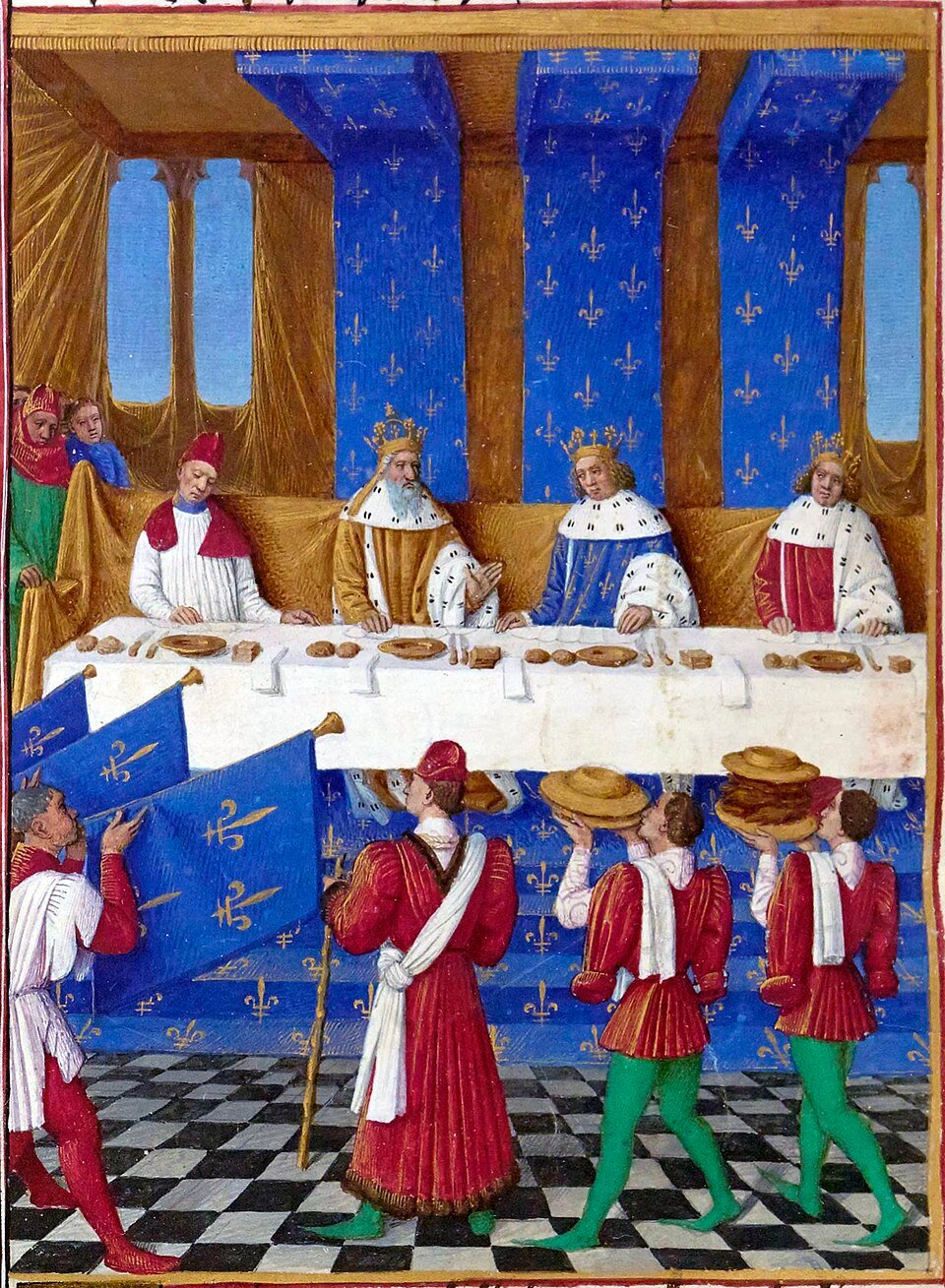
Food was the heart of castle life, and the household of Joan de Valence spent about 40% of her income on food and drink. The day revolved around two main meals:
- dinner, served around 10 or 11 in the morning, which could last two or three hours;
- supper, after the evening church service of vespers;
- together, the two meals could take up to six hours.
Seating followed rank. The lord and the most important guests sat at the high table, at the end of the hall furthest from the kitchen, and everyone else sat further down. Even the bread showed who you were: fine white rolls for the lady, and coarse loaves of barley or peas and beans for the servants. If you are curious how this compared with ordinary village food, see what medieval peasants ate.
A feast at Goodrich
According to the accounts from Goodrich, a lot of supplies were brought in for the Easter Sunday feast of 1297. The shopping list was huge, with a lot of food including beef, bacon, half a boar, half a salmon, 600 eggs, 17 capons and hens, nine young goats, two calves, pigeons and cheese. When Joan arrived at the castle in November 1296, 81 pigs were slaughtered in order to feed the household. Well, that’s what I call a feast! I can even hear the bards singing! The cooks at Goodrich could be feeding up to 200 people, with two meals a day.
Of course, all this huge amount of food was part of the show. Lords were expected to provide minstrels, jugglers and acrobats, some kept a full-time jester, and wandering harpers and storytellers were welcome in the evenings. All these “employees” were there to entertain the lord’s court and his guests. Our article on medieval music tells you what those minstrels might have been playing.
Where did everyone sleep?
Of course the lord and lady had private rooms, including their own bedchamber (I hope it was king-size), placed in the safest part of the castle. It’s good to be the king! At Goodrich, family and guests used the upper floors of the towers. In the meantime, officers, soldiers and servants were housed in the east range, the gatehouse and perhaps the keep. Some of the retinue were not that fortunate and probably had to sleep in the village or in tents outside the walls.
Further down the ladder, things got worse. Soldiers slept in a dormitory, pages shared feather beds, and the lowliest servants simply slept wherever they could find a space.
Cold stones and smelly toilets
Keeping warm was one of the hardest parts of life in a medieval castle. Describing 12th-century Rochester Castle, English Heritage lists “thick stone walls, tiny unglazed windows and inefficient open fires”. Fireplaces built into the walls helped, and heavy tapestries on the walls were not just decoration: they kept some of the cold out.
And the toilets? They were called gongs, and many simply overhung an outside wall, so the waste dropped down the outside of the castle. Lords had private ones next to their rooms, while castles such as Goodrich and Middleham had toilets with several seats. Someone still had to clear out what collected below: the gong-farmer, a job nobody envied. There is much more on that in our article on medieval toilets.
Could I have lived in a castle?
I think I would have enjoyed the feasts. I would have danced with the pretty ladies at the court, and surely I would have laughed at the jester’s jokes and clapped at the bard’s music. When it comes to the cold winters and the smell of the gongs, I would probably have had much less interest. But now I imagined being a person who was high up on the social scale. If I were a servant, I don’t think I would have liked it so much.
Was life in a medieval castle really glamorous?
When it comes to the lord and lady, life in a medieval castle meant real comfort for its age. They had the best food, private rooms and entertainment at dinner. This looked like a vacation for most of us. For the rest of the people inside, it meant hard work, shared beds and cold stone. Some say you could get used to it, but I doubt it. A castle was less a fairy-tale place; it was not all fun and joy. For most of the people inside it meant a crowded workplace with very thick walls. If you want to see what happened when those walls came under attack, read about medieval siege warfare, and to find out how ordinary people got by outside the walls, start with our overview of daily life in the Middle Ages.
Frequently asked questions
What was life like in a medieval castle?
Busy, crowded and often cold. A castle was home to a lord’s family, dozens of servants and a few soldiers, and its days revolved around two long meals, work, prayer and, on special days, great feasts with entertainment.
Who lived in a medieval castle?
The lord or lady who owned it, their family and guests, a household of servants and officials, children sent to learn manners as pages and damsels, and a small garrison of soldiers under a constable. Large households could number well over a hundred people, so life in a medieval castle was rarely quiet.
Did lords live in their castles all year round?
Usually not. Great lords and kings owned several castles and manor houses and moved between them with their households. While they were away, a constable looked after the castle.
What did people eat in a medieval castle?
Food was at the centre of life in a medieval castle: plenty of meat, including beef, pork, game and birds, fish on Fridays and other fast days, salted meat and fish, and bread whose quality depended on your rank. There were two main meals a day.
Were medieval castles cold?
Yes. Cold was part of everyday life in a medieval castle. Thick stone walls, small unglazed windows and smoky open fires made them hard to heat. Wall fireplaces and tapestries helped make the private rooms more comfortable.
Sources
- English Heritage, Life in a Castle
- English Heritage, Goodrich Castle: Life in a Medieval Household
- English Heritage, 10 Ways of Keeping Warm Through History
- Mark Cartwright, “The Household Staff in an English Medieval Castle”, World History Encyclopedia (2018)