

Was Robin Hood Real? The Truth Behind the Legend
I believe we all know this story and the character: the man, the legend. There was an outlaw dressed in green clothing who lived in Sherwood Forest with his band of merry men, the one who robbed the rich and gave to the poor. It is said that whenever he joined an archery contest, he was so good that his shots split arrows in half. He did all of this out of loyalty to good King Richard. It’s one of the most famous legends in the world. But the question is: was Robin Hood real? If you think a simple yes or no will cover it, you’re wrong. The thing is that almost every part of that familiar story was most likely added centuries after the first tales were told. Let’s go back to the earliest sources and see what’s left of the outlaw who so kindly gave riches to the not-so-fortunate ones.
Jump to a section:
Was Robin Hood real? The short answer
Probably not, at least not as a single, identifiable person. Historians have searched the records for centuries and found no outlaw who matches the hero of the stories. What they have found is a legend that grew slowly, picking up new characters, a new king and a new home with almost every retelling.
There are, however, a few intriguing clues: real outlaws whose names look a lot like his, and early writers who were sure he had lived. To judge them, you have to start with the oldest mention of all.
The first time anyone mentions him
The earliest known reference to Robin Hood in literature comes from William Langland’s long poem Piers Plowman, in a version written around 1377. In it Sloth, one of the seven deadly sins, portrayed as a lazy priest, admits that he can’t say the Lord’s Prayer properly, “But I kan rymes of Robyn hood”.
That one line tells us a lot. By the 1370s, songs about Robin Hood were already so well known that a poet could joke about them, and they were clearly more popular than prayers. Nobody, though, had written any of them down yet.
The earliest stories
The oldest surviving Robin Hood ballad is Robin Hood and the Monk, copied into a manuscript some time after 1450 and now in Cambridge University Library. Robin Hood and the Potter survives in a manuscript from around 1500. The longest early tale, A Gest of Robyn Hode, was probably composed between about 1450 and 1475.
The Gest was also one of the first Robin Hood stories to be printed, in the early 1500s, by Wynkyn de Worde in London and by Jan van Doesborch in Antwerp. Printing helped spread the outlaw’s adventures far beyond the people who heard them sung.

Barnsdale before Sherwood
What if Robin Hood was not originally from Sherwood? Here is an interesting fact. Anyone who has visited Nottinghamshire may be surprised to find out that the earliest ballads place Robin mostly in Barnsdale, an area of Yorkshire between Pontefract and Doncaster. The Gest opens with “Robyn stode in Bernesdale”, and of course Little John is standing beside him. Of the early tales, only Robin Hood and the Monk clearly places him in Sherwood. Some familiar faces are there from the start. Little John and the Sheriff of Nottingham both appear in the oldest ballads, with the sheriff already being Robin Hood’s great enemy. It sounds like a modern-day comic book. Pretty cool, if you ask me!
Real outlaws called Robin Hood?
One of the best pieces of evidence I found for a “real” Robin Hood comes from legal records. Back in 1226, the royal records for Yorkshire mention the goods of “Robert Hod, fugitive”, an outlaw whose property had been seized after the assizes at York. Some historians have taken him seriously as a possible original, based solely on this royal record.
Then, in Berkshire, a man named William son of Robert le Fevre was outlawed for theft in 1261, and in a royal record of 1262 the same person is called “William Robehod”. It seems that the name “Robinhood” was already becoming a nickname for any outlaw, and anybody who was against the law was linked with Robin Hood. This suggests the legend was older than the records. Some scholars even think that the 1262 name may simply be a clerk’s slip. Whether he was a real person or not, the Robin Hood legend moved on with time, and people didn’t forget him.
Which king? Edward, Richard or John
The medieval ballads never mention Richard the Lionheart. The king in the Gest is “Edwarde, our comly kynge”, and nobody is sure which King Edward was meant. Scottish chroniclers had their own dates: Andrew of Wyntoun, around 1420, put Robin in 1283, and Walter Bower, in the 1440s, linked him to the rebels of 1266 who had fought with Simon de Montfort.
The link with Richard I came later. In 1521 the Scottish historian John Major placed Robin in the time of Richard and his brother John, and in 1598 the playwright Anthony Munday turned him into a dispossessed nobleman, the Earl of Huntington. That’s how the outlaw became a loyal subject of Richard the Lionheart and an enemy of the king’s brother, whose reputation you can explore in our article on whether King John was England’s worst king.
Did he really rob the rich to give to the poor?
Sometimes only the good things are put up front, so that a legend or a myth can stand out. The simple answer is: not quite. Well, at least not in the oldest tales of Robin Hood. The Gest tells Robin’s men to leave farmers and ordinary yeomen alone and to beat and rob bishops and archbishops instead. In other words, Robin was not out to hurt ordinary people; his targets were the rich men of the Church. Its final verse remembers him simply as “a good outlawe” who “dyde pore men moch god”.
Even the full slogan arrived much later than we assume. The first writer to say clearly that Robin Hood robbed the rich to give to the poor was a historian of the Elizabethan period named John Stow, in 1592, more than two hundred years after the first mention of Robin. The first version of Robin is less of a charity guy who only wants the good of the people, and more of a dangerous, clever outlaw with a soft spot for ordinary people.
Maid Marian and Friar Tuck
Maid Marian isn’t in the earliest ballads at all. She seems to have joined the story through the May games, the spring festivals of the 15th and 16th centuries, where Robin and Marian were popular characters, and Munday later made her a noblewoman named Matilda Fitzwater. A French play about a shepherdess named Marion and her lover Robin, written around 1283, has a similar pair, but no link with the English legend has been proved.
Friar Tuck is a stranger case. In 1417 royal writs were issued against an outlaw “assuming the name of Frere Tuk” who was causing trouble in Surrey and Sussex, and a later writ of 1429 names him as Robert Stafford, a chaplain of Lindfield. A friar called Tuck appears in a Robin Hood play from around 1475. For what real monks and friars were supposed to be doing, read about medieval monastery life.
Bows, arrows and Lincoln green
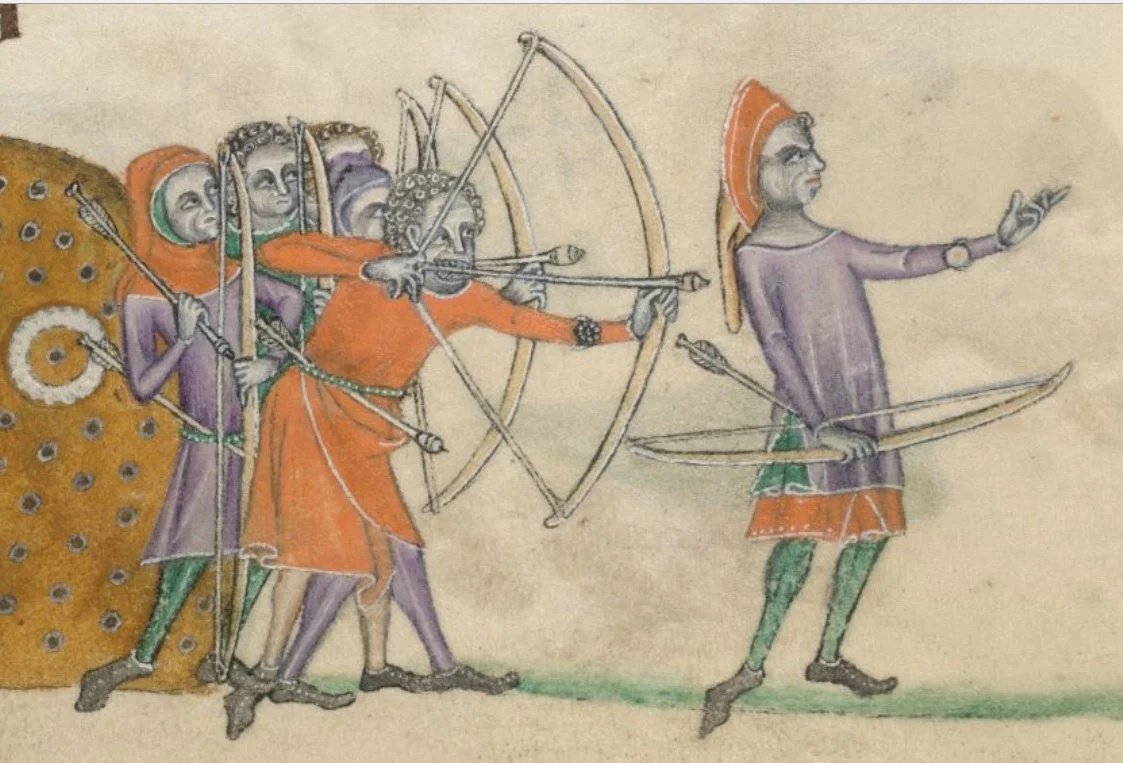
Archery is at the heart of the stories. In the Gest the Sheriff holds an archery contest, and Robin’s skill with the bow is his trademark. The ballads simply call it a bow, but English audiences would have pictured the longbow, the weapon that made English archers famous at battles like Agincourt.
The famous green comes from the Gest too, where the outlaws wear “Lyncolne grene”, a cloth from Lincoln, perfect for hiding in the woods. For what ordinary people really wore, see medieval clothing.
How did Robin Hood die?
Some of the stories we hear have happy endings, and some have sad endings. This is also the case with our hero, Robin Hood. In the Gest, Robin goes to the prioress of Kirklees, a relative, to be bled as a medical treatment, but she betrays him with the help of her lover, Sir Roger of Donkesly. If you don’t know about bloodletting, it was a normal cure at the time, as you can see in our article on medieval medicine.
A later ballad also gives us a detail worth mentioning in a legend. The dying Robin shoots one last arrow from the window and asks to be buried where the arrow lands. A grave at Kirklees, in West Yorkshire, is still pointed out as his, but the enclosure around it dates from the 1700s. I believe this is a good ending for our beloved hero: a sad one indeed, but at least an ending worthy of an outlaw.
From ballads to Hollywood
Robin Hood never stopped changing. As you may know, writers and the directors of movies and TV series have often tried to impose their own vision and do things their own way. Nineteenth-century writers such as Walter Scott made him a romantic hero, Errol Flynn swung through Sherwood in The Adventures of Robin Hood in 1938, and Disney turned him into a fox in 1973. Each version kept some old pieces and added new ones, which is exactly how the legend was built in the first place.
The Robin Hood I grew up with
The movies that I saw growing up made me admire Robin Hood. He was an outlaw who tried to help the poor, and everyone who tried to defeat him always ended up disappointed. He sounds to me like a local hero. Maybe this is the reason why medieval people depicted him that way. In that period, people suffered a lot from high taxes, with which King Richard financed his crusade and his ransom when he was captured. Creating a figure who fought the sheriff and the rich clergy was exactly what people needed to hear.
So, was Robin Hood real?
Sure, there may well have been a real outlaw, or maybe several, as I mentioned earlier in the article, behind the name, and men like Robert Hod show that the stories grew out of a real world of outlaws, sheriffs and forest laws. But the hero we know, with Marian, Friar Tuck, King Richard and the slogan about the rich and the poor, was created and built over centuries by singers, chroniclers, playwrights and filmmakers. I believe that in a period of dark times, a hero is much needed to boost people’s morale and show them there is still hope!
In that, he has a lot in common with England’s other great legendary hero; find out whether King Arthur was real, and see more stories that grew in the telling in our list of medieval myths.
Frequently asked questions
When did Robin Hood live?
Nobody knows, and he may never have existed as a single person. Medieval writers placed him anywhere from the 1190s to the 1280s, and the earliest mention of the stories dates from around 1377.
Where did Robin Hood live?
The earliest ballads place him mainly in Barnsdale, in Yorkshire. Sherwood Forest in Nottinghamshire became his best-known home later.
Was Robin Hood a nobleman?
Not in the medieval ballads, where he is a yeoman. He was turned into a dispossessed nobleman, the Earl of Huntington, by the playwright Anthony Munday in 1598.
Was Maid Marian real?
There’s no evidence for a real Marian. She doesn’t appear in the earliest ballads and joined the legend through the May games of the 15th and 16th centuries.
Sources
- University of Rochester, Robbins Library, Robin Hood and the Monk (TEAMS Middle English Texts)
- Middle English Texts Series (METS), A Gest of Robyn Hode
- University of Rochester, Robbins Library, The Robin Hood Project: Friar Tuck
- University of Rochester, TEAMS Middle English Texts, Walter Bower, Scotichronicon
- Medievalists.net, Robin Hood: Sherwood Forest or Barnsdale?
- National Geographic, The origins of Robin Hood
- Gresham College, Stephen Church, Robin Hood (lecture slides, 2018)
- Historic England, Listing entry 1413828 (Robin Hood’s Grave, Kirklees)