
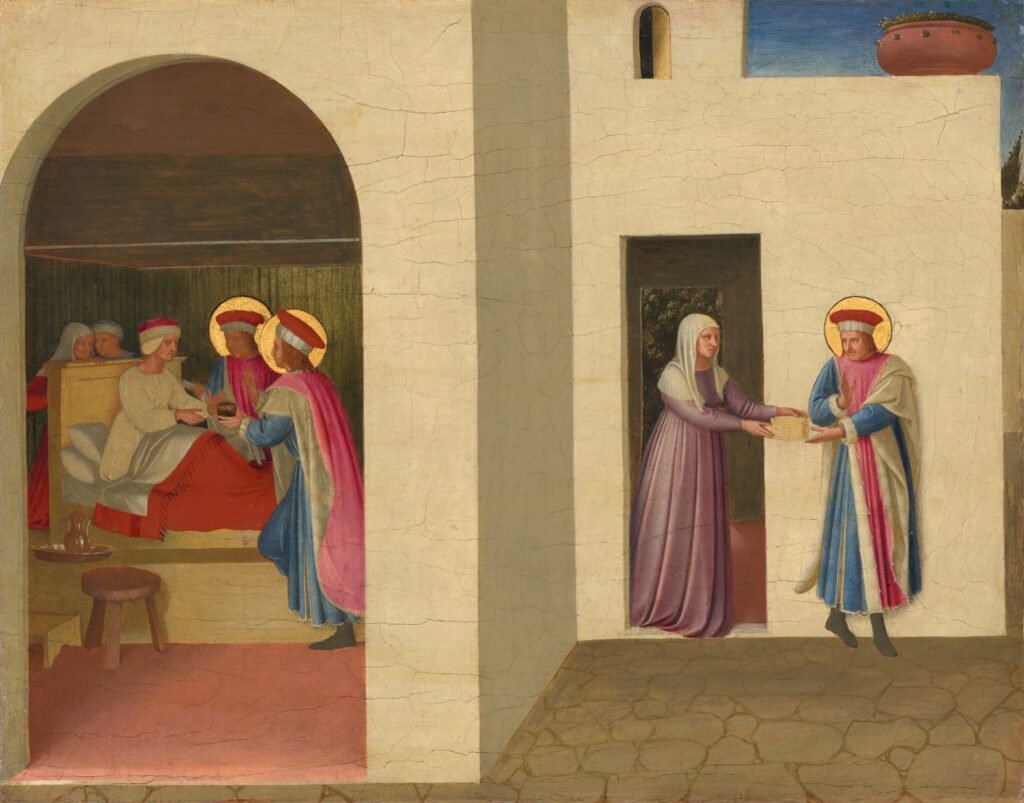
Medieval Medicine: Bloodletting, Herbs and Barber-Surgeons
Feeling a bit under the weather? In the Middle Ages, your doctor might start by holding a flask of your urine up to the light, then check what the moon was doing, and finish by cheerfully opening one of your veins. Medieval medicine has a terrible reputation, and some of it is well deserved. But it was not all leeches and guesswork. There were trained physicians, careful surgeons, hospitals that are still open today and at least one Anglo-Saxon recipe that has impressed modern scientists. So pull up a stool, roll up your sleeve (just in case) and let’s see what the doctor ordered.
Jump to a section:
The big idea: four fluids in a fragile balance
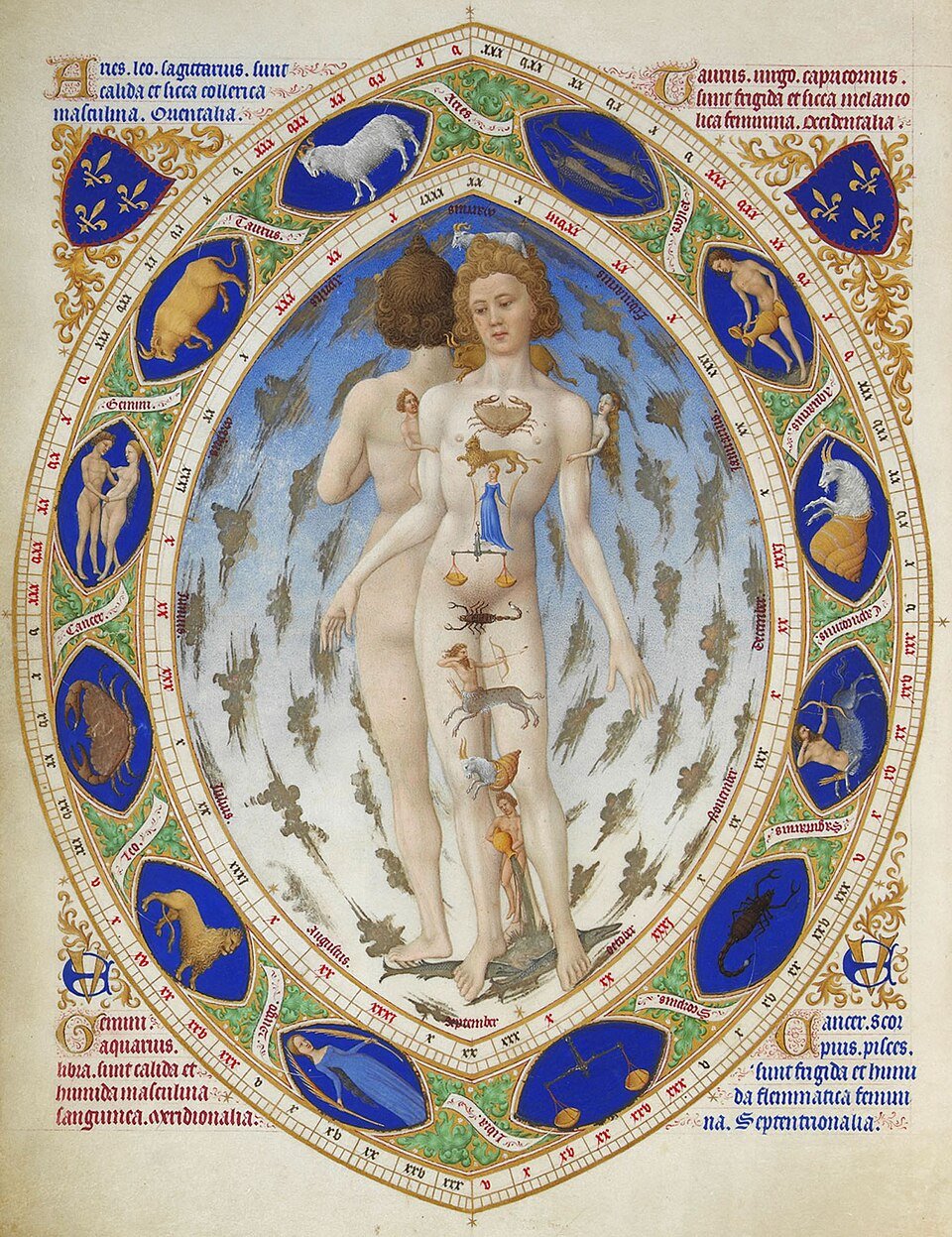
Almost everything in medieval medicine grew out of one ancient theory. The Metropolitan Museum of Art explains that the Greek physician Hippocrates taught that the body was made of four fluids, or humours: phlegm, blood, black bile and yellow bile. If you were healthy, they were in balance. If you were ill, one of them had got out of hand.
The Roman-era doctor Galen built on these ideas in the second century, and the Met notes that his theories dominated western European medicine right up to the 1500s. That is a run of well over a thousand years. Few scientific ideas have ever had such staying power, even wrong ones.
The logic was simple. If you had too much of a humour, you got rid of some. If you had too little, you topped it up with the right food, drink or herbs. And the easiest humour to get rid of was the one that came out when you cut someone.
Who would treat you?
It depended on your money, your problem and where you lived. The Met lists a whole cast of healers:
- Physicians, who worked out what was wrong by looking at you, touching you, taking your pulse and studying your urine.
- Barbers, who handled the bleeding and the leeches.
- Midwives, who delivered babies and treated young children.
- Apothecaries, who mixed and sold the medicines.
- Local healers and monks, who offered herbs, prayers and whatever else seemed to work.
A medieval doctor even had a slightly unsettling name. As the Online Etymology Dictionary explains, the Old English word læce, our modern “leech”, once meant a physician. Over the following centuries “doctor” slowly took over, which is probably for the best.
Women were not shut out of learning, either. The Met points out that the famous medical school at Salerno, in southern Italy, allowed women to study there. A group of influential Latin texts on women’s health, known as the Trotula, is believed to have been produced at Salerno during the 1100s, according to Medievalists.net.
Bloodletting: the cure for (almost) everything
If medieval medicine had a signature move, this was it. The Met describes three ways of draining off a troublesome humour: bleeding, cupping and leeching. The Royal College of Physicians of Edinburgh explains that bleeding commonly meant opening a large vein in the forearm or the neck. The blood ran into a bowl so the doctor could measure it, and a tourniquet stopped things getting dangerous.
Timing mattered too, and this is where the stars came in. The Edinburgh college notes that diagrams like the Anatomical Man above linked each part of the body to a sign of the zodiac. The position of the moon decided which parts of the body were safe to bleed and which were off-limits. So your appointment could depend on the night sky as much as on your symptoms.
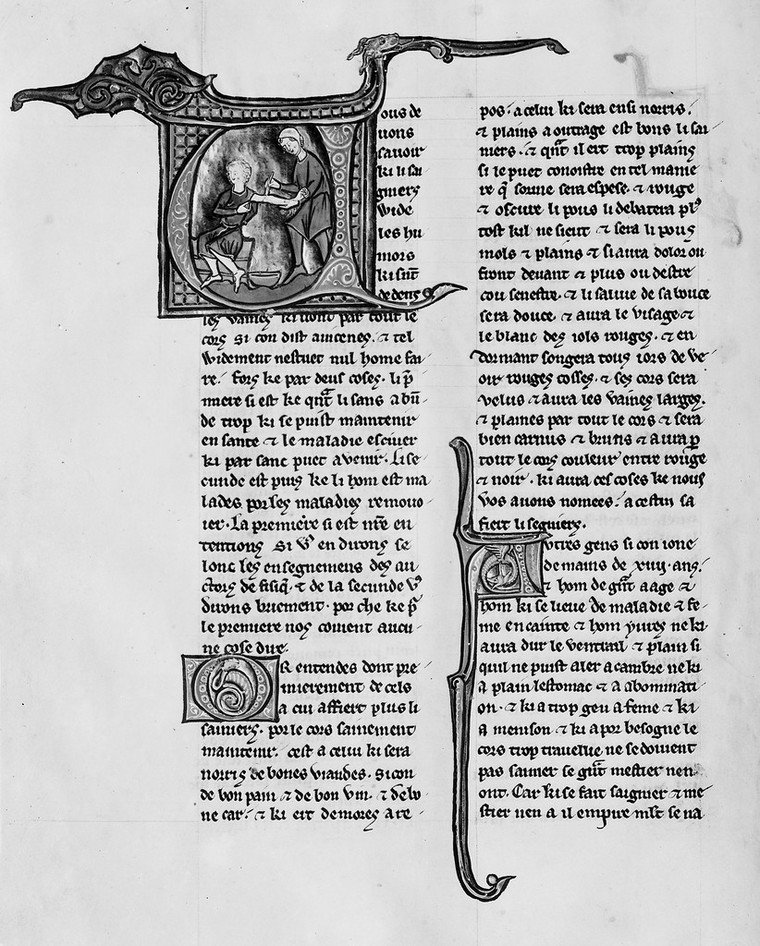
And the leeches? They have had the last laugh. The Edinburgh college reports that NHS doctors still use them today, to get blood moving again and to dissolve clots.
Barber-surgeons and that striped pole
Need a haircut, a shave and a pint of blood removed? The same man could do all three. According to the Royal College of Physicians of Edinburgh, barber-surgeons trimmed hair, removed lice and bled patients. The famous pole outside their shops stood for the rod that patients squeezed to make a vein stand out.
In London, the barbers were organised early. The Worshipful Company of Barbers traces its history back to 1308, when a man called Richard le Barbour was chosen to keep his fellow barbers in line. The company explains that monastery barbers had started picking up minor surgical skills after a 13th-century papal ban stopped the clergy from practising medicine. In 1540 an Act of Parliament merged the barbers and surgeons into a single company, an event marked by a painting by Hans Holbein that still hangs in their hall. The surgeons eventually walked out in 1745 and went on to found the body that is now the Royal College of Surgeons.
A good look at your urine
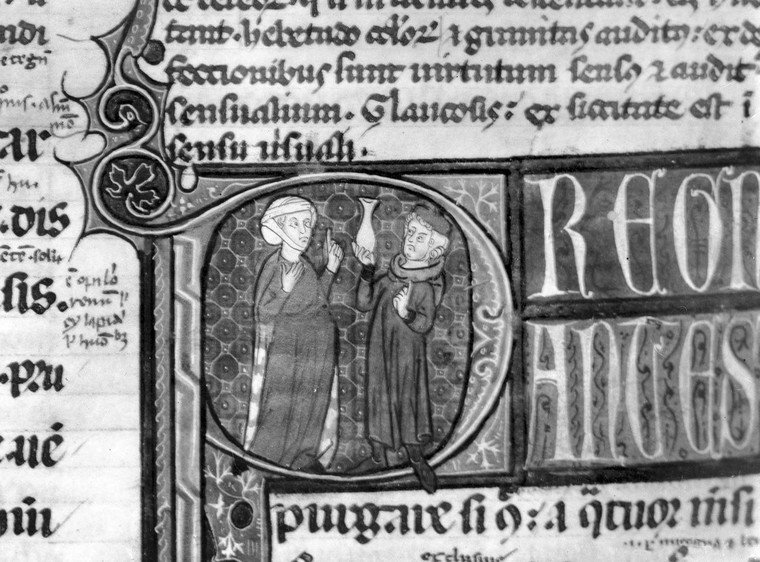
If you have ever wondered why old pictures of doctors show them peering at a glass flask, here is your answer. Uroscopy, or diagnosis by examining urine, was a key skill for any physician. Katie Birkwood of the Royal College of Physicians explains that doctors believed urine revealed the state of the four humours, so its colour, thickness, clarity and sediment all told a story.
Handy charts helped. A “urine wheel” from a Venetian edition of 1500, in a medical handbook called the Fasciculus medicinae, arranges 20 descriptions of urine around its edge and sorts the flasks into seven groups. Some of the verdicts were grim. Black urine, the book warned, meant that the body’s natural heat had gone out, which was not a diagnosis anyone wanted to hear.
Herbs, potions and a thousand-year-old surprise
Plants were the backbone of medieval medicine. The Met notes that the ancient Greek writer Dioscorides described more than 600 medicinal plants, and his work shaped herbal medicine until about 1500. Monasteries grew healing herbs in their gardens, and the sick came to the monks to get them.
Some of the recipes medieval doctors relied on sound like a dare. Theriac, an ancient antidote to poison that people later took for everything from snakebite to coughs and colds, could contain around 60 ingredients, including viper flesh, according to the pharmacy historian Briony Hudson, writing for Wellcome Collection. Venice became a major centre for making it, and its suppliers even kept “viper gardens” to breed the snakes.
But here is the twist. An eye salve from Bald’s Leechbook, an Old English medical book from the tenth century, calls for garlic, a second plant from the onion family (onion or leek), ox bile and wine, brewed in a brass vessel and left for nine days. When a team led by the University of Nottingham recreated it, the full mixture almost wiped out Staphylococcus aureus bacteria in artificial wounds. In tests on mice, it worked against MRSA, a drug-resistant superbug, as well as standard antibiotics or better. On their own, the ingredients did nothing much. Together, they packed a punch. Medieval medicine, it seems, occasionally got lucky, or knew more than we give it credit for.
Surgery: braver than you might think
Medieval surgeons worked without anaesthetic or antibiotics, but some were genuinely skilled. Take John of Arderne, born in 1307 or 1308, who practised in Nottinghamshire and London. The University of Glasgow Library, which holds a 15th-century illustrated copy of his treatises, explains that his greatest achievement was an operation for anal fistula, which the library describes as one of the deadliest procedures in medieval surgery. He believed strongly in cleanliness and avoided the harshest treatments of his day.
Arderne also had firm views on bedside manner. Surgeons should be modest and sober, agree their fee before starting and keep a few funny stories handy to cheer the patient up. Even he followed the stars, though: no cutting, he warned, while the moon passed through Libra, Scorpio or Sagittarius.
Hospitals: care before cure
Medieval hospitals were often about nursing and shelter as much as treatment. The Met notes that many monasteries had their own infirmaries, that some large ones ran hospitals such as the Hôtel-Dieu of Paris, and that Siena’s Santa Maria della Scala was known for how efficiently it was run. One London example is still going. Rahere, who had once served at the court of Henry I, founded St Bartholomew’s Hospital in 1123. Barts Health NHS Trust says no hospital in England has looked after patients on one site for longer. That is nine centuries of bedside care.
Myth alert: the plague doctor’s beak
When people picture medieval medicine, they often picture the sinister plague doctor in a long coat and a bird-like mask. There is one problem: he is not medieval. The historian Winston Black, writing for Live Science, explains that the costume first turns up in the 17th century. The earliest account comes from Charles de Lorme, a physician to the French king Louis XIII, who described an outfit he had made for an outbreak in Paris in 1619. That is roughly three centuries after the Black Death. The beak was stuffed with perfume or fragrant herbs, which were supposed to protect the wearer from disease-carrying air.
Doctors facing the great plague of the 1340s had no such costume, and, as the Met points out, no cure either. Prayer and pilgrimage were often all that was left.
So, was medieval medicine any good?
By modern standards, much of it was wrong. Bleeding a sick person rarely helped, and the four humours do not exist. But medieval medicine was not random cruelty. It was a logical system built on the best ancient learning available, practised by people who studied hard, wrote textbooks, founded hospitals and sometimes stumbled on remedies that still work. If you had to fall ill in the Middle Ages, a good monastery infirmary was not the worst place to be.
To see how doctors, barbers and healers fitted into everyday routines, explore daily life in the Middle Ages. Curious about cleanliness too? Read whether medieval hygiene deserves its bad name, or check how long people really lived in the piece on medieval life expectancy.
Frequently asked questions
Why was medieval medicine so keen on draining blood?
Because they followed the theory of the four humours. Illness was blamed on an excess of one fluid, and removing blood was thought to restore the balance.
Could a woman practise medicine in the Middle Ages?
Yes. Midwives and local healers were often women, and the medical school at Salerno allowed women to study. The influential Trotula texts on women’s health were produced there in the 1100s.
Did any of these old remedies really work?
Some did. Modern tests on an eye salve from the tenth-century Bald’s Leechbook showed that it could kill Staphylococcus aureus bacteria, including the superbug MRSA, in lab tests and in mice. Leeches are also still used in hospitals today.
What do the stripes on a barber’s pole mean?
The pole recalls the rod that patients gripped during bloodletting, when barbers also acted as surgeons. After 1540, English barbers had to stripe their poles blue and white, while surgeons kept red and white.
Is the beaked plague mask from the Black Death?
No. It first appears in the 17th century, linked to the French physician Charles de Lorme and an outbreak in Paris in 1619, about three hundred years after the Black Death.
Sources
- Sigrid Goldiner, The Metropolitan Museum of Art, Medicine in the Middle Ages (2012)
- Royal College of Physicians of Edinburgh, Bloodletting
- Katie Birkwood, Royal College of Physicians, The urine wheel (2013)
- The Worshipful Company of Barbers, History of the Company
- University of Nottingham, School of Life Sciences, AncientBiotics – a medieval remedy for modern day superbugs (2015)
- Briony Hudson, Wellcome Collection, Theriac: an ancient brand? (2017)
- University of Glasgow Library, Fifteenth Century Manuscript of John of Arderne Medical treatises (Book of the Month, May 2006)
- Barts Health NHS Trust, St Bartholomew’s Hospital: Our history
- Monica H. Green, via Medievalists.net, The Development of the Trotula (2013)
- Online Etymology Dictionary, Leech
- Winston Black, Live Science, Plague doctors: Separating medical myths from facts (2020)