
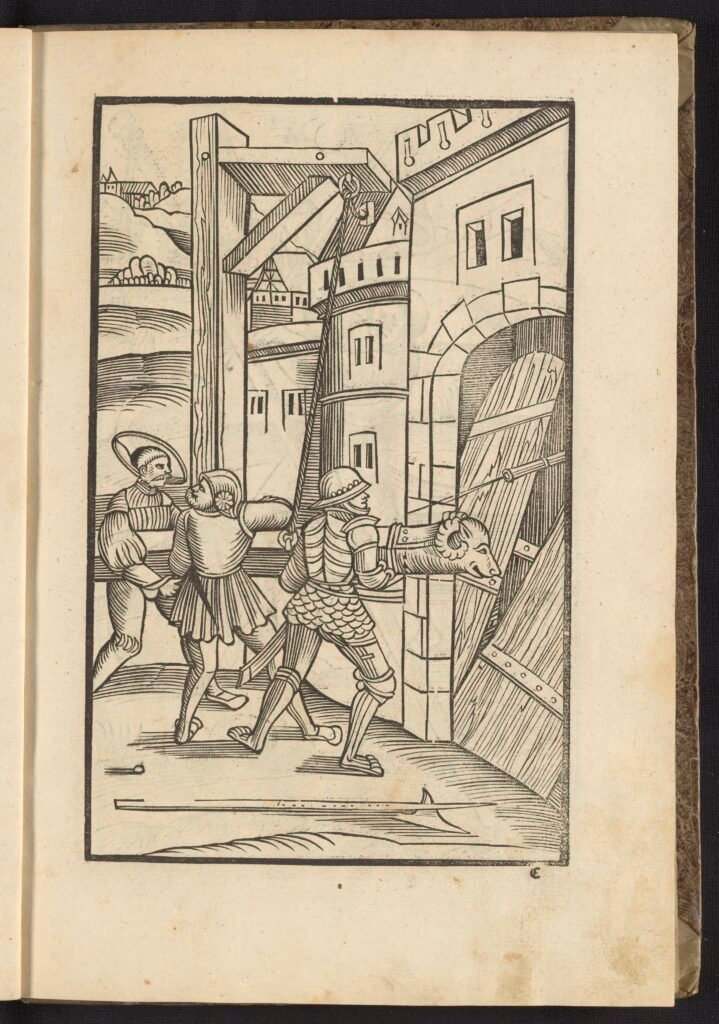
The Battering Ram: The Oldest Siege Weapon Still Used in the Middle Ages
Some weapons need years of engineering. Others need a tree, a few dozen strong arms and a door you would like to see on the floor. The medieval battering ram belongs firmly in the second group. It was the bluntest tool in the siege kit, in every sense, and it had already been knocking on enemy gates for some three thousand years before the first castle was built. So how did it work, why did it last so long, and what did defenders do when they heard that dreadful thud? Grab a helmet. It gets noisy.
Jump to a section:
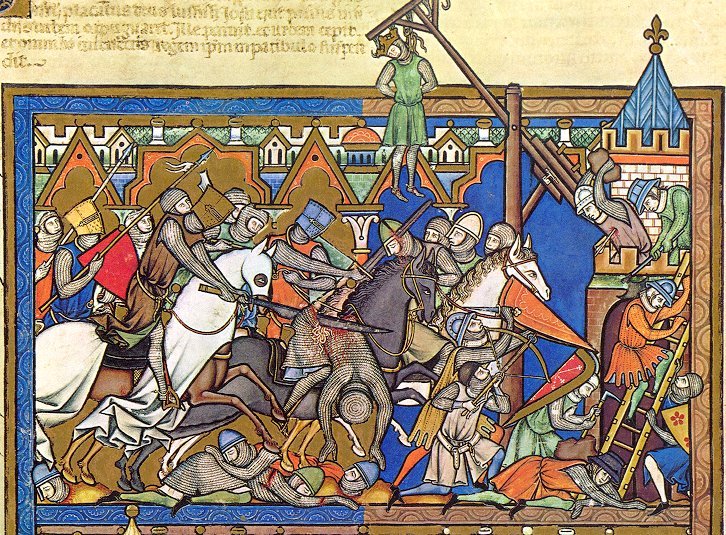
What was a medieval battering ram?
At its simplest, it was a big heavy log. Encyclopaedia Britannica describes it as a hefty beam, “typically with a metal knob or point at the front”, that armies used to break through the walls and gates of towns and castles under siege. World History Encyclopedia’s Mark Cartwright adds that the basic design barely moved on from ancient times: one large trunk, one end protected by a sharpened metal cap.
There were several ways to put it to work. According to Cartwright, soldiers might simply lift the ram and run at the target, roll it forward on wheels, or hang it from a frame. To keep missiles off the crew, it could be housed under a roof of wood and iron. Britannica explains that the beam was usually slung on ropes beneath the shed’s roof, and that hides were stretched over the top to shield the men underneath from falling stones and fire.
PBS’s NOVA programme describes the finished machine nicely. Carpenters narrowed the front of the trunk to a dull tip, gave it an iron cap and hung it on chains inside the shed. Because the whole thing crept so slowly towards the wall, and because the iron head kept poking out of its shell and back again with every swing, it earned the nickname “tortoise”. A very angry tortoise with an iron nose.
Older than castles: where the ram came from
The medieval battering ram had a very long family tree. The historian Sean Manning points out that rams already appear in Egyptian and Mesopotamian pictures from the third millennium BC, which is roughly 4,500 years ago. The Mesopotamians had some wonderful names for it, including the “one-horned ox” and the “wooden donkey”.
One of the most famous early pictures comes from the Assyrian empire. In 701 BC, King Sennacherib’s army besieged the city of Lachish in the kingdom of Judah, and he had the whole campaign carved in stone on the walls of his palace at Nineveh. Tyndale House in Cambridge describes how the carvings, now in the British Museum, show Assyrian rams pushed up earth ramps to the walls, while the defenders hurl down rocks and blazing torches. The Assyrians even had a device for pouring water over their rams so they would not catch fire. Firefighting, 2,700 years ago.
The Greeks were latecomers. Manning notes that the historian Diodorus credited the Athenian leader Pericles with building siege machines, including rams, at the siege of Samos around 440 BC, and even hailed him as their inventor. That was flattering to Pericles and quite unfair to the Assyrians. According to William Smith’s 19th-century dictionary of classical antiquities, the Greek name for the weapon was krios, meaning “ram”, because its head of bronze or iron was shaped like a ram’s head. Some beams were said to be 80, 100 or even 120 feet long, and a hundred men or more might work a single one.
The Romans took the idea and ran with it. The Jewish historian Josephus was inside the town of Jotapata when the Romans besieged it in AD 67, and he saw their ram at close quarters. He described it as a vast beam like a ship’s mast, with an iron head carved to look like a ram’s head, “whence its name is taken”. It hung from ropes and was hauled back and slammed forward by a large crowd of men. So when medieval engineers built their own rams, they were following a recipe that was already ancient.
How a medieval battering ram worked
The idea was brutally simple. Bring the ram up to a gate or a weak stretch of wall, then keep pounding one patch of it until something gave. Gates were the favourite target. Cartwright observes that a castle gate was a tempting place for attackers to try burning their way in, or bashing it down with a ram.
The problem was getting there. The crew had to stand right up against the masonry, well within reach of every rock, arrow and pot of something nasty the garrison could find. That is why the shed, the animal hides and the slow, careful approach mattered so much. A medieval battering ram without its roof was basically a log with a lot of very nervous people attached.
Rams also had a quieter cousin. Cartwright points out that giant bores, spun round with ropes, could do even more damage to a wall than a ram could. Instead of bashing the stone, the attackers slowly drilled into it.
How defenders fought back
Defenders had plenty of tricks, and some of them were surprisingly clever.
- Fire. According to NOVA, defenders shot flaming arrows at the shed to burn it down. The attackers’ answer was to drape it in hides or pile soil on top.
- Cushions. NOVA also describes defenders lowering mattresses over the wall to soften the blows. Josephus tells a similar story from Jotapata, where the defenders hung sacks filled with chaff in front of the spot the ram kept hitting. The Romans answered with long poles fitted with hooks to cut the sacks away.
- Grabbing the ram. Cartwright explains that defenders dangled chains, ropes and hooks to catch the ram and overturn it, while NOVA mentions grappling irons used to seize the trunk and stop it swinging.
- Dropping something heavy. The simplest answer of all. At Jotapata, Josephus says, a defender named Eleazar hurled a huge stone down onto the Roman ram and snapped its head clean off.
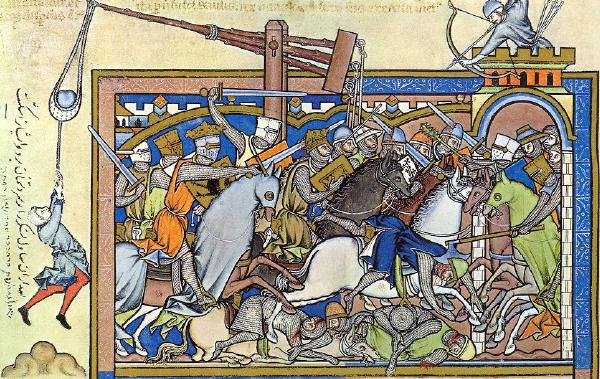
Rams in real medieval sieges
Jerusalem, 1099. When the armies of the First Crusade besieged Jerusalem, they needed timber and rope. According to Cartwright’s account of the siege, ships from Genoa and England put in at the port of Jaffa with supplies, and the crusaders turned that material into towers, stone-throwers, ladders and a ram. The medieval battering ram was just one piece of a much larger plan to get into the city.
Dunbar, 1338. This is the most entertaining ram story of the Middle Ages. During the wars between England and Scotland, the Earl of Salisbury besieged Dunbar Castle, which was defended by Agnes Randolph, better known as Black Agnes. According to Historic UK, Salisbury’s secret weapon was a huge battering ram with a wooden roof, known as a “sow”. Agnes had large boulders dropped from the walls, which smashed through the roof and sent the surviving crew running. In a well-loved later retelling, she shouts after them: “Behold the litter of English pigs.” The English gave up on 10 June 1338, after about five months of trying.
Why the medieval battering ram mattered
The medieval battering ram was never glamorous, but it was cheap, simple and frighteningly effective against a gate. It survived for thousands of years because the problem it solved never changed: someone had shut a door, and someone else wanted it open. In the end, as Cartwright notes, it was the huge cannon batteries of the 15th century that brought the age of the static siege, rams included, to a close.
To see how rams fitted into the bigger picture of ladders, mines, starvation and stone-throwers, explore medieval siege warfare. Curious about going over the wall instead of through it? Read about the medieval siege tower, or learn how a trebuchet worked.
Frequently asked questions
Where does the “ram” in battering ram come from?
From the animal. The iron or bronze head on the end of the beam was often shaped like a ram’s head. The Greeks called the weapon krios and the Romans aries, and both words mean “ram”.
How much muscle did a ram need?
That came down to its size. A small medieval battering ram could be lifted and swung by a handful of soldiers, while ancient writers say the biggest beams kept a hundred men or more busy.
How did the crew survive right under the enemy walls?
By working inside a covered shed, often roofed with wood and iron and draped in animal hides or earth to stop stones and fire getting through.
Why did the English call their ram at Dunbar a “sow”?
“Sow” was a nickname for some covered siege engines. At Dunbar in 1338, the English sow was a huge ram under a wooden roof, and the defenders crushed it with boulders, which is where the joke about the litter of pigs comes in.
Sources
- Encyclopaedia Britannica, Battering ram
- Mark Cartwright, World History Encyclopedia, Siege Warfare in Medieval Europe (2018)
- Mark Cartwright, World History Encyclopedia, The Capture of Jerusalem, 1099 CE (2018)
- PBS NOVA, Battering Ram
- Tyndale House, Cambridge, The Lachish Reliefs
- Sean Manning, Book and Sword, How the Greeks Got Battering Rams (2020)
- William Smith (ed.), A Dictionary of Greek and Roman Antiquities (1875), Aries
- Flavius Josephus, The Jewish War, book 3, translated by William Whiston, 3.132–3.339
- Historic UK, Black Agnes
- History… the Interesting Bits, Black Agnes (2025)