
Charlemagne: The Emperor Who Rebuilt Europe
He conquered half of western Europe, was crowned emperor by a pope on Christmas Day, reformed the coinage, filled his court with scholars and helped give us the lowercase letters you’re reading right now. He also spent thirty years waging a brutal war on the Saxons, had four or five wives and, by his biographer’s account, never quite learned to write. Charlemagne, “Charles the Great”, has long been hailed as the father of Europe. Here’s the story of the man behind the legend, and why both France and Germany still claim him as their own.
Jump to a section:
Who was Charlemagne?
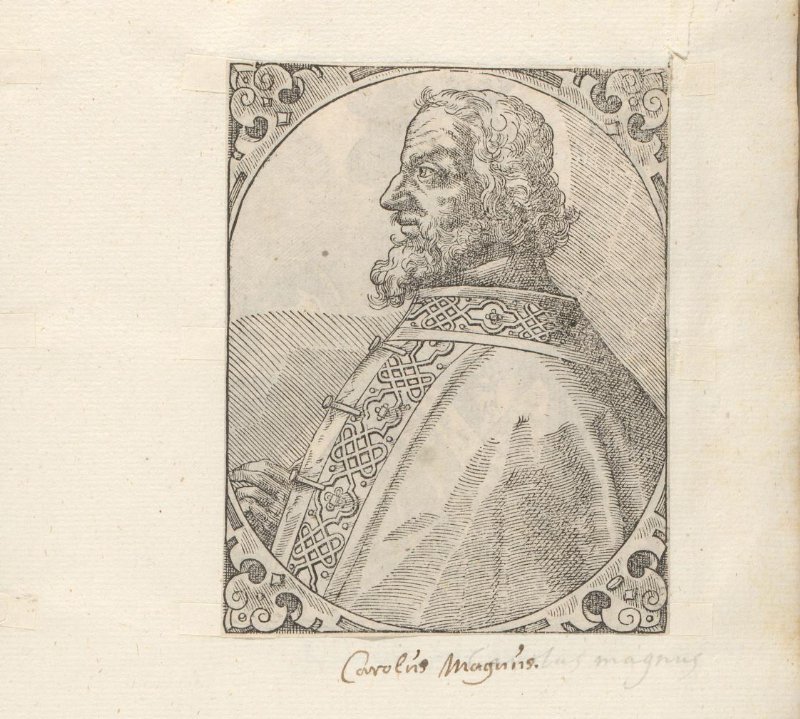
Charlemagne was born around 747 or 748, the eldest son of Pepin the Short, the first king of the Carolingian dynasty, and his wife Bertrada. His family had risen from powerful officials to kings: in 751, Pepin pushed aside the last of the old Merovingian rulers of the Franks and took the crown for himself, a move later backed by the papacy.
When Pepin died in 768, his kingdom was split between Charles and his younger brother Carloman. The two didn’t get on, and civil war looked possible, but in 771 Carloman died suddenly. Charles took over his lands and became sole king of the Franks. He was in his early twenties, and he would rule alone for the next 43 years.
A lifetime of war
The new king campaigned almost every year of his reign. In 773–774 he invaded Italy at the pope’s request, besieged the Lombard capital of Pavia and made himself king of the Lombards. In the east he crushed the Avars, a nomadic people based in what is now Hungary, and in the 790s his armies carried off their legendary treasure in wagonloads.
His longest and bloodiest war was against the Saxons, the pagan peoples of what is now northern Germany. It began in 772, when he destroyed one of their sacred sites, the Irminsul, and dragged on, with revolts and reconquests, until 804. In 782, after a Frankish defeat, the Frankish royal annals record that 4,500 Saxons were executed at Verden; a revised version says they were beheaded in a single day. His laws for Saxony made refusing baptism a capital crime. Conversion to Christianity was part of conquest, and the Church’s role in his empire, covered in the medieval Church, was never separate from his power.
Roncevaux and the Song of Roland
Not every campaign went to plan. In 778 he crossed the Pyrenees into Spain, but the expedition achieved little, and on the way back, on 15 August, his rearguard was ambushed in the pass of Roncevaux by Basques. Among the dead was a commander named Roland. Three centuries later, that minor defeat had become the Song of Roland, a great epic poem in which the Basque raiders have turned into a huge Muslim army and Roland dies a hero’s death blowing his horn. It’s a fine example of how legends grow, a theme we explore in medieval myths.
Christmas Day, 800: Charlemagne becomes emperor
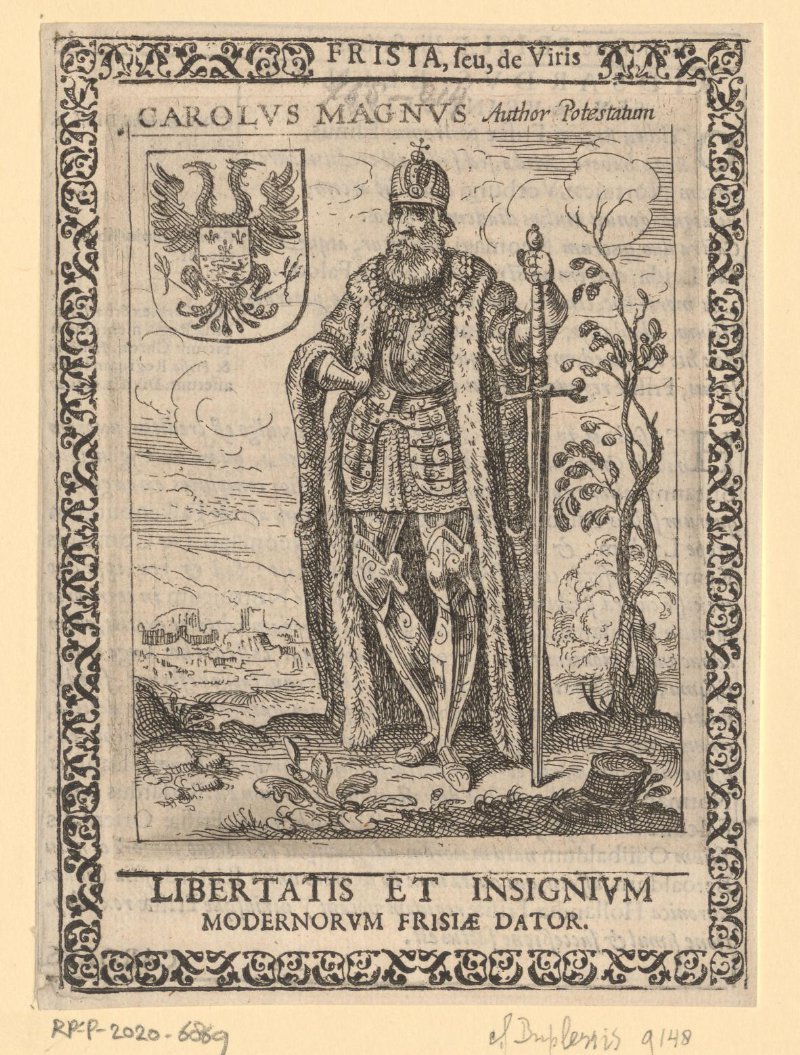
In 799, Pope Leo III was attacked in the streets of Rome by his enemies and fled to the Frankish king for help. The following year, the king came to Rome to settle the case and shore up Leo’s position. On Christmas Day 800, as Charles prayed in St Peter’s Basilica, the pope placed a crown on his head and the crowd hailed him as emperor of the Romans. There had been no emperor in the west for more than three centuries. How kings were crowned and anointed in this era is the subject of medieval coronations.
His biographer Einhard claims that Charles was annoyed and would not have entered the church that day if he had known what the pope planned. Many historians suspect that’s modesty for show. The Byzantine emperors in Constantinople, who saw themselves as the only true Roman emperors, were not pleased either. At the time their throne was held by a woman, Irene, which some in the west argued meant it was effectively empty. Byzantium only recognised his imperial title, grudgingly, in 812.
What was Charlemagne like?
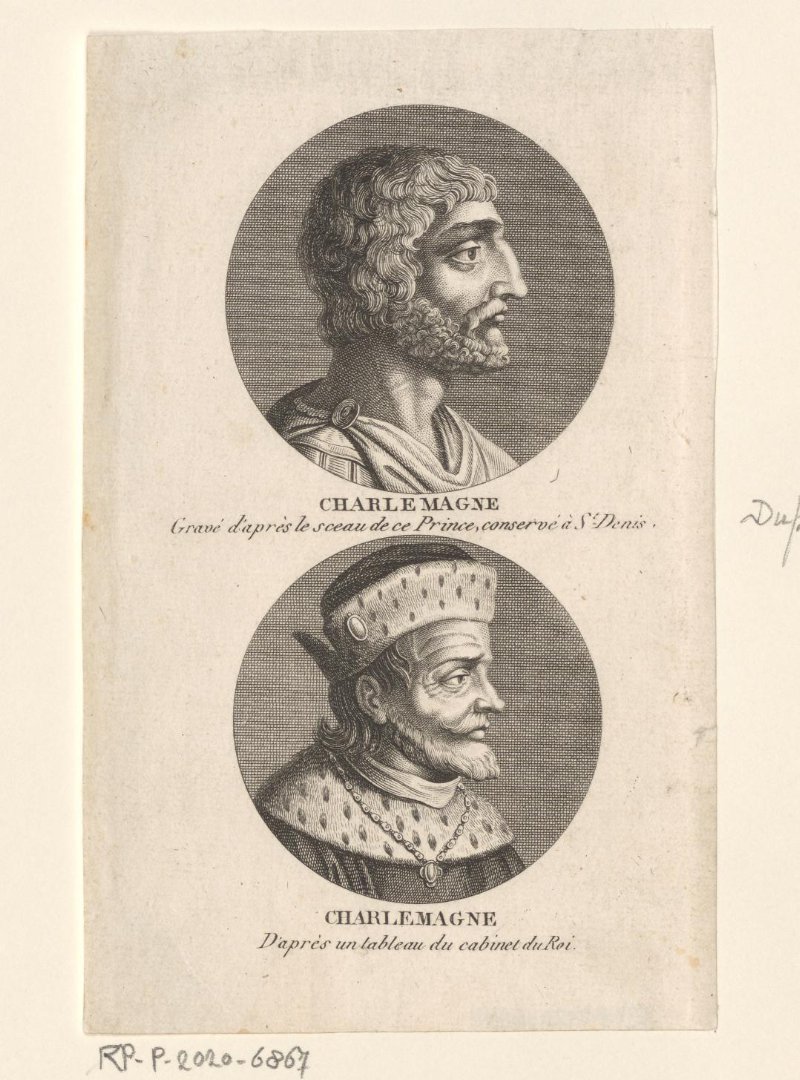
Einhard, who knew him well, gives a vivid portrait. He was tall, about seven times the length of his own foot. A scientific study of his surviving leg bone, published in 2010, put his height at about 1.84 metres, or just over six feet, when the average man stood around 1.69 metres. He had a thick neck, a voice thinner and higher than you’d expect from a man his size, and a big appetite, especially for roast game, which his huntsmen brought to the table on the spit. He loved hunting and swimming, and he built his favourite palace at Aachen partly because of its hot springs.
He spoke Latin as well as his native Frankish and could understand Greek. Writing was another matter. Einhard says he kept wax tablets under his pillow to practise forming letters in bed, but he had started too late in life and never had much success.
His private life was complicated. He had four or five wives in succession, several concubines and at least eighteen children. He was famously reluctant to let his daughters marry, and kept them at court, where they had relationships and children of their own anyway.
Schools, books and your lowercase letters
For a ruler who struggled to write, he cared a great deal about learning. He invited scholars from all over Europe to his court, most famously Alcuin of York, and in 789 he ordered that schools be set up at monasteries and cathedrals to teach boys to read, chant and count. Some cathedral schools later grew into universities, as happened in Paris. Monks copied ancient texts on a massive scale, and many works of classical Latin literature survive only because they were copied in Carolingian monasteries. The whole revival is known today as the Carolingian Renaissance.
The scribes also developed a clear, rounded new script, now called Carolingian minuscule. Centuries later, Renaissance humanists revived it, printers turned it into type, and it became the model for the lowercase letters we still use. For how this changes the old picture of the period, see were the Dark Ages really dark?
Pounds, shillings and pence
Charles also reformed money. He standardised a silver penny, the denarius, and the accounting system that went with it: 12 pennies to a shilling (solidus) and 20 shillings to a pound (libra), so 240 pennies to the pound. The system spread across Europe and lasted in Britain until decimalisation in 1971. That’s why old British prices were written with “£ s d”: librae, solidi, denarii.
To govern his vast lands he relied on local counts, bishops and abbots, and sent out pairs of royal agents, the missi dominici, to check on them and announce his decrees. It was personal rule, held together by oaths and loyalty, and it foreshadowed the ties between lords and vassals described in what was feudalism.
He even had an elephant. The Abbasid caliph Harun al-Rashid, famous from the Thousand and One Nights, sent him one named Abul-Abbas, which arrived in 802 and became the star of the court until it died in 810. Most Europeans knew elephants only from books like the medieval bestiary, which claimed they had no knee joints.
Death and legacy
Charles died at Aachen on 28 January 814, probably of pleurisy, and was buried in his palace chapel there. He was in his mid-sixties, an age that was less unusual than people think for an adult who survived childhood, as the real story of medieval life expectancy shows. He had already crowned his only surviving legitimate son, Louis the Pious, as co-emperor. The empire didn’t hold together for long: in 843 Louis’s three sons divided it in the Treaty of Verdun, and the western and eastern parts eventually grew into France and Germany.
Both nations claimed him as a founding father, and the legends kept coming. In the year 1000, Emperor Otto III opened his tomb, and a later chronicle claimed he found the dead emperor sitting upright on a throne, crowned. In 1165, the emperor Frederick Barbarossa even had him declared a saint by an antipope, a status the Church in Rome never formally confirmed. Today the city of Aachen awards the International Charlemagne Prize for work on European unity. He set a pattern that rulers would try to copy for centuries, as you can read in medieval kings.
Hero or tyrant? My verdict
Whether he was a hero or a tyrant is, I think, a matter of perspective. On one side, he had 4,500 Saxons executed at Verden and forced baptism on a whole people. On the other, he took learning very seriously: he built schools and helped save a huge number of ancient texts. And as a bonus, we can thank him for our lowercase letters. Some would say he was a tyrant because he killed so many people, but name me a ruler who waged wars without anyone dying. Many rulers of his time left behind little more than battles; he left books and schools too. So I think he was a hero, because later generations made good use of those ancient texts. In a small way, so did I: without the knowledge preserved in his time, I would have a lot less to write about on this website. So, for me, hero it is!
Frequently asked questions
Why is Charlemagne called “the Great”?
“Charlemagne” comes from the Latin Carolus Magnus, “Charles the Great”. The name reflects his huge conquests and his reputation as the restorer of the empire in the west.
Was Charlemagne French or German?
Neither, strictly. He was a Frank, and France and Germany didn’t yet exist. Both countries grew out of his divided empire, so both claim him.
Could Charlemagne read and write?
He could probably read, at least to some degree, but his biographer Einhard says he tried to learn to write late in life and never managed it well.
When did Charlemagne become emperor?
On Christmas Day 800, when Pope Leo III crowned him in St Peter’s Basilica in Rome.
Sources
- Wikipedia, Charlemagne
- Einhard, The Life of Charlemagne, Internet Medieval Sourcebook, Fordham University
- Wikipedia, Carolingian Renaissance
- Wikipedia, Abul-Abbas
- Encyclopaedia Britannica, Charlemagne