
How Heavy Was a Medieval Sword?
Think of a sword fight in a film. The hero lifts a huge blade with both hands, swings it slowly over his head and brings it down like an axe, and when he misses, the sword sinks into the ground and he has to pull it out with all his strength. Many people still imagine that a medieval sword weighed as much as a small child and that only the strongest men could use one. But museums hold hundreds of real swords from the Middle Ages, and they have weighed them. So how heavy was a medieval sword really? The answer is much lighter than most people expect.
Jump to a section:
How heavy was a medieval sword?
According to Dirk H. Breiding of the Metropolitan Museum of Art, a single-handed sword of the Middle Ages and Renaissance weighed on average 2 to 4 pounds, which is about 0.9 to 1.8 kilograms. The swords in the museum’s own collection prove it. A typical knightly sword from about 1450, said to have been found in the Vendée river in France, weighs 1,134 grams. An older sword from the 13th or 14th century, from around the time of the last Crusades and now on loan to the Met, weighs only 956 grams. That is less than a one-litre bottle of water.
The fencing researcher John Clements came to the same conclusion. He quotes the sword expert Ewart Oakeshott, who wrote that the average weight of a normal medieval sword was between 2.5 and 3.5 pounds, about 1.1 to 1.6 kilograms. Clements also notes that in the Wallace Collection in London it is difficult to find any sword weighing more than 4 pounds, or 1.8 kilograms.
Longswords and hand-and-a-half swords
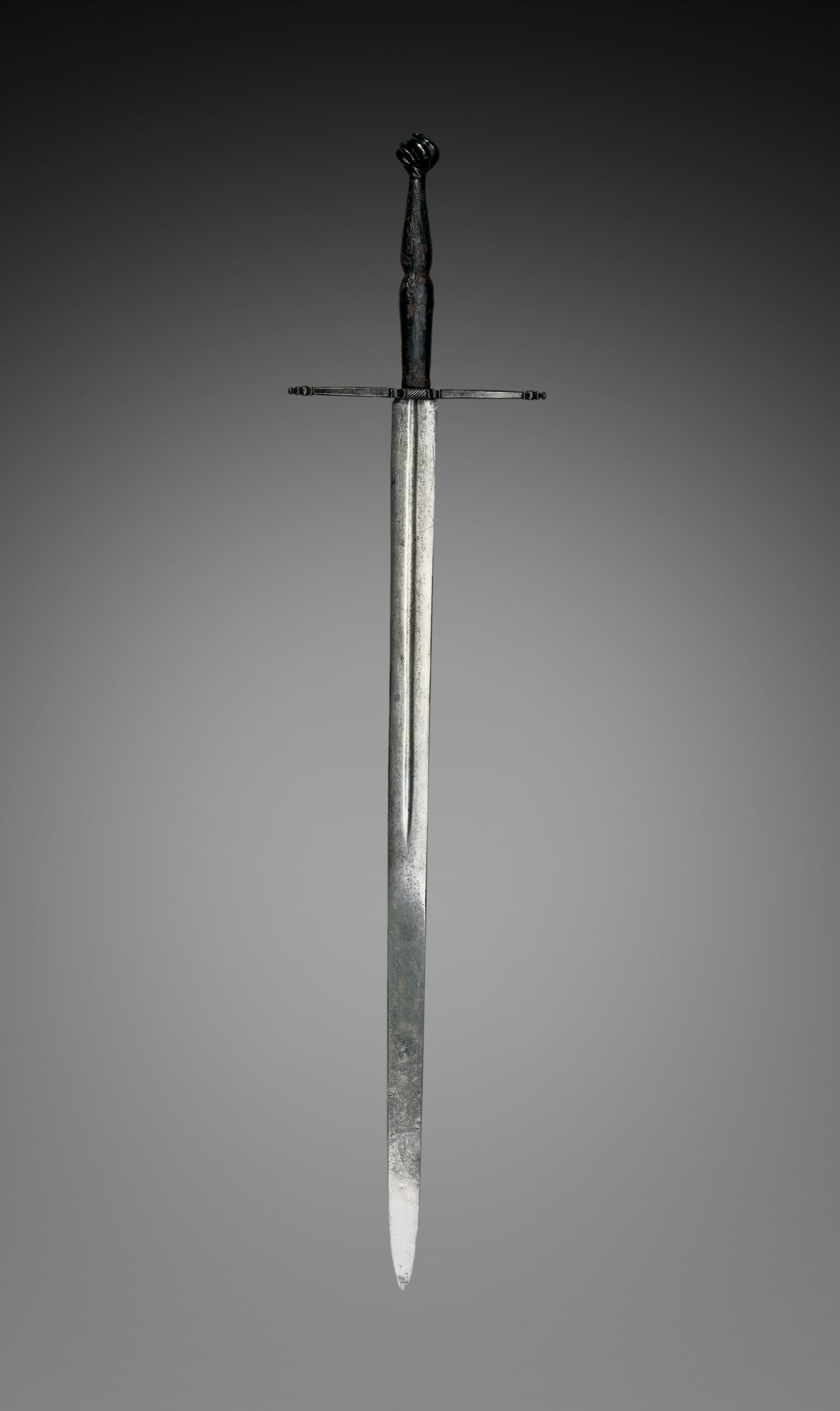
Longer swords were a little heavier, but not by much. In the late Middle Ages, many knights used a sword with a longer grip that could be held with one hand or two, which is why it was called a hand-and-a-half sword. The Cleveland Museum of Art has one from South Germany, made around 1500. It is 117.5 centimetres long and weighs 1.34 kilograms. The Met has another one from about 1400–1430, the years of the Battle of Agincourt, probably German, which is almost 125 centimetres long and weighs 1,560 grams. Its sharp point was made for thrusting into the gaps of an enemy’s armour.

What about the giant two-handed swords?
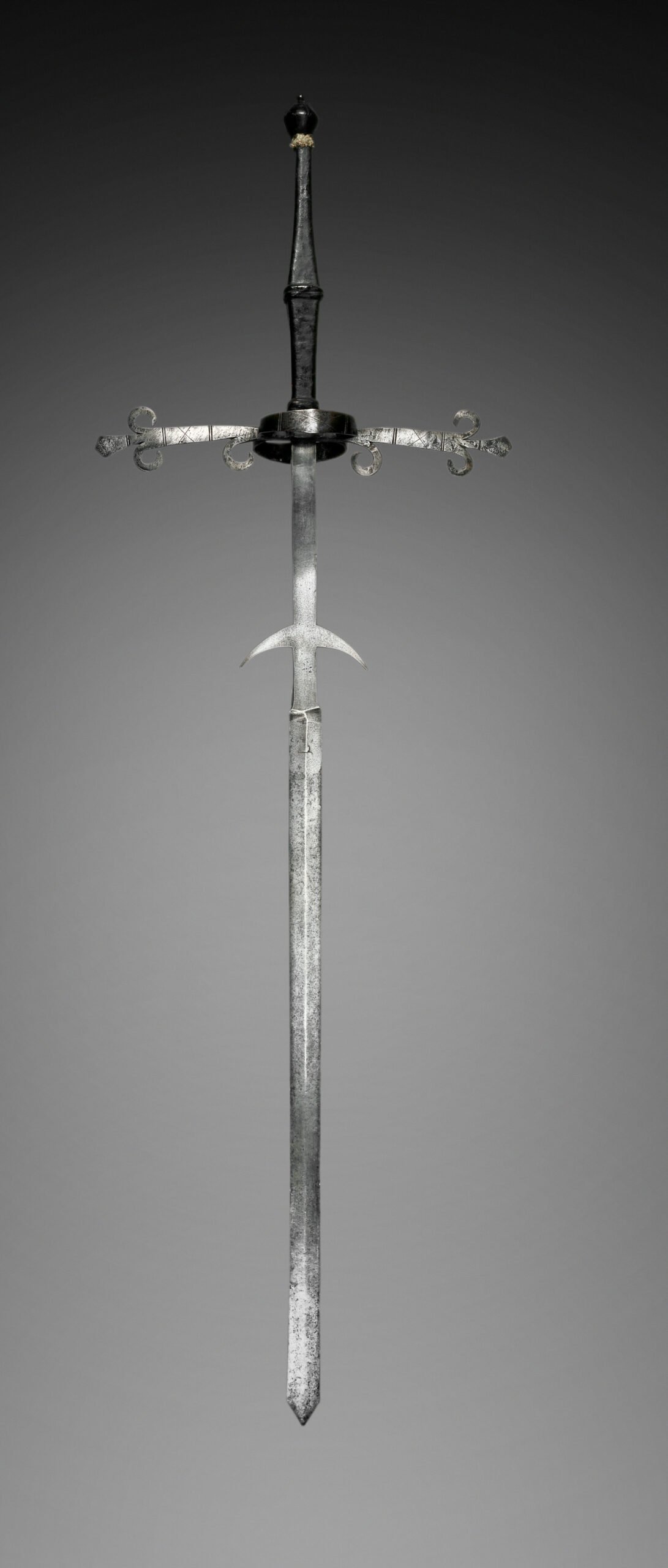
The biggest swords are the ones that really fuel the myth. Most of the huge two-handed swords that survive date from the 16th century, right after the Middle Ages. According to the Metropolitan Museum of Art, even these large swords rarely weighed more than 10 pounds, about 4.5 kilograms. The Cleveland Museum of Art has a German two-handed sword from 1550–1600 that is 170.5 centimetres long, taller than many people, but weighs 3.28 kilograms. The museum explains that it began as a weapon of war for specialist foot soldiers, and only later became a ceremonial or bodyguard weapon.
The really heavy swords were never used in battle
Some swords were truly heavy, but they were not made for fighting. Kings, princes and cities had ceremonial swords that were carried in front of them in processions to show their power. The Met owns a processional sword carried by the guard of Duke Julius of Brunswick, dated 1573, which is almost two metres long and weighs 4,653 grams. The Worcester Art Museum has an even bigger bearing sword, 213.7 centimetres long and weighing 14 pounds 11 ounces, about 6.7 kilograms. The museum says it was simply too big to be useful in battle.
Why a medieval sword felt even lighter
Weight is only half the story. A good medieval sword was carefully balanced. The heavy pommel at the end of the hilt worked as a counterweight to the blade, so the sword’s point of balance sat close to the hand. The Met describes exactly this on its sword from about 1450: the large pommel counterbalanced the double-edged blade. This made the sword quick and easy to control. A sword that is badly balanced, with all its weight towards the tip, feels much heavier in the hand than it really is.
Where did the myth of heavy swords come from?
According to Breiding, the idea that medieval swords were heavy, crude weapons that a normal man could barely lift is simply wrong. He explains that very few people have ever held a genuine medieval sword, and many of the swords that survive were dug out of the ground or rivers, badly rusted and broken. Seeing such a lump of corroded iron, it is easy to imagine a clumsy weapon. Clements also quotes a History Channel commentator who claimed that 14th-century swords weighed 40 pounds, about 18 kilograms, which no real fighting sword in any museum comes close to. Like the story of defenders pouring boiling oil on attackers, it is one of those medieval myths that films keep alive.
A sword compared with armour
Compared with the rest of a knight’s equipment, a medieval sword was light. The Metropolitan Museum of Art says that a full suit of armour made for battle usually weighed 20 to 25 kilograms, so the sword was only a small part of what a knight carried. Knights also trained with their weapons from childhood, so for them a sword of one or one and a half kilograms was a familiar tool, not a heavy burden.
Could I have fought with a medieval sword?
Lifting it would not be the problem. A sword of just over a kilogram weighs about the same as a bag of sugar, and almost anyone can pick one up. The hard part would be using it for a whole battle, in armour, against someone who had trained since he was a boy. I think I would last about ten seconds. Still, I would love to hold a real one in a museum just once, to feel how light it is.
So, how heavy was a medieval sword?
Much lighter than in films. Most one-handed swords weighed around 1 to 1.5 kilograms, longswords and hand-and-a-half swords about 1.3 to 1.8 kilograms, and even the giant two-handed swords of the 16th century rarely went above 4.5 kilograms. Only ceremonial swords, which were never meant for battle, were heavier. A medieval sword was a fast, balanced weapon, not a heavy club.
Frequently asked questions
How much did a knight’s sword weigh?
Usually about 1 to 1.5 kilograms (2 to 3.5 pounds). A typical knightly sword from about 1450 in the Metropolitan Museum of Art weighs 1,134 grams.
How heavy was a two-handed sword?
Often around 3 kilograms. According to the Met, even large two-handed swords rarely weighed more than 10 pounds (about 4.5 kilograms). One in the Cleveland Museum of Art, 170.5 centimetres long, weighs 3.28 kilograms.
How long was a medieval sword?
A one-handed sword was usually about 85 centimetres to 1 metre long. Hand-and-a-half swords reached about 1.2 metres, and two-handed swords of the 16th century could be 1.7 metres or more.
Why do people think medieval swords were heavy?
Because of films, games and the fact that most people have never held a real one. Many surviving swords are rusty finds from rivers and the ground, which makes them look crude and heavy.
What was the heaviest medieval sword?
The heaviest were ceremonial bearing and processional swords. One in the Worcester Art Museum weighs about 6.7 kilograms, but it was too big to be used in battle.
Sources
- The Metropolitan Museum of Art, Dirk H. Breiding, Arms and Armor: Common Misconceptions and Frequently Asked Questions
- The Metropolitan Museum of Art, Sword, ca. 1450 (14.25.1096)
- The Metropolitan Museum of Art, Hand-and-a-Half Sword, ca. 1400–1430 (2006.564)
- The Metropolitan Museum of Art, Medieval Sword, ca. 13th–14th century (L.2018.48.11)
- The Metropolitan Museum of Art, Two-Handed Processional Sword of Duke Julius of Brunswick, 1573 (04.3.60)
- Cleveland Museum of Art, Hand-and-a-Half Sword, c. 1500
- Cleveland Museum of Art, Two-Handed Sword, 1550–1600
- Worcester Art Museum, Bearing Sword
- John Clements, ARMA, What Did Historical Swords Weigh?