
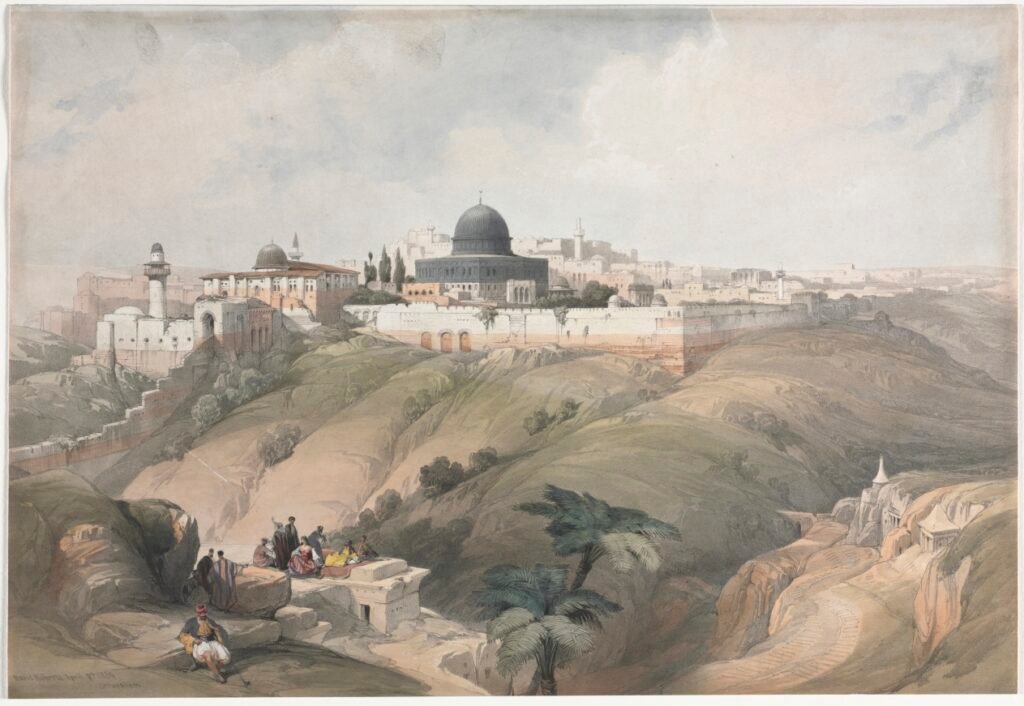
The Siege of Jerusalem, 1099: The End of the First Crusade
In the summer of 1099, a battered, half-starved army that had walked most of the way from western Europe finally reached the walls of Jerusalem. Three years earlier, tens of thousands had set out. Many never got there. The survivors had no proper siege equipment, almost no water and an enemy behind some of the strongest walls in the Mediterranean. Less than six weeks later the city was theirs. The siege of Jerusalem in 1099 was the climax of the First Crusade: a story of thirst, timber, visions, a tower moved in the dark and a massacre that is still remembered nine centuries on.
Jump to a section:

How the crusaders got to Jerusalem
The journey began with a speech. In November 1095, Pope Urban II addressed a church council at Clermont, in France, and called on western Christians to help the Byzantine Empire against the Seljuk Turks and to free Jerusalem. The response was enormous. Armies led by great lords set off in 1096, crossed into Asia Minor and spent the next two years fighting their way south, including a gruelling siege of Antioch that lasted the best part of eight months. For everything that came before and after, read the Crusades explained.
By the time the crusaders reached Jerusalem on 7 June 1099, their numbers had shrunk dramatically. Modern historians usually estimate something like 1,200 to 1,300 knights and about 12,000 foot soldiers, plus pilgrims and other non-combatants. That was a small force for the job. Jerusalem had changed hands shortly before: the Fatimid rulers of Egypt had seized it from the Artuqids in 1098, Turkish lords loyal to the Seljuks, and their governor, Iftikhar al-Dawla, had prepared well. He had expelled many of the city’s Christians, gathered supplies and, crucially, made sure the wells outside the walls were blocked or poisoned.
The first attack: not enough ladders
The crusaders were impatient. A hermit on the Mount of Olives told them that God would give them the city if they attacked at once, so on 13 June they tried. They managed to break through the outer wall, but, according to one chronicler, they had only a single scaling ladder long enough to reach the top of the inner one. A few brave men climbed up, and they were quickly cut down. The assault failed. Siege warfare, it turns out, needs equipment as well as faith. For how attackers normally went about breaking into a fortress, see medieval siege warfare.
Thirst, heat and a lucky delivery of timber
Now came the hardest stretch of the siege of Jerusalem. It was midsummer in Judea. The nearest spring, the Pool of Siloam below Mount Zion, flowed only now and then and was exposed to the defenders, so water had to be fetched from miles away, often in leaking animal skins. Horses and pack animals died. Men fought over muddy water. Medieval chroniclers, who were there or spoke to people who were, describe the thirst as worse than the fighting.
The other problem was wood. The hills around Jerusalem had few big trees, and without timber there could be no siege engines. Then, on 17 June, Genoese ships arrived in Jaffa’s harbour (some sources mention English ships too). The crusaders stripped them for timber and carried the wood inland. Expeditions travelled further afield to fell trees. By early July, carpenters were building catapults, ladders and two great wooden towers.
A barefoot procession round the walls
Morale was low and the leaders were squabbling. Then a priest called Peter Desiderius reported a vision. Adhemar, the bishop who had been the crusade’s spiritual leader and had died the year before, had appeared to him. He told the army to fast and to walk barefoot round the walls of Jerusalem, as Joshua’s Israelites had marched round Jericho. On 8 July, that’s exactly what the whole army did, praying and singing while the defenders jeered from the battlements. The walls did not fall down. But the procession pulled the army together, and that mattered.

The towers go in
The crusaders built two main siege towers for the siege of Jerusalem. One belonged to Raymond of Toulouse and faced the south of the city near Mount Zion. The other was the work of Godfrey of Bouillon on the northern side. These towers were tall enough to overtop the walls, with a platform or bridge that could be dropped onto the battlements, and their sides were protected with hides against fire. How these monsters worked is explained in our feature on the medieval siege tower.
Godfrey then pulled off one of the cleverest tricks of the siege. The defenders had seen where his tower was standing and had strengthened that section of wall. So shortly before the assault, his men took the tower apart, carried the pieces to a weaker stretch of the northern wall further east, and put it back together overnight. When dawn broke, the defenders found the tower in a place they hadn’t prepared for.
The attack began on 14 July. The defenders fought back with arrows, stones and fire, including burning pots of pitch and other incendiaries thrown at the towers. Raymond’s tower, in the south, was badly damaged. But on the morning of 15 July, Godfrey’s tower was pushed up against the northern wall. A bridge came down, and two brothers from Tournai, Litold and Engelbert, are said to have been the first across, although other accounts give the honour to Tancred. Godfrey followed. Within hours, the crusaders had opened a gate and poured into the streets. To see what defenders usually relied on in a fight like this, read how castles were defended.
The massacre
What happened next shocked people even at the time. The crusaders killed a large part of the city’s population, Muslims and Jews, soldiers and civilians. Many Muslims took refuge on the Temple Mount, around the al-Aqsa Mosque, and were killed there despite having been promised protection by one of the crusade’s leaders. Jewish sources describe deaths and captives, and a Damascus chronicler, writing some decades later, says that Jews were burned in a synagogue.
Just how many died is hard to say. Ibn al-Athir, a Muslim historian writing over a century later, gave a figure of 70,000, which historians regard as a huge exaggeration. One crusader chronicler claimed the blood reached the bridles of the horses, but that line echoes the Book of Revelation and was meant to sound biblical, not to be measured. Modern estimates vary widely, from about 3,000 to tens of thousands, but most historians agree the medieval figures are inflated. Some inhabitants survived: the Fatimid garrison in the citadel known as the Tower of David, along with the governor Iftikhar al-Dawla, surrendered to Raymond of Toulouse and was allowed to leave. Whatever the exact number, the slaughter left a deep mark on how the Muslim world remembered the crusades.
What happened after the siege of Jerusalem in 1099
The crusaders had their city, and now they needed someone to run it. On 22 July they chose Godfrey of Bouillon. He is said to have refused to wear a king’s crown in the city where Christ had been crowned with thorns, and took a humbler title, usually translated as Defender or Advocate of the Holy Sepulchre. Three weeks later, on 12 August, the crusaders defeated a Fatimid relief army at the Battle of Ascalon, which made sure they would keep what they had taken.
Godfrey died the following year, and his brother Baldwin became the first crowned King of Jerusalem. The kingdom that grew out of the siege lasted, in one form or another, for almost two centuries, although the city of Jerusalem itself was lost to Saladin in 1187. Most of the crusaders simply went home. They had fulfilled their vows, and the long walk back was waiting.
Why the siege of Jerusalem in 1099 still matters
The siege of Jerusalem in 1099 showed what determination, improvised engineering and a lot of luck could achieve against a well-defended city. It also showed the brutal side of holy war, in a massacre that was remembered for generations. For western Europe it was a triumph that inspired every later crusade. For the people of Jerusalem, it was a catastrophe. Both are part of the story, and you can’t really understand the Middle Ages without keeping them side by side.
Frequently asked questions
How long did the siege of Jerusalem in 1099 last?
About five and a half weeks. The crusaders arrived on 7 June 1099 and broke into the city on 15 July.
Who held Jerusalem when the First Crusade arrived?
The Fatimid Caliphate of Egypt, which had captured it the year before from the Artuqids, a Turkish dynasty loyal to the Seljuks. Its governor was Iftikhar al-Dawla.
Who was the first crusader over the wall?
According to the chroniclers, two brothers from Tournai, Litold and Engelbert, crossed from Godfrey of Bouillon’s siege tower before anyone else.
Was Godfrey of Bouillon the King of Jerusalem?
Not officially. He would not take the title of king and ruled as Advocatus Sancti Sepulchri, Advocate of the Holy Sepulchre. His brother, Baldwin I, was the first to be crowned king, in 1100.
Sources
- Wikipedia, Siege of Jerusalem (1099)
- Wikipedia, First Crusade
- Encyclopaedia Britannica, First Crusade
- Wikipedia, Godfrey of Bouillon