

The Fall of Constantinople, 1453: How the City Finally Fell
The greatest city in the Christian world, Constantinople, lasted for more than a thousand years, protected by the strongest walls ever built. It was a city that saw peace and war, and emperor after emperor ruled it, all of them still calling themselves Romans. It almost sounds like a happy-ending story sung by a bard in a medieval tavern, right? Well, not quite. In the spring of 1453, a young Ottoman sultan, aged 21, arrived at the gates of Constantinople with a vast army and a giant cannon, ready to break not only the city walls but also the illusion that those so-called strongest walls ever built could never fall to technological progress. And if that doesn’t impress you, the sultan even had his ships hauled over a hill. That will do the job! The fall of Constantinople ended the Byzantine Empire and put the Ottomans among the top world powers. The fall of this city is also still often used to mark the end of the Middle Ages. Now let’s walk through the story together and see how it happened!
Jump to a section:
A city that had survived everything
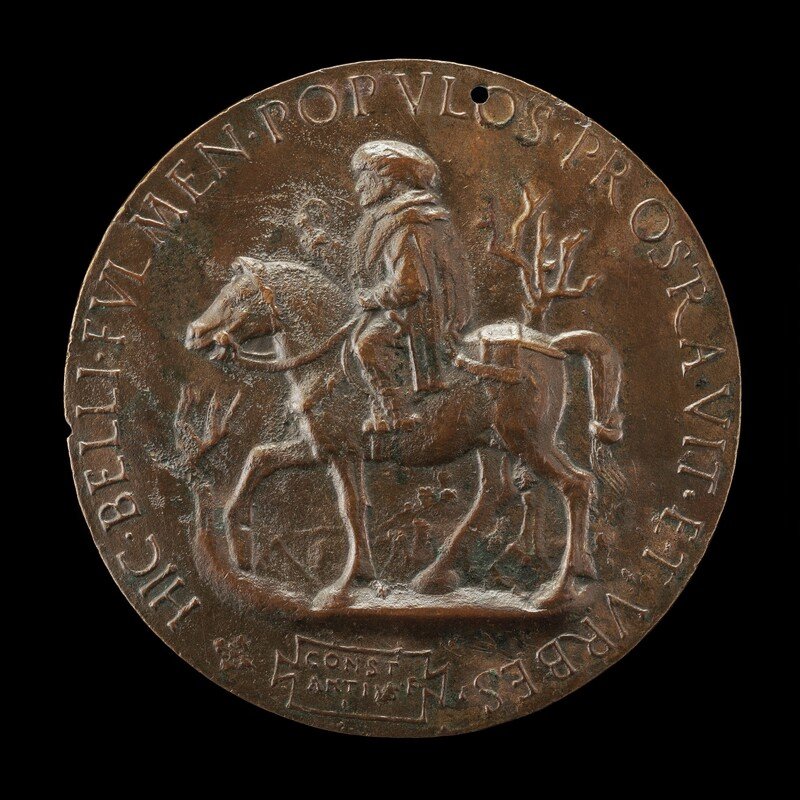
Constantinople was inaugurated as a new capital of the Roman Empire by Emperor Constantine the Great in 330. By the 1400s it had survived Persian, Avar, Arab, Bulgarian and Rus’ attacks, partly thanks to its position, surrounded by water on three sides, and partly thanks to the triple line of Theodosian walls on the land side. In the 600s and 700s its defenders had even burned enemy fleets with their secret weapon, Greek fire.
But the city of 1453 was a shadow of its former self. It had been sacked by the knights of the Fourth Crusade in 1204, a disaster that deepened the rift between Catholic and Orthodox Christians described in the Great Schism of 1054. By the 1400s, the Byzantine Empire had shrunk to little more than the city and a few scattered territories, and its population had fallen to perhaps 40,000 to 50,000 people, a fraction of what it had once been.
Mehmed II: a young sultan with one goal
Mehmed II became Ottoman sultan for the second time in 1451, while still a teenager. From the start he seems to have been determined to take Constantinople. In 1452 he built a powerful fortress, Rumeli Hisarı, on the European shore of the Bosphorus, the narrow strait north of the city. Together with an older castle on the opposite shore, it allowed him to control ships coming from the Black Sea. When a Venetian ship tried to run past without stopping, it was sunk by cannon fire and its captain executed by impalement, the same punishment that would make Vlad the Impaler infamous a few years later.
The last Byzantine emperor, Constantine XI Palaiologos, appealed to the West for help. Little came. The pope sent a small force, and a Genoese commander, Giovanni Giustiniani Longo, arrived with around 700 soldiers and took charge of the land walls. In all, the defenders probably numbered no more than about 7,000 to 8,000 men. Estimates for the Ottoman army vary widely, but modern historians often suggest somewhere between 50,000 and 80,000 troops, plus a large fleet.
The giant cannon
Mehmed had a new weapon for the fall of Constantinople. A cannon founder called Orban, from Hungary or Transylvania, had first offered his services to the Byzantines, who couldn’t afford him. The sultan could. Orban cast for Mehmed a huge bronze bombard, around 8 metres long, which fired stone balls weighing hundreds of kilograms. It took dozens of oxen to move and could only fire a few times a day, but together with the other Ottoman guns it pounded the ancient walls day after day.
The defenders worked every night to repair the damage with timber, earth and rubble. The Ottomans also dug tunnels under the walls, and the defenders dug their own tunnels to meet them, a deadly underground war described in medieval siege mining. For how cannon changed fortress warfare more generally, see how gunpowder ended the age of castles.
Ships over the hills
The Byzantines had stretched a great chain across the mouth of the Golden Horn, the city’s harbour, so the Ottoman fleet couldn’t get in. On 20 April, three Genoese ships and a Byzantine transport fought their way through the Ottoman fleet and into the harbour, to the fury of the sultan, who reportedly rode into the sea on his horse as he watched.
Mehmed’s answer was astonishing. On 22 April, the Ottomans dragged dozens of ships overland on greased wooden rollers, from the Bosphorus over the hills behind the suburb of Galata, and launched them into the Golden Horn behind the chain. Now the defenders had to guard the harbour walls too, stretching their tiny army even thinner.
Bad omens
As May went on, the mood in the city shifted and turned dark. Contemporary accounts describe a lunar eclipse on 22 May, a procession in which a sacred icon of the Virgin slipped to the ground, and a violent storm and thick fog. If I were trapped inside a medieval siege, thinking that food would run out at some point, as it often did in long medieval sieges, and on top of that God seemed to have abandoned me, hell yeah, I would be frightened and want to leave ASAP. Meanwhile, the sultan prepared his final assault on the city.
29 May 1453: the final assault
In the early hours of 29 May, the Ottomans attacked in waves: first irregular troops, then regular soldiers, and finally the elite Janissaries. The defenders held for hours. Then Giustiniani was badly wounded and carried away from the walls, and panic spread among his men. According to one Byzantine historian, a small gate in the walls, the Kerkoporta, had been left open, and Ottoman soldiers got in and raised their flags on the towers. Historians debate how much of that story is true, but before long the defences collapsed.
Constantine XI died in the fighting. He is said to have thrown off his imperial insignia and charged into the enemy, and his body was never securely identified, which helped give rise to Greek legends that he had been turned to marble and would one day return. The city was sacked, and many of its inhabitants were killed or enslaved. Mehmed rode to Hagia Sophia, the great church of the city, which was converted into a mosque.
The emperor who chose to stay
Imagine you are Emperor Constantine. All around you in the city you hear the clash of swords and the clanging of armour, and people giving orders in every direction. Your people are frightened, and chaos has arrived at your doorstep. What would you do? Just like a ship’s captain in the pirate movies, the most honourable thing to do is to go down with the ship while you still command it. At least, that is what I would have done in that situation. I think Emperor Constantine is my kind of hero, and a captain I would follow anywhere! His courage still resonates with us today, and as a fan of history, loyalty and warfare, this brings tears to my eyes. This is the kind of leader I would like to see pretty much everywhere today.
Why the fall of Constantinople mattered
The fall of Constantinople ended an empire that traced an unbroken line back to ancient Rome. Mehmed, now known as “the Conqueror”, made the city his capital, repopulated it and began turning it into Istanbul, the heart of an Ottoman Empire that would last until the 20th century. He even adopted the title of Caesar of Rome.
The shock was felt across Europe. Some Greek scholars and manuscripts reached Italy, adding to a flow of Greek learning that was already feeding the Renaissance. Technological progress, in the shape of the Ottoman cannon, showed the world that even the mightiest walls could no longer keep a city safe, and that a new kind of warfare was on its way. That’s one reason why many historians use 1453 as one of the dividing lines between the Middle Ages and the modern world. For more great sieges and how they were fought, explore medieval siege warfare.
Frequently asked questions
When did Constantinople fall?
On 29 May 1453, after a siege that began in early April and lasted about seven weeks.
Who conquered Constantinople?
The Ottoman sultan Mehmed II, who was about 21 years old at the time and became known as “the Conqueror”.
What happened to the last Byzantine emperor?
Constantine XI Palaiologos was killed during the final assault. His body was never securely identified.
Why is 1453 important?
It marked the end of the Byzantine Empire, the last direct continuation of the Roman Empire, and the rise of the Ottomans as a major power. Many historians see it as one of the turning points between the medieval and modern eras.
Sources
- Wikipedia, Fall of Constantinople
- Wikipedia, Mehmed II
- Wikipedia, Orbán (ironmaster)
- Wikipedia, Constantine XI Palaiologos
- Encyclopaedia Britannica, Fall of Constantinople