
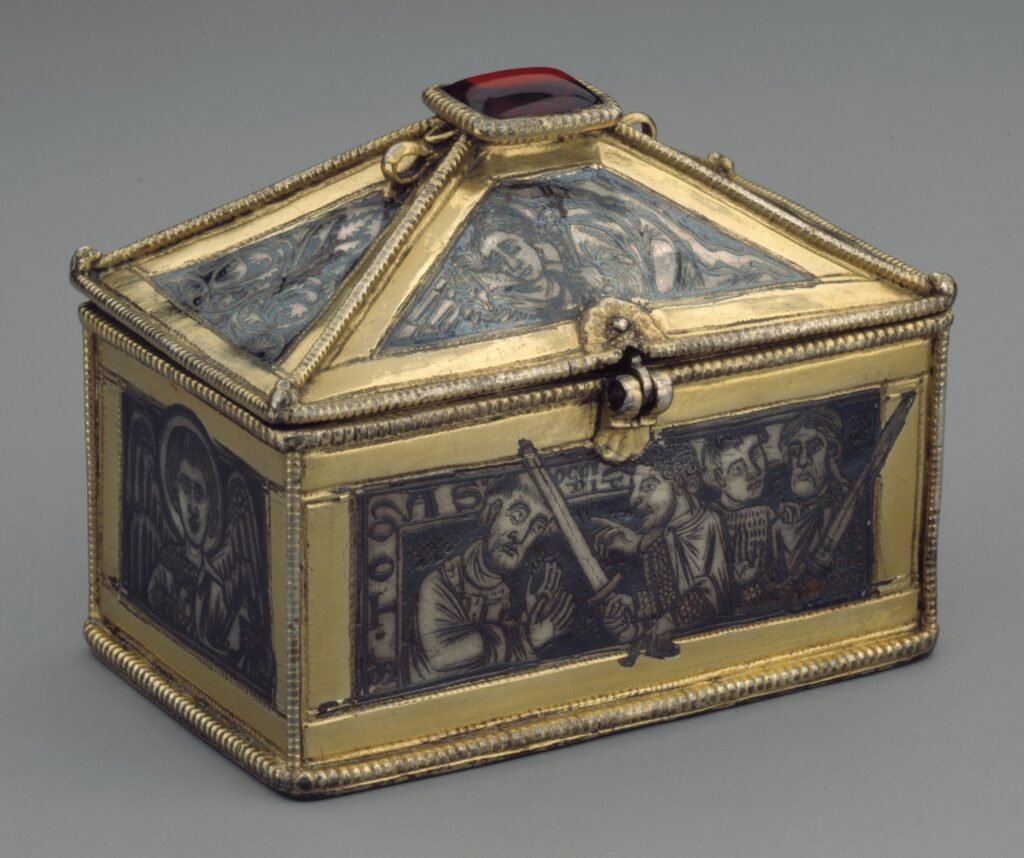
Thomas Becket: Murder in the Cathedral
Some friendships end with an awkward silence. Some end with a slammed door. The friendship between King Henry II and Thomas Becket ended with four armed knights, a cathedral floor and the most famous murder in English history. Becket went from the king’s party-loving right-hand man to his most stubborn enemy, and then, within three years of his death, to one of the most popular saints in Europe. How does a royal favourite end up hacked down at his own altar? Let’s walk through it, but mind the steps. They get slippery towards the end.
Jump to a section:
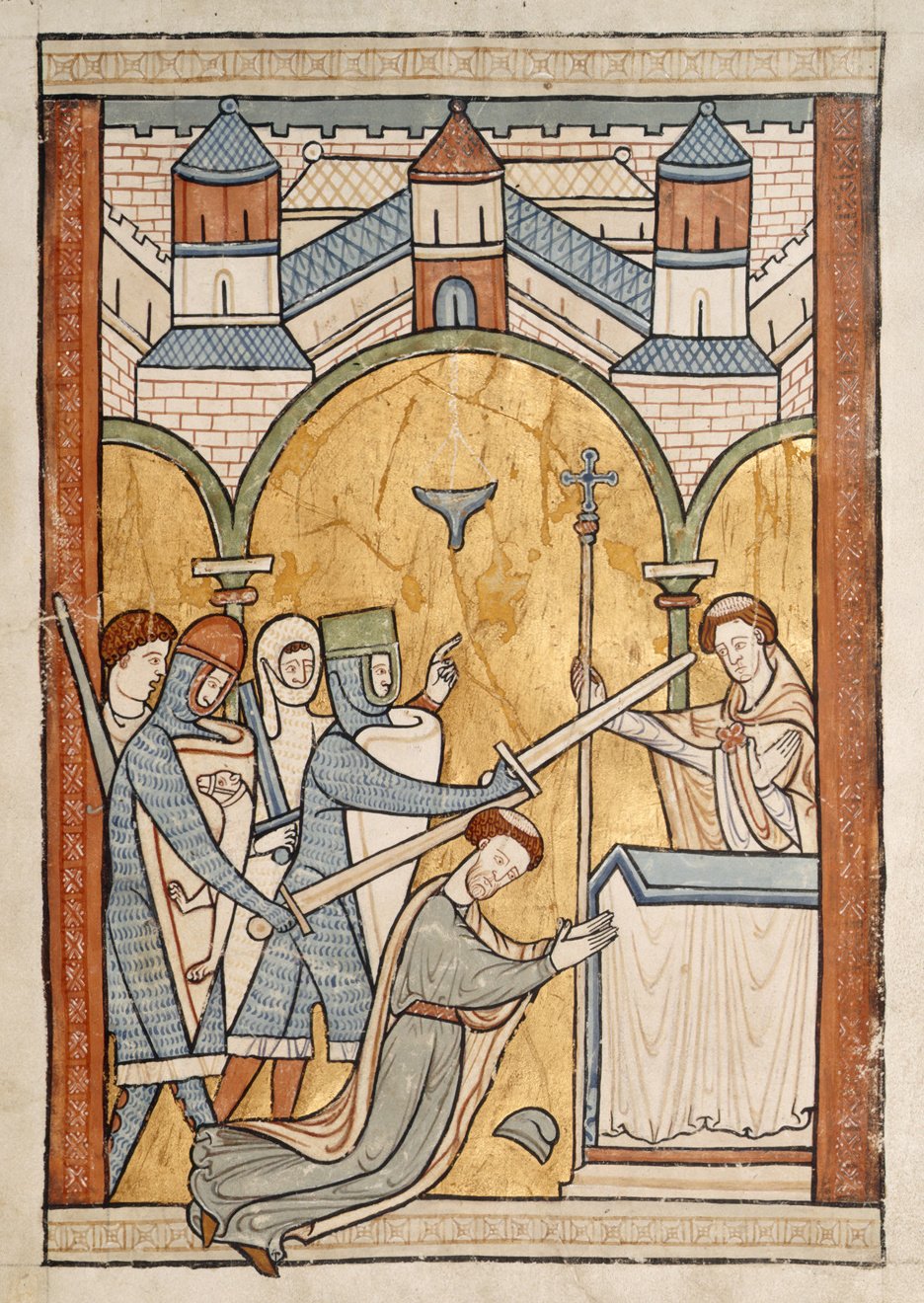
Who was Thomas Becket?
He was a Londoner through and through. World History Encyclopedia’s Mark Cartwright tells us that Thomas was born around 1118 in Cheapside, the busy heart of the city, where his father, a rich wine dealer, sold to the royal household. Some accounts put his birth a year or two later, so if you want to bring him a birthday cake, aim for roughly then.
His education was good but a little patchy. He studied at Merton Priory and then had unfinished spells at the schools of Paris, Bologna and Auxerre. In 1146 he joined the household of the Archbishop of Canterbury as a clerk, and by 1152 he was archdeacon of Canterbury. Not bad for a merchant’s son.
The king’s best friend
In January 1155 the young King Henry II made Becket his chancellor, one of the top jobs in the kingdom. The two men got on famously. Becket even helped tutor Henry’s eldest son, later known as Henry the Young King.
Becket also enjoyed the good life. Cartwright reports that when he travelled to Paris on a royal mission in 1158, he reportedly brought an entourage of 250 servants and no fewer than 24 outfits. The French must have wondered what the English king himself would look like if this was merely his chancellor.
A surprise archbishop
Then Henry had what seemed like a brilliant idea. If his best friend became Archbishop of Canterbury, the king would have an ally at the very top of the English Church. In June 1162 Becket got the job, even though, as Cartwright notes, he “was not even in major orders” at the time.
It turned out to be one of history’s great own goals. Once in office, Becket switched sides completely and became a fierce defender of the Church’s rights, including against the king. How serious was the change? After his death, the monks discovered that their archbishop had been wearing a lice-infested hair shirt under his robes, according to the Canterbury Historical and Archaeological Society. That is commitment.
The great quarrel
The flashpoint was justice. Clergymen in England could only be tried in Church courts, which tended to hand out milder punishments than the king’s. Henry wanted that changed. In January 1164 he set out his terms in the Constitutions of Clarendon, sixteen articles that, Cartwright explains, favoured the crown. Becket first gave his oath to them, then took it back.
Things got ugly fast. At a council in Northampton in October 1164, Becket was found guilty of contempt, and he fled across the Channel to a Cistercian monastery in France. He would spend about six years in exile. The final insult came in 1170, when Henry had his son crowned by York’s archbishop rather than Canterbury’s. According to Cartwright, the pope declared that coronation void, and when Becket returned to England in December 1170, he was in no mood to forgive.
Did Henry really say “Will no one rid me of this turbulent priest?”
Few lines in English history are quoted more often, and the king almost certainly never said it in that form. The historian Emily Guerry, writing in BBC History Magazine, explains that the eyewitness Edward Grim recorded a much longer rant, beginning: “What miserable drones and traitors have I nurtured and promoted in my household”. The punchy “meddlesome priest” version, she notes, came from Edward Anhalt’s screenplay for Becket, a 1964 film in which Peter O’Toole played Henry.
Whatever the exact words, four knights took them as an order. Their names were Reginald FitzUrse, Hugh de Morville, William de Tracy and Richard le Breton.
Murder in the cathedral
The knights spent the night at Saltwood Castle in Kent and rode on to Canterbury. On 29 December 1170 they found Becket in his cathedral. He refused to run. In Edward Grim’s account, translated in Fordham University’s Internet Medieval Sourcebook, the archbishop declares that he is “prepared to die for my Lord”.
Grim was standing right beside him and paid for it: one of the blows struck his arm. Then came the worst of it. A later stroke cut away the crown of Becket’s head with such force that the sword shattered on the stone floor. A cleric who had come in with the knights, nicknamed “Mauclerk”, meaning “evil clerk”, according to the British Museum, put his foot on the dead man’s neck and announced that he would not be getting up again. Then they left.
The monks were stunned. The Canterbury Historical and Archaeological Society explains that his body rested for a single night before the high altar. After that it went down into the crypt, which was its home for roughly half a century.
From murder victim to superstar saint
If the knights hoped to silence Thomas Becket, they failed spectacularly. Reports of miracles started almost at once. According to Current Archaeology, some 700 accounts of miracles had already been gathered by 1173, and on 21 February that year Pope Alexander III declared Becket a saint. Few saints have ever been made so quickly.
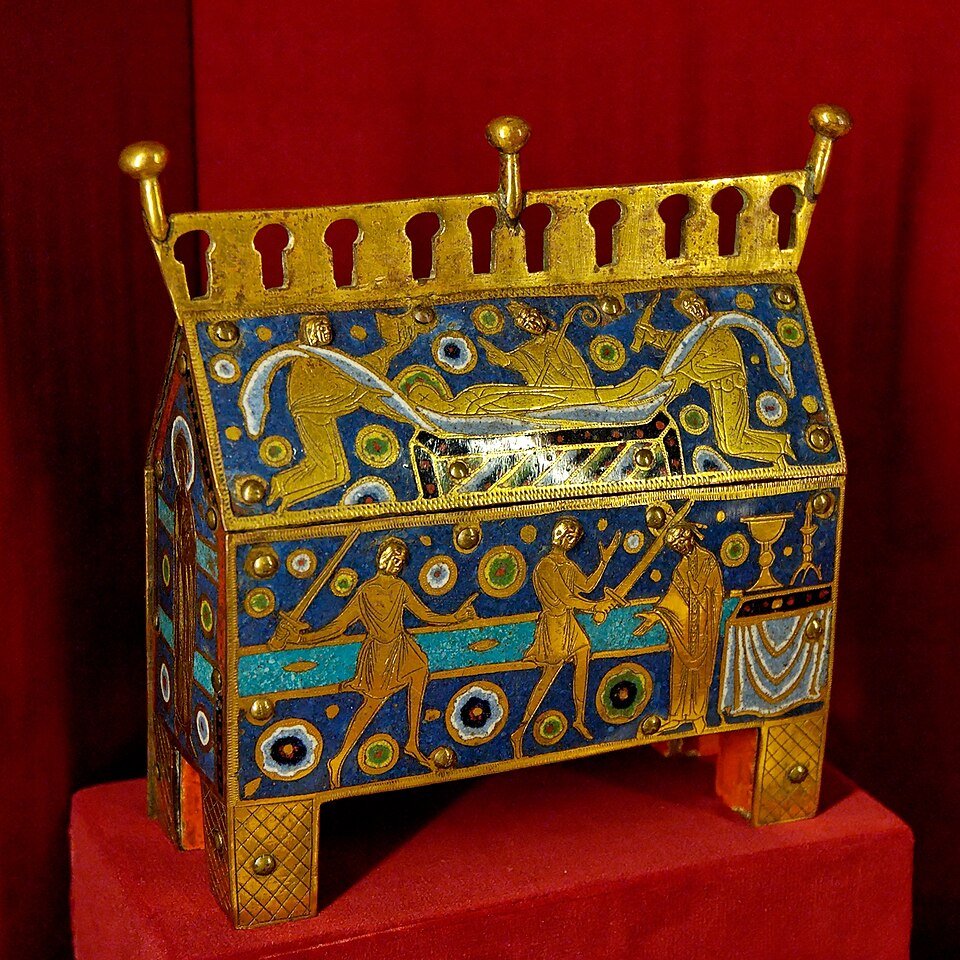
Canterbury cashed in. The British Museum’s curators describe “St Thomas’ Water”, a mix of water and the martyr’s blood that monks sold to pilgrims in little lead flasks called ampullae. One flask carries a wonderfully confident slogan: “Thomas is the best doctor for the worthy sick”. Pictures of the murder turned up in churches from Norway to Spain.
And the king? Henry had to say sorry in the most public way imaginable. On 12 July 1174 he walked barefoot to the cathedral and knelt at the tomb. The Canterbury Historical and Archaeological Society records that every bishop present gave him five strokes with a rod, and each of the hundred monks gave him three. He then spent the night praying beside his old friend.
Henry took no open action against the four knights at first, although he later seized their estates and barred their sons from inheriting. According to the historian Anne Duggan, they submitted to Pope Alexander III, who sentenced them to spend fourteen years fighting in the Holy Land as a penance. They seem to have died there not long afterwards.
Henry VIII strikes back
In 1220 the saint’s remains were moved to a glittering new shrine in the cathedral, which drew pilgrims from all over Europe for more than three centuries. Then a second King Henry decided that he did not much like archbishops who defied kings either.
In September 1538 Henry VIII had the shrine torn apart. Current Archaeology reports that the gold and jewels filled two chests so heavy that each one needed six to eight men to carry it. In November the king went further and declared that Becket should no longer be called a saint, only “Bishop Becket”, and branded him a traitor. His name was inked out of prayer books, his statues were smashed and his bones vanished. Nobody knows for certain what happened to them.
Why Thomas Becket still matters
Thomas Becket’s story is about much more than one murder. It is about a question medieval Europe argued over for centuries: who comes first, the king or the Church? It is also a reminder of how quickly a dead man could become more powerful than a living one. And his pull has not faded. In 2016, CNN reported, a bone fragment thought to come from his arm, kept for centuries at Esztergom in Hungary, came back to England for a short tour whose last stop was Canterbury, before it returned to Hungary.
To see how saints, bishops and popes shaped everyday life, explore the medieval Church. Or join the crowds who walked to his shrine in the story of medieval pilgrimage.
Frequently asked questions
What turned Henry II and Becket from friends into enemies?
Mainly the question of who should judge clergymen accused of crimes. Henry wanted royal courts to have a say, and Becket insisted that the Church alone should deal with its own people. Clashes over the Constitutions of Clarendon and the crowning of Henry’s son made things worse.
Is the “turbulent priest” quote genuine?
Not in that form. An eyewitness recorded a longer outburst about the “miserable drones and traitors” in Henry’s household. Neither the “turbulent” nor the “meddlesome” version appears in his account, and the “meddlesome priest” line was made famous by the 1964 film Becket.
Which knights carried out the killing?
Reginald FitzUrse, Hugh de Morville, William de Tracy and Richard le Breton. The pope later sent them to serve in the Holy Land as penance.
How long did it take Becket to become a saint?
Just over two years. He was killed on 29 December 1170 and declared a saint by Pope Alexander III on 21 February 1173.
Where are Becket’s bones today?
Nobody knows. They disappeared when Henry VIII destroyed the shrine in 1538. Only a few scattered relics, such as the fragment kept in Hungary, are claimed to survive.
Sources
- Mark Cartwright, World History Encyclopedia, Thomas Becket (2020)
- Emily Guerry, BBC History Magazine, via History Revealed, “Will no one rid me of this meddlesome priest?” The truth behind Henry II’s notorious lament (2021)
- Edward Grim, translated by Dawn Marie Hayes, Internet Medieval Sourcebook, Fordham University, The Murder of Thomas Becket
- Canterbury Historical and Archaeological Society, Becket, Thomas (biography)
- Lloyd de Beer and Naomi Speakman, British Museum, Thomas Becket: the murder that shook the Middle Ages (2019)
- Current Archaeology, via The Past, Who will deliver me from this turbulent priest? How two Henrys failed to erase the memory of Thomas Becket (2021)
- Anne Duggan, BBC History Magazine, via History Revealed, What happened to the assassins who killed Thomas Becket? (2013)
- CNN, report on the Becket relic’s return to England (May 2016)