
The Book of Kells: Secrets of Ireland’s Greatest Manuscript
Some books you read on the bus. The Book of Kells is not one of them. Made by monks some 1,200 years ago, it is so lavishly decorated that whole pages are given over to swirling knots, strange beasts and tiny hidden animals. It survived Viking raids, a robbery and a spell hidden under a lump of turf, and today hundreds of thousands of people queue up every year just to see a few of its pages. So what exactly is it, who made it, and why do cats chase mice across one of its holiest pages? Let’s turn the page.
Jump to a section:
What is the Book of Kells?
At heart, it is a copy of the four Gospels of the New Testament, written in Latin. Trinity College Dublin, which has looked after it for centuries, explains that the text is based on the Vulgate, the Latin translation of the Bible completed by Saint Jerome, and that the Gospels are introduced by tables of cross-references, summaries and prefaces.
What makes it special is everything around the words. The book is written on 340 leaves of vellum, which is specially prepared calfskin, giving a total of 680 pages. According to Medievalists.net, around 185 calves were needed to supply the skins. That is a lot of cows for one book, and it tells you this was never meant to be cheap.
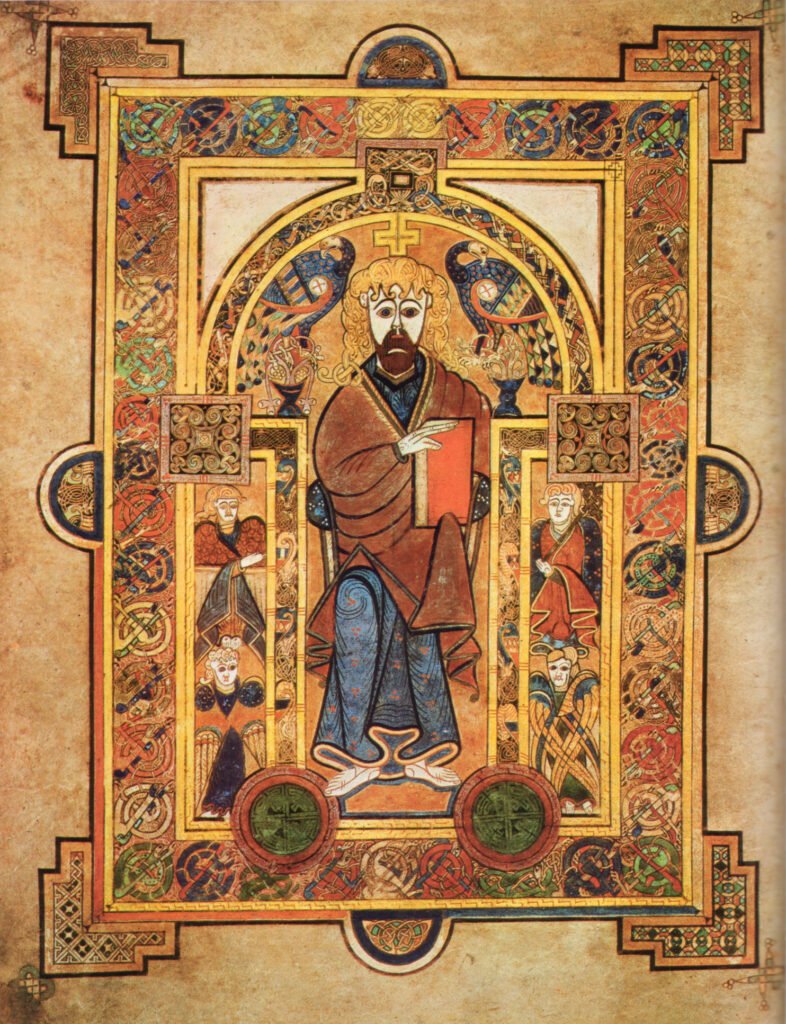
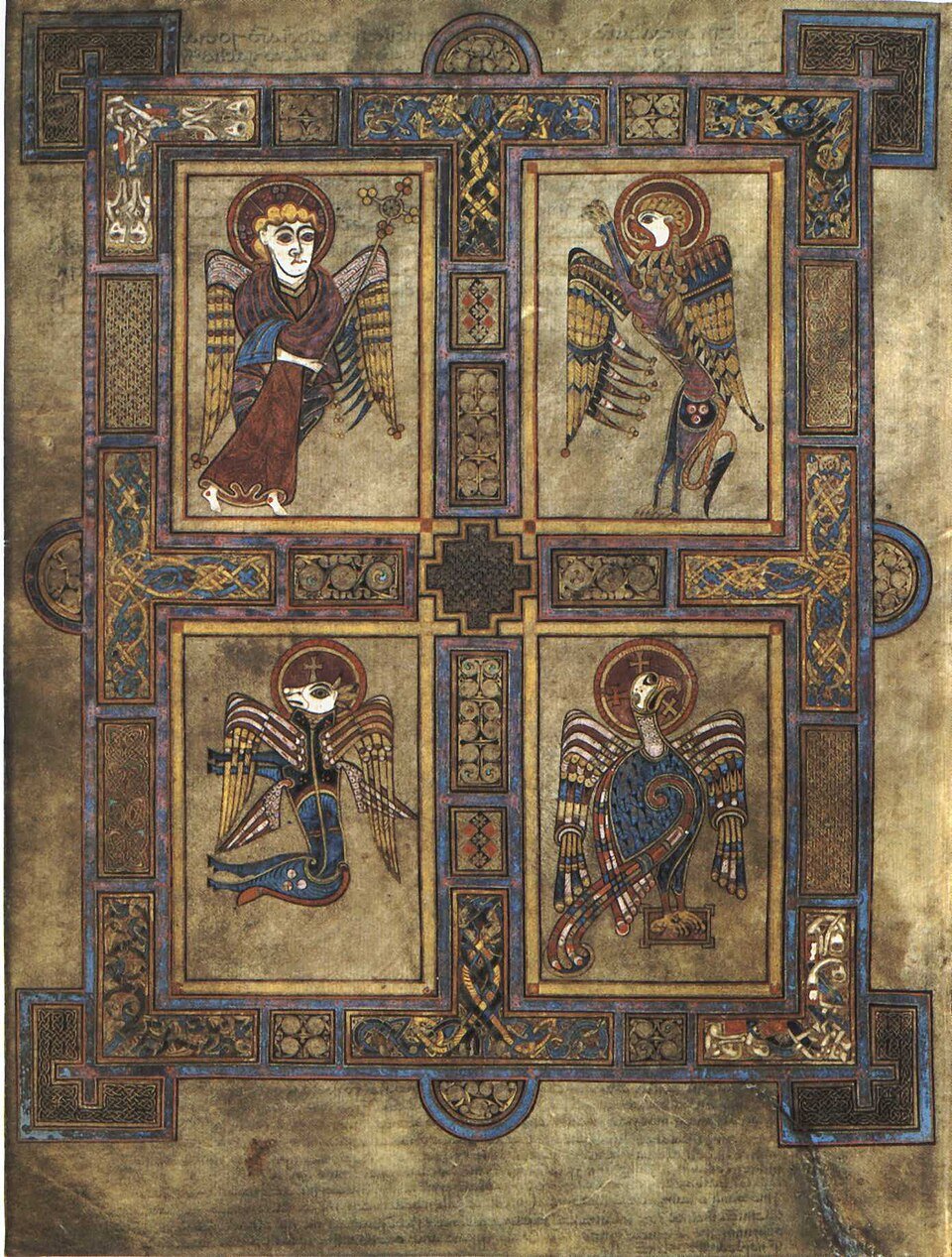
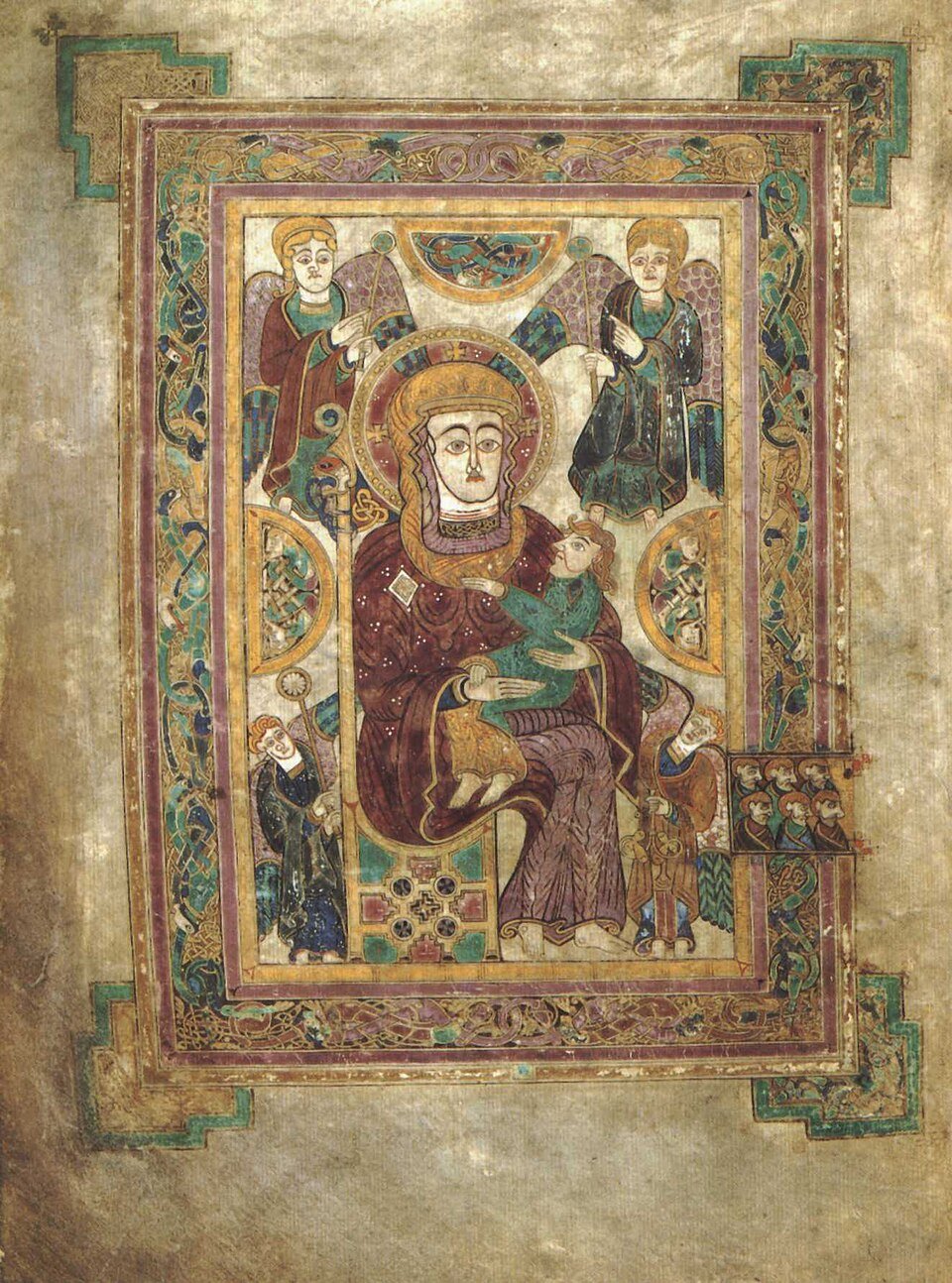
Scholars at University College Cork describe it as the most lavishly decorated Insular manuscript still in existence, Insular being the art of early medieval Ireland and Britain. Its colours are also far more varied than those of other famous Gospel books, such as the Lindisfarne Gospels.
Who made the manuscript, and when?
Nobody signed it, so the details are still debated. Trinity College says it was most likely written around the year 800, and most scholars link it to the monastery on Iona, a tiny island in the Inner Hebrides of Scotland. Iona had been founded around 561 by the Irish saint Colum Cille, also known as Columba.
The work was shared out. Trinity identifies four main scribes who copied the text and three artists who created the major decorated pages. Medievalists.net notes that each scribe had his own habits, and that the text contains some copying mistakes. It seems the monks cared more about how the pages looked than about spelling every word perfectly. Teachers everywhere would sympathise.
From Iona to Kells: running from the Vikings
Life on Iona became dangerous in the age of Viking raids. Trinity College reports that a raid in 806 left 68 members of the community dead. Those who lived through it relocated across the sea to Kells, an inland site north-west of Dublin. That is how the Book of Kells got its name, even though it was probably started somewhere else entirely.
Stolen, stripped and buried in the mud
Kells was not completely safe either. In the early 1000s, the book was stolen. Trinity College dates the theft to 1006 (some accounts give 1007) and says the thieves were after its ornamental cover, or shrine, known in Irish as a cumdach. The Annals of Ulster, quoted by Medievalists.net, record that the great Gospel was taken by night from the church’s western sacristy and found again “after two months and twenty nights”, with its gold stripped off and a sod of earth over it.
In other words, the robbers kept the bling and left the masterpiece under a sod of earth. Medievalists.net suggests that this rough treatment may explain why the opening and closing sections of the book have gaps.
The art: knots, beasts and hidden animals
The decoration of the Book of Kells is so dense that you could stare at a single page for an hour and still spot something new. Medievalists.net lists peacocks, hares, doves, snakes, wolves and lions among the creatures, along with people, monsters and endless Celtic knots.
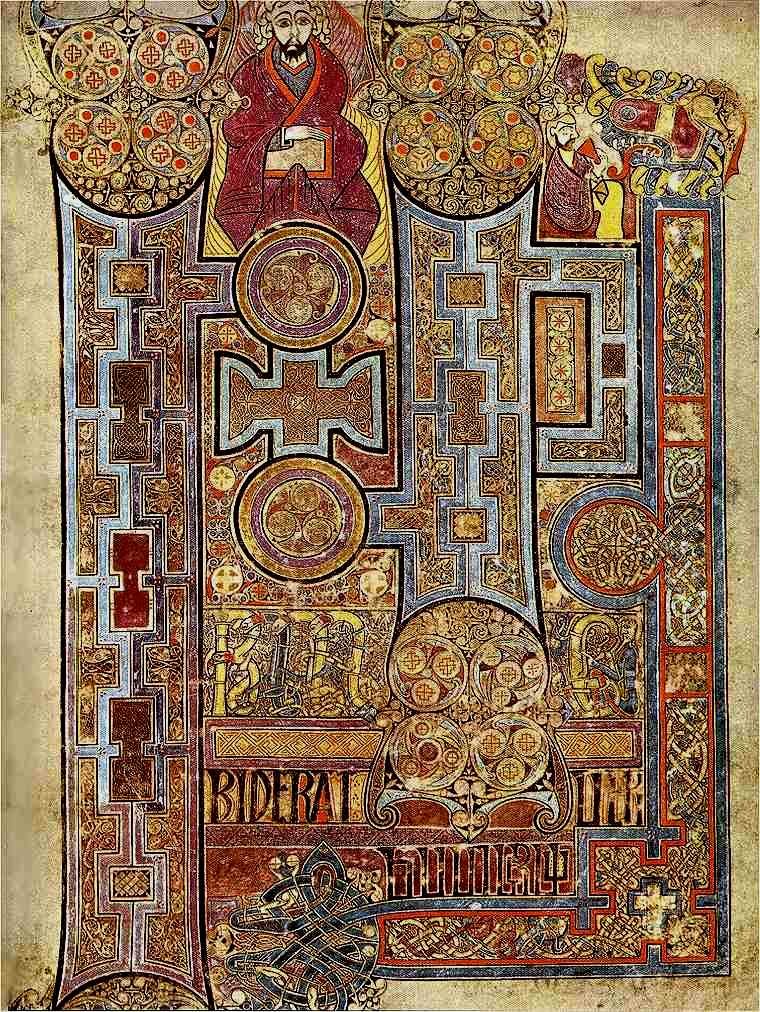
The most famous page of all is the Chi Rho page, folio 34r. It opens Matthew’s account of the birth of Jesus with the first two Greek letters of the name “Christ”, which look like an X and a P. The letters are blown up to fill almost the whole page and packed with spirals and patterns. Look closely, though, and you will find a little scene at the bottom. As University College Cork describes it, two cats pin down the tails of two mice that are nibbling at a communion wafer, while two more mice sit on the cats’ backs. Nearby, an otter holds a fish, and moths flutter near the top of the page. Angels are hidden in the design too.
Why put cats and mice on the holiest page of the book? Nobody knows for sure. Trinity College’s visitor blog suggests the mice may stand for people who receive the Eucharist unworthily, while the fish was an early Christian symbol for Christ. Or perhaps the monastery simply had a mouse problem. We will never know, but it is nice to think that medieval monks had a sense of humour too.
What were the colours made of?
The pigments of the Book of Kells have been studied closely. Trinity College says the blue came from indigo or woad, the yellow from a mineral called orpiment, the reds from red lead or other sources, and the greens from copper. The costly blue stone lapis lazuli, on the other hand, was probably not used. The artists also built up their colours in layers, sometimes up to three on top of a base coat.
According to Medievalists.net, chalk, gypsum and indigo all went into some of the colours, and the black ink was made from charred wood or bone. Some of the pink shades still puzzle researchers.
How the manuscript reached Trinity College
The book stayed at Kells for centuries. In the troubled 17th century, it was sent to Dublin around 1653. According to Trinity College, it arrived at the college a few years later, through Henry Jones, who became Bishop of Meath in 1661.
Since 1953 the manuscript has been split across four separate bound volumes. Two of them are normally on show at a time: one open at a decorated page and the other at two pages of text. Trinity says the exhibition draws over half a million people every year. If you cannot get to Dublin, Open Culture reports that the whole manuscript can be viewed online through the Trinity College Library’s digital collections.
Why the Book of Kells still matters
It is much more than a pretty book. It shows how a small community of monks, working on remote islands under the threat of Viking raids, produced one of the greatest works of art in European history. It also shows how much a book could mean in the early Middle Ages: enough to be wrapped in gold, enough to be stolen and, luckily, enough to be saved.
To see how this masterpiece fits into the wider story of medieval painting, carving and building, explore medieval art. You can also discover how illuminated manuscripts were made, step by step, and see what a monk’s day looked like in medieval monasteryA Day in the Life of a Medieval Monk life.
Frequently asked questions
So what is the Book of Kells, in one sentence?
It is a lavishly painted Gospel book in Latin from about 800, and today it lives in the library of Trinity College Dublin.
Was it really made in Kells?
Probably not, or at least not entirely. The majority view is that work began on Iona in the Scottish Hebrides. The monks later fled Viking attacks and settled at Kells, and the town lent the book its name.
How long is the manuscript?
The Book of Kells has 340 leaves of vellum, or 680 pages. A number of leaves at the start and the finish have been lost.
Why are there cats and mice on the Chi Rho page?
On this page, two cats hold down mice nibbling at a communion wafer. Its meaning is uncertain. One suggestion is that the mice represent people receiving communion unworthily.
Is there a way to look through it from home?
There is. Trinity College Library has put the complete manuscript in its digital collections, where anyone can page through it.
Sources
- Trinity College Dublin Library, The Book of Kells
- Peter Konieczny, Medievalists.net, The Book of Kells: Ireland’s Medieval Treasure (2022)
- University College Cork, The Book of Kells: Image and Text, Introduction
- University College Cork, The Book of Kells: Image and Text, The Chi Rho Page
- Visit Trinity, Symbolism in the Book of Kells: the Chi Rho page
- Open Culture, The Medieval Masterpiece, the Book of Kells, Is Now Digitized and Put Online (2019)