
How Did a Medieval Coronation Work?
Inheriting a kingdom in the Middle Ages was a bit like inheriting a car with no keys. Technically it was yours, but nobody was going anywhere until the paperwork was done. That paperwork was the medieval coronation: a long, sacred, slightly sticky ceremony that took an ordinary mortal, smeared him with holy oil and handed him back to his subjects as God’s chosen ruler. So how did it actually work, what could go wrong, and why did one king end the day missing a shoe? Let’s find out.
Jump to a section:
Why did a king need a coronation at all?
A crown could come to you by birth, by conquest or by election. The ceremony was what made everyone else accept it. Encyclopaedia Britannica points out that kings were made in plenty of ways long before Christianity arrived. A new ruler might be lifted up on a shield, handed a spear or dressed in a special robe or headdress. Once Europe became Christian, some of these old habits were folded into a church service, and that service took its model from the Bible, where the prophet Samuel anoints Saul as the first king of Israel.
Anointing a king with oil became a regular custom in two places first, according to Oxford historian Conor O’Brien: Visigothic Spain in the 600s and the kingdom of the Franks in the 700s. Interestingly, O’Brien argues that the idea grew out of the world of the lay nobility rather than the Church. The ritual was aimed less at the priests performing it and more at the crowd watching it. In other words, a coronation was theatre with a purpose. Everyone had to see the moment a man became a king.
The medieval coronation, step by step
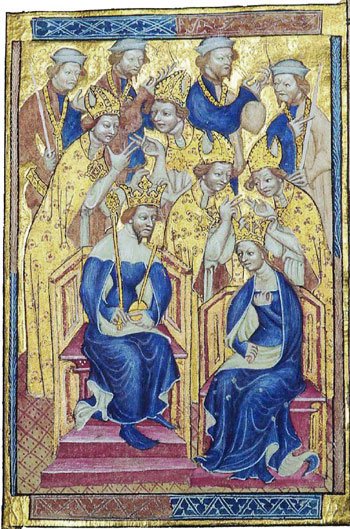
The best guide we have is a book. The Liber Regalis, or “Royal Book”, is a beautifully decorated instruction manual kept at Westminster Abbey. The Abbey dates it to about 1382, around the time Richard II’s queen, Anne of Bohemia, was crowned, although nobody knows exactly who it was made for. Think of it as an IKEA leaflet for making monarchs, only with more gold leaf and fewer leftover screws.
According to Westminster Abbey, the running order has hardly changed in centuries. A medieval coronation took place in the middle of a Mass, and went roughly like this:
- Recognition: the new ruler was shown to the people, who were asked to accept him.
- Oath: he made solemn promises to God and to his subjects, including to protect the Church and keep the law.
- Anointing: the archbishop marked him with holy oil, the holiest moment of the day.
- Investing: he was handed the regalia, the symbols of his power, such as a sword, a ring and a sceptre.
- Crowning: the crown went on his head, and the church erupted with shouts.
- Enthronement: he moved to his throne, and the great men of the kingdom knelt and promised to serve him.
The English version had very deep roots. Bath Abbey explains that Edgar received his crown as ruler of all England in the town of Bath, at Whitsun in 973, using a service put together by Dunstan, the Archbishop of Canterbury. That service became the basis for every English coronation that followed, all the way to 1953. Not bad for a script written over a thousand years ago.
It was also a very long day. Westminster Abbey notes that some coronations lasted up to five hours. Richard II was only ten when he was crowned in 1377, and he fell asleep partway through. Honestly, who could blame him?
The holy oil: the secret ingredient
Of all the steps, the anointing mattered most. Westminster Abbey calls it the holiest moment of the whole service. The archbishop anointed the monarch with oil on the hands, the chest and the head. The crown was the bit people remembered. The oil was the bit that made the king holy.
One piece of the medieval regalia still survives. The Coronation Spoon, now in the Royal Collection, is a silver-gilt spoon that first turns up in the records in 1349, when it was already kept among the regalia at Westminster Abbey. Today it is used, together with a golden flask called the ampulla, for the anointing. Its style points to the 1100s, and it may have been made for Henry II or Richard I. No other royal goldsmiths’ work from the 1100s has survived. After the English Civil War it was sold off, and it came back at the Restoration of Charles II, when pearls were added. So one of the holiest objects in the Crown Jewels has been through a second-hand sale. Let’s hope the buyer got a good price.
The oil had its own legends. A 14th-century English story claimed that the Virgin Mary visited Thomas Becket in a vision and gave him a golden eagle and a small flask of oil for anointing future kings. The French had an even better tale.
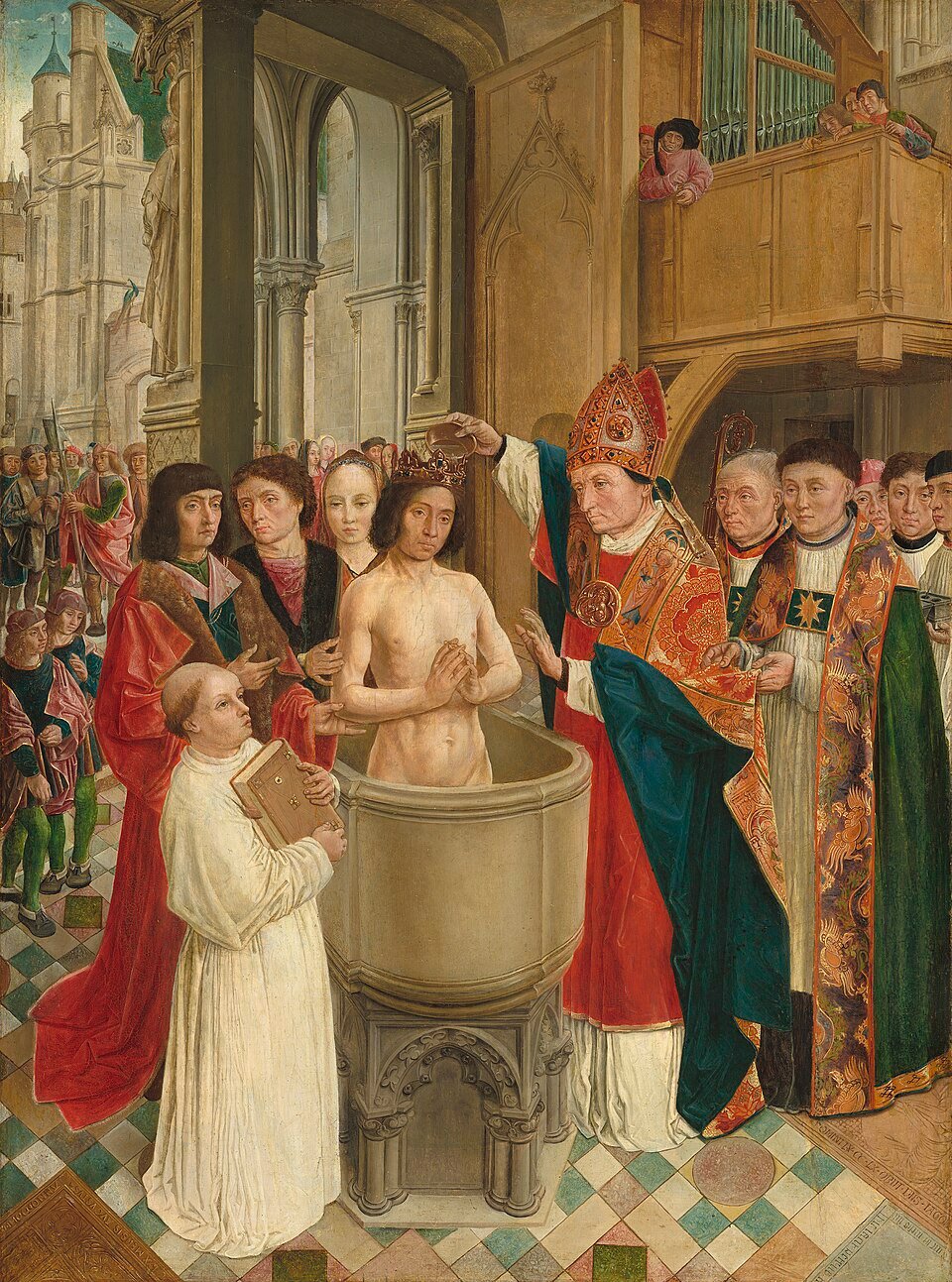
According to Britannica, French kings received their anointing from a small flask called the Sainte Ampoule, or Holy Ampulla, kept at Reims. Legend said a dove had carried it down from heaven for Clovis, the first Christian king of the Franks. Nobody could compete with that. Sadly, the flask did not survive the French Revolution, which was not a great time to be a royal souvenir.
Where were kings crowned?
For a medieval coronation, location mattered almost as much as the oil. Each kingdom had its favourite stage.
England: Westminster Abbey. Since William the Conqueror’s crowning in 1066, English coronations have almost always taken place at the Abbey. Its most famous piece of furniture is the Coronation Chair. Westminster Abbey explains that Edward I had it made in 1300 to 1301 to hold the Stone of Scone, which he had taken from Scotland in 1296. It is made of oak and was painted by a craftsman known as Master Walter. Historians argue about exactly when it was first used, but Henry IV was certainly crowned in it in 1399. Over the centuries it also collected graffiti. One visitor carved “P. Abbott slept in this chair 5-6 July 1800” into the seat, which must count as the most royal nap in history.
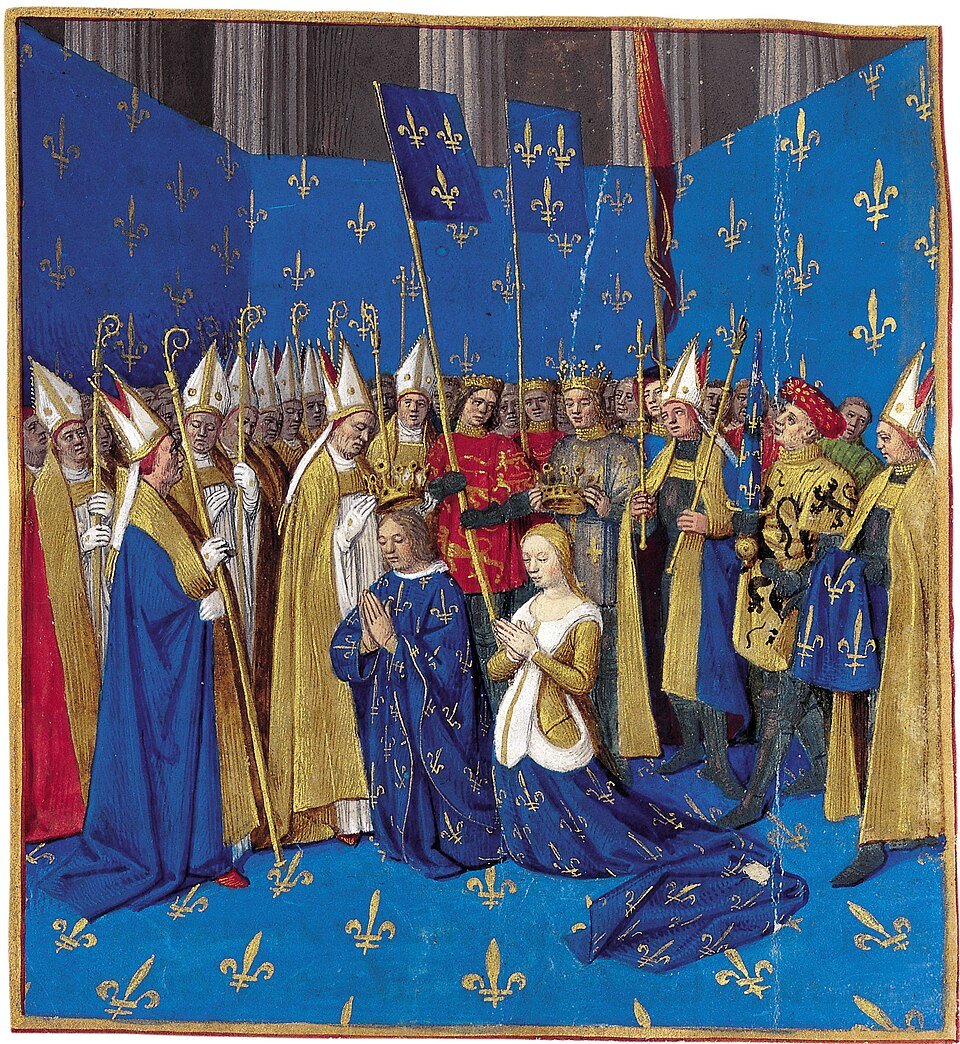
France: Reims. Britannica counts 25 coronations of French kings in Reims Cathedral, between 1223, when Louis VIII was crowned, and 1825, when Charles X became the last. Afterwards, the court moved to the archbishop’s palace next door, the Palais du Tau, for the coronation banquet.
The Holy Roman Empire: Aachen and Rome. Here you often needed two ceremonies. German kings were crowned in Aachen, Charlemagne’s old capital. Aachen Cathedral says that a total of 30 kings, plus 12 queens, were crowned there between 936 and 1531, starting with Otto I, and the throne used for them was built from four slabs of ancient Roman marble. To become emperor, though, a king had to be crowned by the pope in Rome. Charlemagne received the imperial crown from Pope Leo III on Christmas Day in 800, and Otto I followed suit, crowned by Pope John XII in 962.
When a medieval coronation went wrong
With huge crowds, nervous soldiers and hours of ritual, plenty could go wrong. And it did.
William the Conqueror, 1066. Westminster Abbey tells the story. During the service, William was presented to the congregation in English and in French, and both the English and the Normans shouted their approval. The Norman guards outside thought the noise meant their duke was being attacked, so they started setting houses around the Abbey on fire. Smoke poured into the church, the worshippers ran for it, and fighting spread outside. William and the clergy carried on and finished the job anyway. Talk about commitment.
Henry IV, 1399. Henry had just pushed his cousin Richard II off the throne, so he badly needed a smooth ceremony. He didn’t get one. The chronicler Adam of Usk saw three signs of misfortune in the day’s events, and the first was that Henry mislaid a coronation shoe during the procession. Not the most dignified start to a reign.
Henry VI, 1429 and 1431. Henry became king of England before his first birthday, so his coronation had to wait. According to World History Encyclopedia, he was crowned at Westminster Abbey on 6 November 1429, when he was about seven. Two years later, on 16 December 1431, he was crowned again, this time as king of France in Notre-Dame Cathedral in Paris. Two crowns, two countries, one small boy. The French part of the deal did not last.
Joan of Arc and the race to Reims
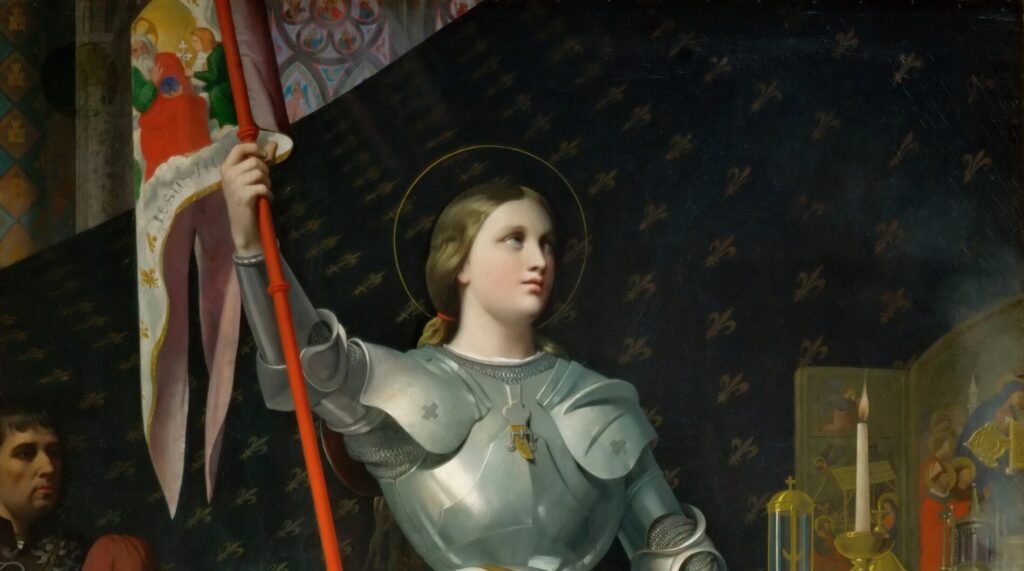
Sometimes a medieval coronation was a weapon. In 1429, the English and their Burgundian allies held much of northern France, including Paris. Charles had claimed the throne back in 1422, but he had never been properly crowned. Britannica explains that Joan of Arc insisted that only being anointed at Reims could turn Charles into a genuine king, picked by God. After her success at Orléans, the French struck out boldly for Reims. On 17 July 1429, Charles received the holy oil in Reims Cathedral, with Joan present.
That ceremony gave Charles VII something no army could: the sacred approval that made him the real king in the eyes of his people. Two years later, the English answered with a coronation of their own, crowning young Henry VI in Paris. In a medieval war, a well-timed coronation could be worth a whole army.
After the ceremony: the feast and the champion
Once the medieval coronation was over, everyone went to dinner. These feasts could be political events in their own right. History Today reports one account claiming that, after Otto I was crowned in Aachen, the other dukes of Germany waited on him at table, as a sign that they were now his men.
England added a touch of drama: the King’s Champion. According to the current holder of the title, writing in The House magazine, the role goes back to Robert de Marmion, who came over with William the Conqueror and was given land at Scrivelsby in Lincolnshire on condition that he and his heirs act as champions at coronations. The job passed by marriage to the Dymoke family. At Richard II’s coronation in 1377, a dispute over which estate carried the role was settled in favour of Scrivelsby, held by Sir John Dymoke, and the family still holds it today.
The champion’s big moment came at the banquet. At James II’s coronation feast in 1685, for example, he rode into Westminster Hall in full armour on a white horse. A herald read out a challenge to anyone who denied the king’s right to the throne, and the champion threw down his gauntlet. This happened three times as he made his way along the hall. Brave words, but by then it was pure ceremony, so the challenge was never seriously taken up and everyone could get back to their dinner.
Why the medieval coronation mattered
A medieval coronation was much more than a fancy hat ceremony. It turned a claim into a fact, gave a king the blessing of the Church and put his subjects on public notice that this was the man they now served. Kings who were crowned in a hurry, crowned twice or crowned in the middle of a war all knew how much the ritual counted.
Of course, the crown was only the start. Keeping it was the hard part, as you’ll see in our look at medieval kings, from the barons who made King John put his seal to Magna Carta to the rulers who lost their thrones altogether. Plenty of royal stories also survive in illuminated manuscripts, and some royal stories end in very strange places, like the king found under a car park.
Frequently asked questions
What happened at a medieval coronation?
The new ruler was presented to the people, took an oath, was anointed with holy oil, received the regalia, was crowned and was then enthroned while the great men of the realm promised their loyalty. All of this took place during a Mass.
What was the most important part of a coronation?
The anointing. At a medieval coronation, people believed the holy oil set the king apart and gave him God’s blessing. The crown was the visible sign, but the oil was the sacred heart of the ceremony.
Where were medieval kings crowned?
From 1066 onwards, English kings were almost always crowned at Westminster Abbey, and French kings at Reims. German kings were crowned at Aachen, while emperors received their imperial crown from the pope in Rome.
How old is the Coronation Spoon?
It first appears in the records in 1349, but its style suggests it was made in the 1100s. No other English royal goldsmiths’ work survives from that century.
Could a king be crowned twice?
Yes. Henry VI of England was crowned at Westminster in 1429 and again in Paris in 1431, when he was crowned king of France.
Sources
- Westminster Abbey, The Liber Regalis
- Westminster Abbey, What happens in a coronation? (Coronation Club activity pack)
- Westminster Abbey, The Coronation Chair
- Westminster Abbey, William I (the Conqueror)
- Royal Collection Trust, The Coronation Spoon
- The Coronation Roll, Ampulla and Spoon
- Encyclopaedia Britannica, Coronation
- Encyclopaedia Britannica, Ampulla
- Encyclopaedia Britannica, Reims Cathedral
- Encyclopaedia Britannica, France: Charles VII
- University of Oxford, Faculty of History, The origins of royal anointing
- Bath Abbey, The coronation of King Edgar
- Aachen Cathedral, The imperial throne and its secrets
- History Today, Otto the Great is crowned Emperor of the Romans
- History Today, The Reign of Henry IV
- World History Encyclopedia, Henry VI of England
- The House magazine (PoliticsHome), Throwing down the gauntlet: the King’s Champion explains his family’s historic coronation role