
Romanesque vs Gothic: How to Tell Them Apart
Walk into almost any old church in Europe and someone will tell you it’s Romanesque, or Gothic, or “a bit of both, really”. It’s one of those things everyone nods along to without being quite sure what it means. The good news is that the Romanesque vs Gothic puzzle is easier than it looks. Once you know four or five clues, you can date a medieval church to within a century or so from the doorway, which is a very satisfying party trick. Grab your imaginary guidebook and look up.
Jump to a section:
Romanesque vs Gothic: the short version
Romanesque came first, roughly in the 11th and 12th centuries. Its churches feel heavy, solid and a little mysterious, with round arches, thick walls and small windows. Gothic grew out of it from around the 1140s and reached for the opposite: height and light. Pointed arches, ribbed ceilings and outside supports let Gothic builders thin the walls and fill them with glass.
One fun detail: neither name was used by the people who built these churches. New York’s Metropolitan Museum explains that “Romanesque” was invented by scholars of the early 19th century, because the buildings seemed to echo ancient Rome. The museum’s own curator calls the label “both useful and misleading”, since it ignores other influences. In England the same style usually goes by another name, Norman, after the conquerors who built so much of it.
What makes a church Romanesque?
The opening chapter of the Romanesque vs Gothic story belongs to a Europe full of new monasteries and long pilgrimage roads. The Met explains that the spread of monasteries drove much of the art of the age, and that bigger stone churches were needed for the crowds of pilgrims coming to pray at saints’ relics. Churches on the pilgrimage routes often had a walkway around the altar end, so the faithful could circle the holy area, with small chapels fanning out from it where several priests could say Mass at once.
Look for these clues:
- Round arches everywhere: over doors, windows and between the pillars.
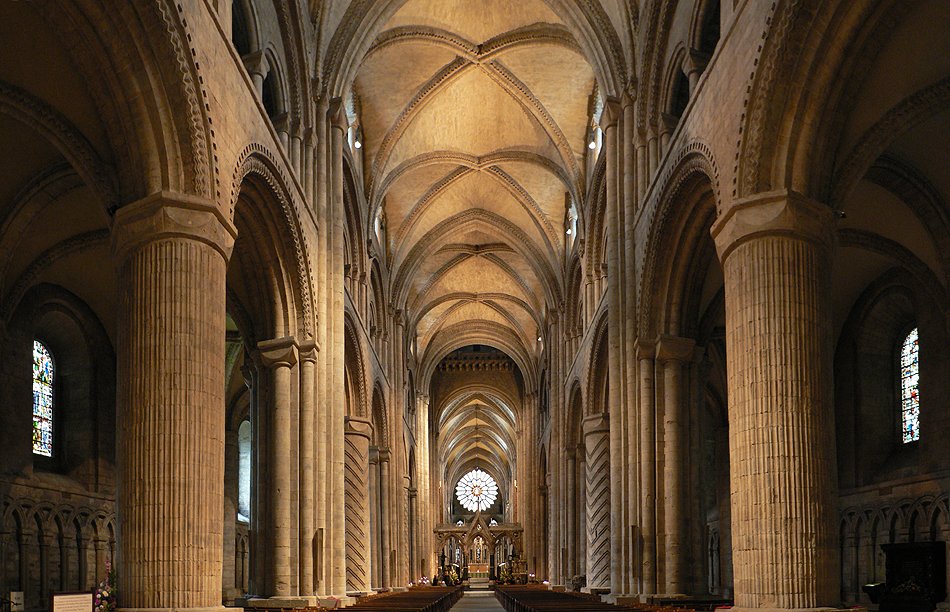
- Thick walls and small windows. The walls carried the weight of the roof, so they couldn’t be cut away too much. The result is often a dim, cave-like interior.
- Barrel vaults, long tunnel-shaped stone ceilings borrowed from Roman building.
- Sculpture over the main door. According to the Met, this was the first time since Roman days that large-scale carving covered church fronts, doorways and column capitals. The half-moon panel above a doorway, the tympanum, often showed the Last Judgment, a stern reminder to behave before you even got inside.
Durham Cathedral is one of the best Romanesque buildings anywhere. Its World Heritage Site team calls it the largest and finest Norman building in England. But Durham also shows that styles don’t switch over neatly. Its builders were the first to make pointed arches work at full size, holding up the nave’s stone vault, and they describe its daring vaulting as a foretaste of Gothic. Durham is a Romanesque church quietly practising to be Gothic.
How Gothic was born at Saint-Denis
The Gothic story usually starts just north of Paris, at the abbey of Saint-Denis. The historian Emma Wells explains that when Abbot Suger began rebuilding the church in 1137, his builders pulled together features that had existed separately into one new system. Suger, often nicknamed the father of Gothic, called the result “modern work”, opus modernum. Others called it opus francigenum, “French work”.
The aims, Wells writes, were simple: as much height and as much light as possible. Three building tricks made that possible:
- The pointed arch. It sends its load more directly down towards the ground than a round arch does, and arches of different widths can be built to the same height.
- The rib vault. A skeleton of crossing stone ribs carried the ceiling, so the panels in between could be thinner and lighter.
- The flying buttress. These stone arms, set against the building’s exterior, propped up the high walls, which meant the walls themselves no longer had to do all the work.
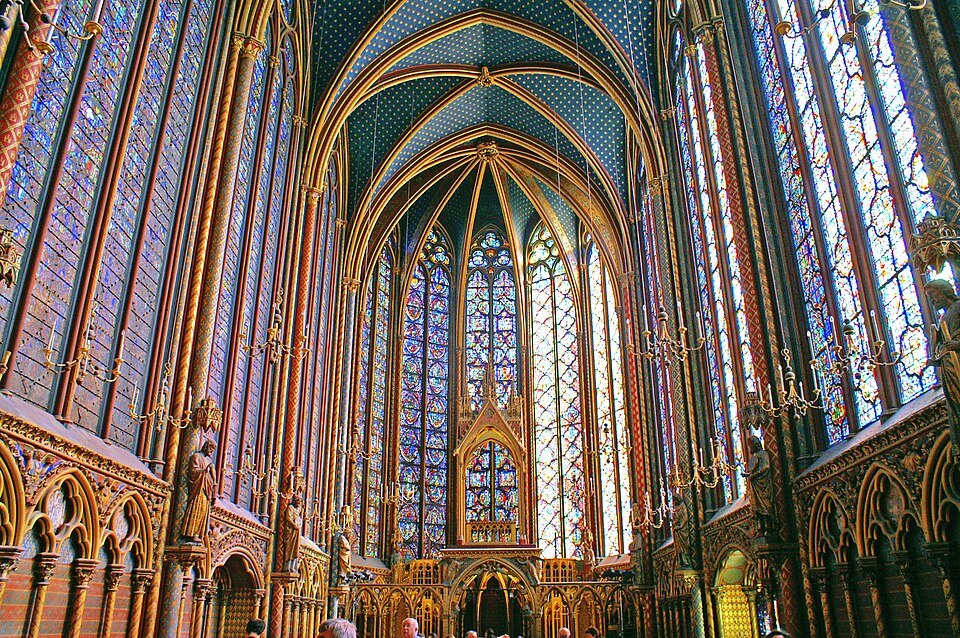
Take the weight off the walls and you can turn them into windows. That’s why Gothic churches glow. The Sainte-Chapelle in Paris, built for King Louis IX to hold the relic believed to be Christ’s Crown of Thorns, is almost all glass. The French Ministry of Culture says its upper chapel has 15 windows, every one roughly 15 metres high, filled with 1,113 painted-glass scenes, and that the whole building went up in just seven years.
Romanesque vs Gothic: a quick spotter’s checklist
Next time you’re standing in front of a medieval church, run through these questions. They’re rules of thumb rather than laws, but they work surprisingly often.
- Arches: round means Romanesque; pointed means Gothic.
- Walls: thick and mostly solid suggests Romanesque; thin with huge windows suggests Gothic.
- Ceiling: a plain tunnel-shaped vault points to Romanesque; a web of stone ribs points to Gothic.
- Outside: chunky walls with small buttresses hint at Romanesque; stone “arms” leaping out from the walls are classic Gothic.
- Mood: dim, heavy and fortress-like is Romanesque; tall, bright and soaring is Gothic.
Be ready for mixtures, because Romanesque vs Gothic is rarely a clean either-or. Many great churches took so long to build that they changed style halfway through. Cologne Cathedral, UNESCO notes, was begun in 1248 and not finished until 1880, so its builders had plenty of time to change their minds.
When Gothic went too far
Not every chapter of the Romanesque vs Gothic story is a triumph, and Gothic builders were not always sensible. At Beauvais, in northern France, they tried to build the highest church in Christendom. The cathedral’s own history says the vault of the choir rises to nearly 47 metres, and no Gothic stone vault anywhere stands higher. In November 1284 the buttresses gave way and the choir vault came crashing down. The builders tried again, and in the 1500s they added a soaring lantern tower over the crossing. It was finished in 1569 and collapsed four years later. The nave was never really built: work stopped after a single bay, which is why Beauvais looks oddly like a church that has had its front half chopped off.
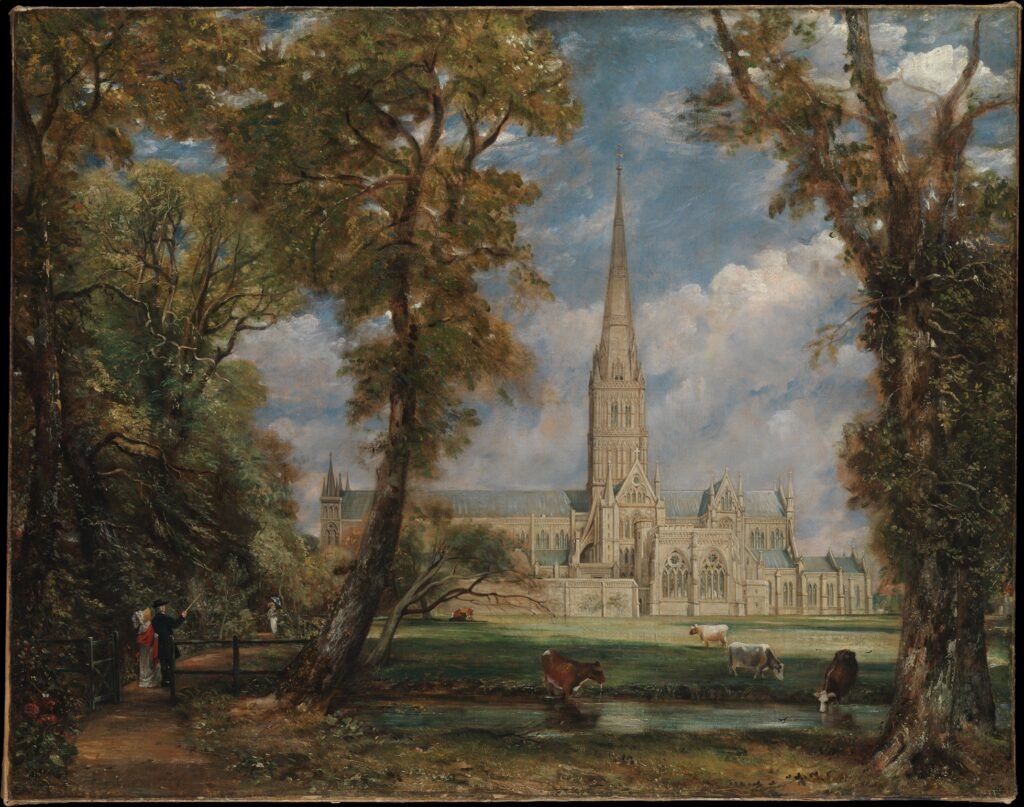
England’s Gothic was a little more restrained. Salisbury Cathedral, Britannica says, was built between 1220 and 1258, and its spire, added later, soars to 123 metres. That makes it the tallest surviving spire built before the 15th century anywhere in the world. Salisbury also keeps one of only four 1215 Magna Cartas still in existence, so it’s a two-for-one visit.
Why is it called “Gothic”?
As an insult. The Goths had nothing to do with it, as they had vanished centuries earlier. In the 1500s, Italian Renaissance writers who admired classical Rome looked at pointed arches and saw barbarism. The artist and biographer Giorgio Vasari, writing in 1550, called this “German” manner of building “monstrous and barbaric” and blamed its invention on the Goths, the tribes held responsible for wrecking Roman civilisation. The name stuck, and the insult wore off. By the 1800s Gothic was so admired that architects were copying it for railway stations and parliaments.
The Romanesque vs Gothic question is really a story about engineering and ambition: first, build something that will survive anything; then, build something that seems to float. To see how the rest of medieval art developed, explore medieval art. For the glowing windows that Gothic walls made possible, find out how medieval stained glass was made, and to see why pilgrims needed such huge churches in the first place, read about medieval pilgrimage.
Frequently asked questions
Is there such a thing as a Romanesque church with pointed arches?
Yes. Some Romanesque buildings, such as Durham Cathedral, already used pointed arches in places. That’s why experts look at the whole building, not just one feature.
In the Romanesque vs Gothic timeline, which came first?
Romanesque. It flourished in the 11th and 12th centuries, and Gothic grew out of it from the 1140s onwards, first in France and then across Europe.
Why do Gothic churches have so much glass?
Because the new engineering freed the walls from carrying the roof. Builders could open them up for enormous windows, and the extra light and height were meant to give worshippers a taste of heaven.
Is Notre-Dame in Paris Romanesque or Gothic?
Gothic. Building began in 1163, and with its pointed arches, rib vaults and flying buttresses it’s one of the most famous Gothic churches in the world.
Sources
- Julien Chapuis, The Metropolitan Museum of Art, Romanesque Art (2002)
- The Metropolitan Museum of Art, Apse from San Martín at Fuentidueña
- Durham World Heritage Site, Significance of the Site
- Emma J. Wells, The Past, The birth of Gothic: building heaven on earth
- French Ministry of Culture, Sainte-Chapelle
- UNESCO World Heritage Centre, Cologne Cathedral
- Cathédrale Saint-Pierre de Beauvais, Historical overview of Beauvais Cathedral
- Encyclopaedia Britannica, Salisbury Cathedral
- Laurence Shafe, The Gothic & Its Revival, quoting Vasari’s Lives (1550) via Chris Brooks, The Gothic Revival (1999)
- Beth Harris, Steven Zucker and Valerie Spanswick, Smarthistory, Gothic architecture, an introduction
- Mental Floss, Why “Gothic” was originally an insult