
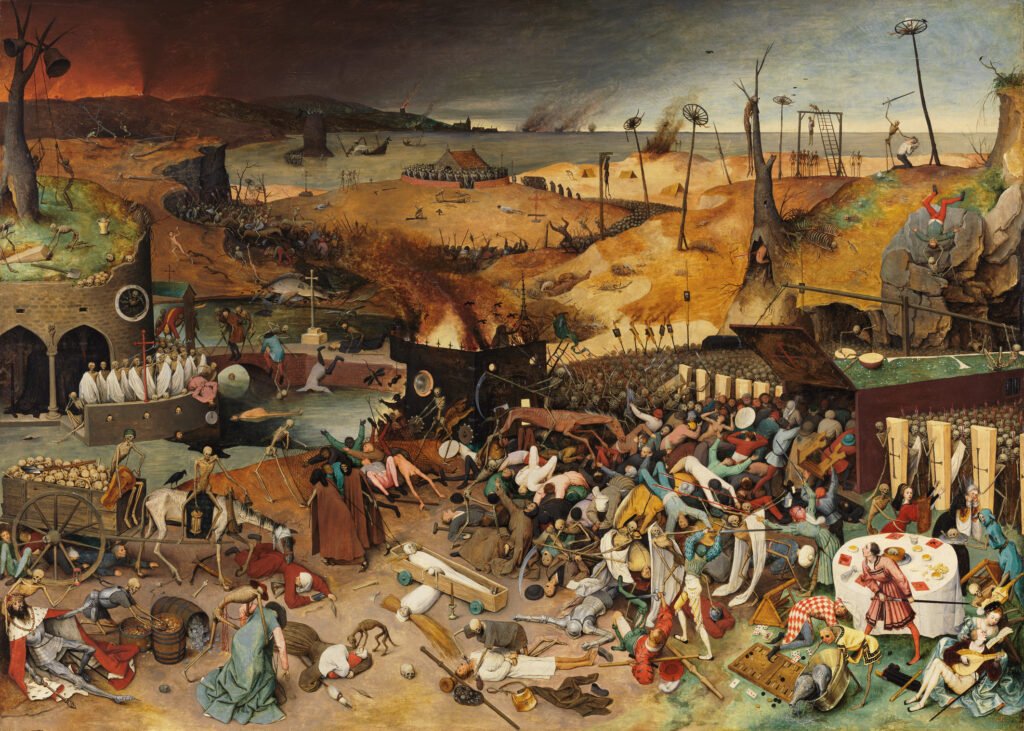
The Black Death: How a Plague Changed Europe
I will tell you a story about death, a story so violent that it left scars until today, and people still talk about it. It all started with some fleas. In the late 1340s a disease swept out of Asia and across Europe so fast that entire villages were emptied in a season. It was so fast and hit so hard that chroniclers back then wondered whether the world itself was dying. It killed at such a high and fast rate that it is still hard to take in today. We call it the Black Death, although nobody who lived in the Middle Ages used this name. Some good things also happened along with the disease: wages went up, and the plague loosened the grip of lords on their peasants. As a bonus, scientists discovered only recently that the Black Death left a mark on our DNA. Remember when I said earlier that it was a disease that burst out of Asia? Sounds familiar? Then wash your hands and let me walk you through this story.
Jump to a section:

What was the Black Death?
Simply put, it was a plague caused by a bacterium called Yersinia pestis. These were sad and hard times for the people of the Middle Ages, and many of them thought that the end of time was near. According to the US National Library of Medicine, rats and other rodents carry it, and their fleas pass it to people. This plague has three forms in total. The first one is bubonic plague, which attacks the lymph nodes. I think this one deserves a place in a top of the worst ways to die. The second form is septicemic plague, which gets into the blood, and the third one is pneumonic plague, which infects the lungs. The last one is the only kind that spreads directly from one person to another. Today, with modern medicine and the invention of antibiotics, the plague is curable. But in 1348 there were no such things as antibiotics. Sad times indeed!
An eyewitness, the Italian writer Giovanni Boccaccio, saw how the plague tore through Florence that year, and his description is grim. He described how the victims of the plague developed swellings in the groin or armpit. The image was grotesque, because some swellings were as large as an apple and others were egg-shaped, followed by dark blotches on the skin. Most of them, as he says, died within about three days of the first signs of the disease. This looks like a Halloween costume theme. Poor souls, what a way to die! Those swellings that Giovanni Boccaccio described are the buboes that give bubonic plague its name.
About the name “Black Death”: people at the time didn’t use it. Britannica notes that medieval chroniclers usually wrote of the “great mortality” (in Latin, magna mortalitas). Another source, the Online Etymology Dictionary, notes that “black death” first turns up in 16th-century Scandinavian chronicles, describing a later epidemic in Iceland. German writers attached it to the 1340s outbreak in the 18th century, and English followed in 1823. Even then, nobody is quite sure why it was “black”. In my opinion, the word “black” comes from the fact that death is associated with black and dark colours, and white with light and the living. Or maybe it comes from the fact that these were dark, black times, full of suffering.
Where did the Black Death begin?
For centuries, historians could do little more than point vaguely east. Then, in 2022, a team including Phil Slavin of the University of Stirling, Maria Spyrou of the University of Tübingen and Johannes Krause of the Max Planck Institute published a detective story in the journal Nature. In the late 1880s, excavators in Kyrgyzstan’s Chüy Valley, near Lake Issyk-Kul, had found gravestones from 1338 and 1339 whose Syriac inscriptions blamed the deaths on “pestilence”. The team tested ancient DNA from teeth buried there and found plague bacteria in three people whose gravestones carry the year 1338. Their strain turned out to be the ancestor of the many strains that later swept the world.
How the Black Death reached Europe
The traditional story begins at Caffa, a Genoese trading port in Crimea, where an Italian notary named Gabriele de’ Mussi claimed the disease broke out during a siege. The historian Hannah Barker has argued that the more likely springboard was Tana, another Black Sea port, and that the plague travelled west with ships carrying grain. Either way, Genoese galleys reached Messina in Sicily in October 1347, Genoa a month later, and Venice in early 1348. A Messina chronicler noticed that breath seemed to pass the illness between people who simply stood talking.
From the Mediterranean ports it raced inland. England’s turn came in the summer of 1348. A friar’s chronicle quoted by Dorset Life says two ships, one from Bristol, put in at Melcombe, now part of Weymouth, just before Midsummer Day (24 June), and that a sailor brought the illness with him. Before the year was out it had reached London.
The capital needed new burial grounds, fast. One of them, at East Smithfield near the Tower of London, opened around the turn of 1348–49. Fordham University’s medieval London project explains that Museum of London archaeologists excavated it in the 1980s. They recovered 558 burials from its western half and the remains of 192 more people from the eastern half, and some graves held bodies stacked five deep. Around 2,400 people may have been buried there in total.
How many people died?
Nobody counted, so historians have to piece the figure together. In a video essay, the OER Project explains that researchers have found more than 200 local communities where mortality can be worked out, mostly from landlords’ and churches’ records of tenants and clergy. On average those populations fell by about 44%, and most estimates for Europe as a whole land somewhere between 30% and 60%. Church records from the English diocese of Coventry and Lichfield, which noted the date of each death, suggest that about half of those recorded died, most of them within eight months.
The picture isn’t the same everywhere, though. In 2022 a team led by Adam Izdebski studied ancient pollen from 261 sites spread across 19 European countries, using it to track whether farmland went wild. They found sharp falls in farming in Scandinavia, France, Greece, central Italy and south-western Germany, matching the horror stories in the chronicles. But much of central and eastern Europe, along with Ireland and Iberia, showed farming carrying on or even growing. The pandemic was catastrophic, but not equally catastrophic everywhere.

Fear, blame and whips
Dark times, with death walking all around you and no cure that could save your loved ones, may turn people’s minds, and they might look for an answer elsewhere. Some people decided, and were sure, that God was punishing humanity. They started to march from town to town, whipping themselves in public, and according to the Christian History Institute some promised that 34 days of exile, flogging and hymn-singing would earn forgiveness. Seeing their madness, on 20 October 1349 Pope Clement VI condemned the movement and banned its processions. For a moment I thought this was a scene from a movie or a video game, but trust me, it was real!

Others looked for someone to blame, and the darkest chapter of the whole story followed. Jews were falsely accused of poisoning wells, a slander the Jewish Encyclopedia rightly calls absurd. Clement VI declared the accusation false in 1348, but it made little difference. In Strasbourg, in February 1349, more than 2,000 Jews were murdered after unrest stirred up by the butchers’ guild drove out the city leaders who had tried to protect them. Massacres followed in Worms, Mainz and many other towns.
What the Black Death reminds me of
A disease that spread all around, people dying really fast, panic and sadness. This reminds me of the COVID pandemic that happened a couple of years ago. There are a lot of similarities that I see between them. I felt on my own skin what it is like to be scared of getting sick and to pray to God that your relatives and loved ones will be safe too. I can relate to the people of the Middle Ages, who felt the same and prayed for the same things as me.
How the Black Death changed Europe
Survivors woke up in a changed world. With so many workers dead, the ones who were left could suddenly bargain. England’s rulers panicked. The Ordinance of Labourers of 1349 and the Statute of Labourers of 1351 tried to freeze pay at the levels of 1346–47 and forced able-bodied people to accept work, with spells in prison for anyone who refused. The chronicler Henry Knighton thought the law failed, although some modern historians argue it was enforced quite efficiently for a while.
In the long run the shortage of hands wore away the old system of serfdom, as lords switched to money rents and paid labour. Ordinary people ate better too, with more meat on the table than before. And in 2022, researchers reported in Nature that the plague even shaped our genes. Studying skeletons from London and Denmark, they found that people with two copies of a variant near a gene called ERAP2 had roughly a 40% better chance of coming through. The US National Institutes of Health points out the catch: the same variant raises the risk of Crohn’s disease today.
The 1340s outbreak wasn’t a one-off, either. It opened what scientists call the Second Plague Pandemic, with outbreaks returning again and again until the early 19th century. The famous beaked plague doctor, by the way, belongs to that later age, not to 1348.
To see how the plague years changed what people ate, discover what medieval peasants ate. For its effect on the old lord-and-serf system, find out what feudalism was, and for the truth about how long people really lived, read about medieval life expectancy. If you want to know where that beaked mask actually came from, explore medieval medicine. Or step back and see the bigger picture of daily life in the Middle Ages.
Frequently asked questions
Was the Black Death really spread by rats?
Rats and other rodents carried the bacteria, and their fleas passed it on. But the pneumonic form could also spread straight from person to person through the air, which helps explain how fast it moved.
How long did the first great wave last?
The worst of it hit Europe between 1347 and the early 1350s, though some places suffered for only a few months. The disease kept coming back in later outbreaks for centuries.
Could anyone in 1348 actually treat it?
Not effectively. Doctors had no idea bacteria existed, so they tried bloodletting, special diets and herbal remedies. Today plague is curable with antibiotics if treatment starts early.
Is the plague still around?
Yes. Yersinia pestis still lives in wild rodents in parts of the world, and there are occasional human cases. The difference is that a quick course of antibiotics usually saves the patient.
Sources
- MedlinePlus, US National Library of Medicine, Plague
- Giovanni Boccaccio, The Decameron, Introduction, Internet Medieval Sourcebook (Fordham University), The Black Death in Florence
- Encyclopaedia Britannica, What are other names for the Black Death?
- Online Etymology Dictionary, Black Death
- Archaeology magazine, Genetic study identifies origin of the Black Death (2022)
- Cosmos magazine, Origins of the Black Death revealed (2022)
- Medievalists.net, How the Black Death came to Europe, on Hannah Barker’s research (2021)
- Dorset Life, The Black Death in Dorset
- Fordham University, Medieval London, East Smithfield
- OER Project, Counting the Dead: How the Black Death Killed Half of Europe (transcript)
- Max Planck Institute for the Science of Human History, Black Death mortality not as widespread as long thought (2022)
- Christian History Institute, Don’t whip yourself for faith, said the Pope
- Jewish Encyclopedia (1906), Black Death
- Jewish Encyclopedia (1906), Strasburg
- The Statute of Labourers, 1351, translation hosted by the University of Missouri–St. Louis, The Statute of Labourers
- US National Institutes of Health, How the Black Death shaped human evolution (2022)