
Was King John Really England’s Worst King?
Every family has that one relative nobody wants to sit next to at Christmas. England’s royal family has John. He was even born on Christmas Eve, which feels like a warning. In seventeen years on the throne he lost most of his French territory, fell out with the pope, squeezed his barons for every penny and ended up at war with his own country. No English monarch since has dared to take his name. So is the old “King John worst king” label a fair one, or did a few grumpy monks stitch him up? Let’s put him on trial and you can be the jury.
Jump to a section:
Who was King John?
John was the youngest son of Eleanor of Aquitaine and Henry II, born in Oxford on 24 December. Even the year is uncertain: Westminster Abbey says many scholars accept 1167, though some historians give 1166. As the baby of a big family, nobody imagined he would ever wear a crown. According to Medievalists.net, it was his own father who dubbed him “Lackland”, because there was so little land left over for him after his older brothers had been provided for. Thanks, Dad.
Then his brothers started dying. When Richard the Lionheart died on 6 April 1199, the throne passed to John, and on 27 May he was anointed and crowned in Westminster Abbey. The Abbey’s own account says he behaved with “unseemly levity” during the ceremony and left before taking Communion. Not the most promising start for a man about to be anointed by God.
Charge one: the nephew who vanished
John had a rival. His nephew Arthur of Brittany, the son of his late brother Geoffrey, also had a claim to the family lands, and the French king Philip II was happy to back him. In 1202 Arthur besieged his own grandmother, the elderly Eleanor of Aquitaine, in the castle of Mirebeau. John rushed to the rescue, freed his mother and captured Arthur.
Arthur was locked up, first at Falaise in the care of Hubert de Burgh, and in 1203 he simply disappeared. The Internet Shakespeare Editions, which collect the evidence behind Shakespeare’s play about John, set out the competing stories:
- The chronicler Ralph of Coggeshall wrote that Hubert was told to blind and castrate the boy, and reported him dead instead.
- The French writer William the Breton claimed John ran his nephew through with a sword while they were out in a boat on the Seine.
- The annals of Margam Abbey, which the editors consider perhaps the most convincing account, say John killed Arthur at Rouen in a drunken fury, tied a stone to the body and dropped it in the river.
Nobody can prove exactly what happened. But the historian Marc Morris, writing in History Today, does not hesitate: Arthur was murdered on John’s orders. Either way, a royal prince vanished while in his uncle’s custody, and that is never a good look.
Charge two: losing the family business
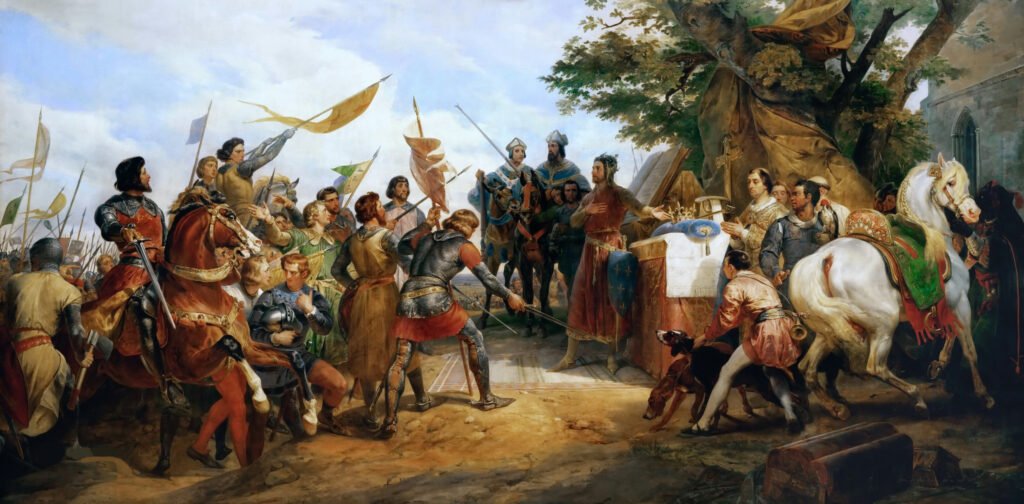
John had inherited a huge empire stretching from England through Normandy and Anjou down to the Pyrenees. By 1204 Philip II had taken Normandy and most of the rest. Morris sums up the record bluntly: John lost nearly all of it and never won it back. English writers noticed, and his poor showing on the battlefield earned him a second nickname, “Softsword”.
He spent the next ten years and a mountain of money trying to recover his losses. On 27 July 1214 it all came crashing down at Bouvines, near Lille, where Philip II crushed the allied army led by Emperor Otto IV that John was relying on. John himself was not even there: he was campaigning in western France, where his own army had already fallen back. There would be no return to Normandy.
Charge three: picking a fight with the pope
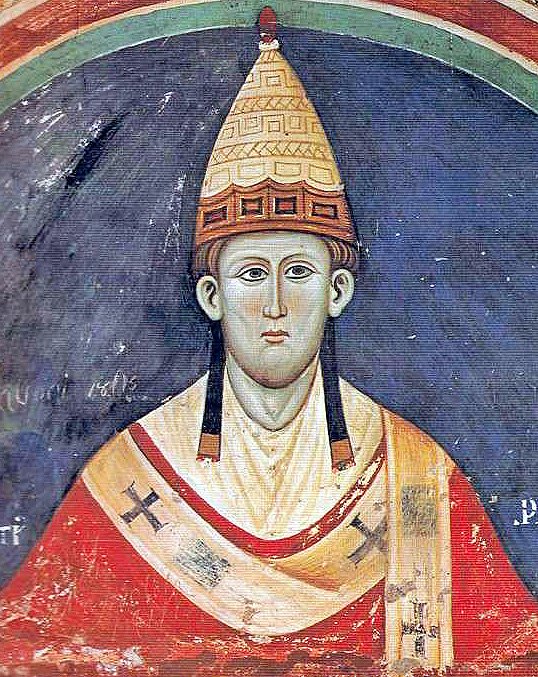
Next, John took on the most powerful man in Christendom. He and Pope Innocent III clashed over who should be Archbishop of Canterbury: Innocent wanted Stephen Langton, and John would not accept him. In 1208 the pope placed England under an interdict, a kind of spiritual strike in which most church services stopped. Marc Morris likens it to ordering the clergy to down tools. In November 1209, according to Historic UK, Innocent went further and excommunicated John himself.
John held out for years, but with a French invasion looming he gave in. In 1213 he submitted to the pope, and Innocent became his feudal overlord. English Heritage calls it a “humiliating climbdown”. Few kings have lost an argument quite so publicly.
Charge four: the taxman in a crown
Wars cost money, and John needed lots of it. Morris argues that he squeezed more cash out of the English than “any king since the Norman Conquest”. English Heritage adds that heavy taxes were not enough, so he also raised money “by questionable means”.
The barons eventually ran out of patience. In June 1215 they forced him to agree to Magna Carta at Runnymede. Within weeks John asked his new friend the pope to cancel it, and on 24 August 1215 Innocent declared the charter “shameful, demeaning, illegal and unjust”, as the British Library records. The result was civil war.
The grand finale: pigs, peaches and a lost treasure
The last year of John’s life reads like a black comedy. In the autumn of 1215 he besieged rebel barons inside Rochester Castle. English Heritage describes how his miners dug under one corner of the keep and then burned the fat of forty pigs to destroy the timber props that held it up. The corner collapsed, and hunger eventually forced the rebels out.
It did not save him. The rebels invited Prince Louis of France to take the crown, and Louis landed in England in May 1216. If you are keeping score in the King John worst king debate, this was not a great year. Then, in October, came the most famous accident of the reign. As John’s baggage train crossed the tidal sands of the Wash, it was lost to the incoming sea. The chronicler Roger of Wendover described how “bottomless whirlpools” swallowed the lot. Treasure hunters have been digging ever since, but as Alexander Lee puts it in History Today, “So far, however, no gold or jewels have been found.”
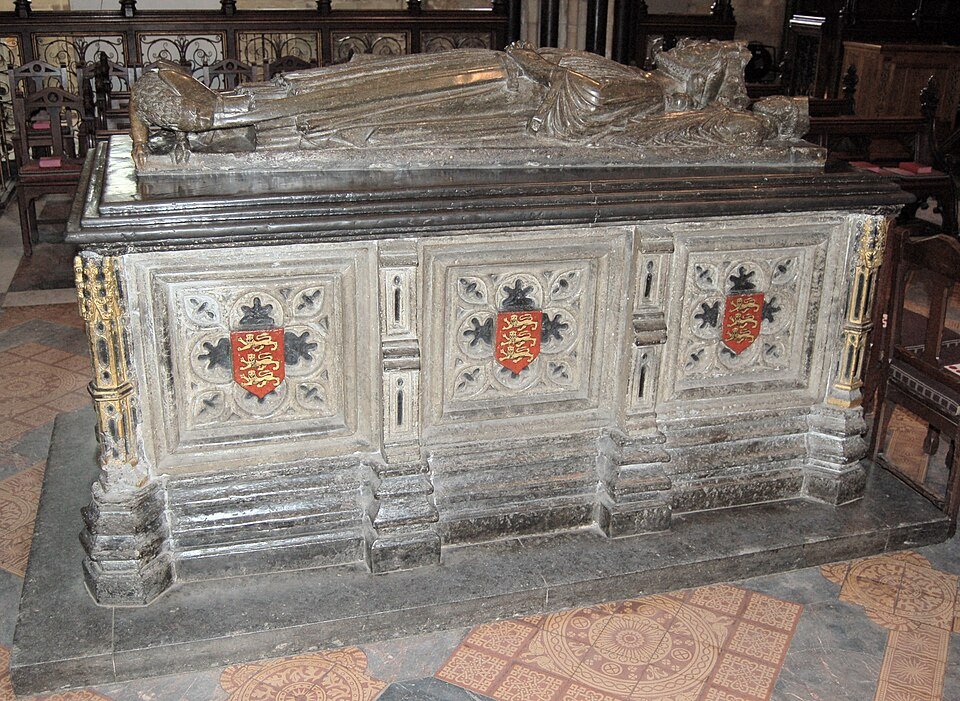
John was already ill with dysentery. Westminster Abbey repeats the old story that he made things worse by gorging on peaches and too much cider. He struggled on as far as Newark Castle and died there during the night of 18 to 19 October 1216. At his own request he was laid to rest in Worcester Cathedral, close to the shrines of the saints Wulfstan and Oswald. Perhaps he hoped some of their holiness would rub off.
The case for the defence
Every defendant deserves a lawyer, and not every historian accepts the King John worst king verdict. In History Today, Graham E. Seel argued that much of John’s dreadful image was created by monastic chroniclers who had a grudge against him, and that the official records reveal a more complicated man. In the 16th century the Tudors briefly rehabilitated him, because he had dared to defy the pope.
Those records are part of his defence. The National Archives explains that the surviving systematic series of the royal writing office’s records begins in 1199, soon after John came to the throne, with copies of its outgoing letters recorded on long parchment rolls. John was, in the Archives’ words, “very keen on filing”, and his system shaped royal recordkeeping for centuries. He was also frequently on the move, with his clerks following behind. Not exactly the profile of a lazy tyrant.
There is just one problem. Those same rolls hold much of the evidence against him. Even the National Archives’ own blog concedes that, as a king, John was “almost undoubtedly” bad.
The verdict: is “King John worst king” fair?
The monks certainly thought so. The chronicler Matthew Paris, writing a generation after John’s death, delivered the most famous insult ever aimed at an English monarch: “Foul as it is, Hell is made fouler by the presence of John.” Centuries later, A. A. Milne opened a children’s poem with the line “King John was not a good man.”
To be fair to John, the competition for the title of worst king is stiff, and he was not a monster in every respect. He took a close, personal interest in the business of government. But he was also cruel, untrustworthy and unlucky, and he lost almost everything he inherited. Put the “King John worst king” question to most historians, and you tend to get the same answer as Marc Morris: he deserves to stay at the very bottom of the list. And the best proof of all? In more than 800 years, not a single English monarch has wanted to be called John II.
To compare John with the rulers who did better, and some who did worse, explore medieval kings. You can also read what Magna Carta actually said, or find out how a medieval coronation worked.
Frequently asked questions
Why do so many people rank King John worst king of England?
Because the charge sheet is long: a nephew who vanished in his custody, the loss of Normandy, a feud with the pope, crushing taxes and a civil war, all recorded by chroniclers who loathed him.
Why has England never had a John II?
There is no law against it. But John’s reputation was so poor, helped along by hostile chroniclers such as Roger of Wendover and Matthew Paris, that later royal families simply avoided the name for their heirs.
Is John’s treasure still buried somewhere under the Wash?
Possibly. His baggage was lost in October 1216 near the Wellstream, a river that has since become the Nene, but searches, including a dig in 2024, have found no gold or jewels so far.
What did the nickname “Lackland” mean?
It meant just that: a prince without land. His father, Henry II, gave it to him because, as the youngest son, he stood to inherit very little.
Did John really murder his nephew Arthur?
Nobody knows for certain. Arthur vanished in royal custody in 1203, and medieval writers told several versions of his death. Many historians, Marc Morris among them, believe John was responsible.
Where can you visit John’s tomb today?
In Worcester Cathedral, just before the high altar. No older royal effigy survives anywhere in England, and the cathedral library still holds his will.
Sources
- Marc Morris, History Today, King John: Still England’s Greatest Villain (2015)
- Graham E. Seel, History Today, via Medievalists.net, Good King John (2012)
- Alexander Lee, History Today, King John’s Lost Treasure (2024)
- The National Archives blog, King John and recordkeeping
- Westminster Abbey, John
- Worcester Cathedral, King John
- Internet Shakespeare Editions, Historical Notes on King John: Arthur of Brittany
- Medievalists.net, The 10 Strangest Nicknames of Medieval Rulers (2023)
- Victoria Masson, Historic UK, Why Has There Only Been One King John?
- Paul Pattison, English Heritage, The Sieges of Dover Castle 1216–17
- English Heritage, History of Rochester Castle
- British Library, “Shameful and demeaning”: the annulment of Magna Carta
- Encyclopaedia Britannica, Battle of Bouvines
- City of London, Magna Carta resource timeline (PDF)
- All About History, via Live Science, All About History 114: Was King John England’s worst king?