
What Did Medieval Peasants Eat? Bread, Stew and a Lot of Cheese
Close your eyes and imagine a medieval meal. Odds are you see a long table, a roast boar with an apple in its mouth, and somebody in a crown waving a turkey leg. Lovely. Now put that picture away, because almost nobody ate like that. Most people in the Middle Ages were peasants, and their dinner looked very different. So what did medieval peasants eat? The honest answer is: a lot of bread, a lot of stew, more cheese than you would expect and, depending on the century, surprisingly little bacon. Grab a spoon. We are going in.
Jump to a section:
What did medieval peasants eat? The short version
If you had to pack a peasant’s diet into one shopping list, it would read something like this:
- Bread, and plenty of it, usually made from whatever grain the family could get.
- Pottage, a thick stew of vegetables and grain, with meat when there was any.
- Dairy, especially cheese, butter and milk.
- Ale to drink, and yes, water too.
- Whatever the season offered: peas, beans, onions, leeks, apples, berries and nuts.
Notice what is missing? Spices. Exotic fruit. Sugar. The British Museum points out that while the upper classes enjoyed imported foods, ordinary families had to make do with whatever their own fields and neighbours could supply. If it did not grow nearby, you probably did not eat it.
Bread: the edible plate of the Middle Ages
Bread was the backbone of the diet. But forget the soft white loaf from the supermarket. White wheat bread was a luxury. According to an educational guide from Rosslyn Chapel in Scotland, poorer households baked with barley and oats, and padded the dough out with peas and beans. Oatcakes and flat breads were common too.
Peas and beans in your bread? It sounds odd, but think of it as the medieval version of “use what’s in the cupboard”. A loaf that filled you up was a good loaf.
Here is where it gets interesting. The historian Christopher Dyer studied the meals given to harvest workers on manors across the south and east of England over two hundred years. In the 1200s, those labourers were handed loaves in large numbers and a little cheese, while ale, fish and meat came in modest portions. Bread, in other words, was most of the meal.
Pottage: the soup that never ended
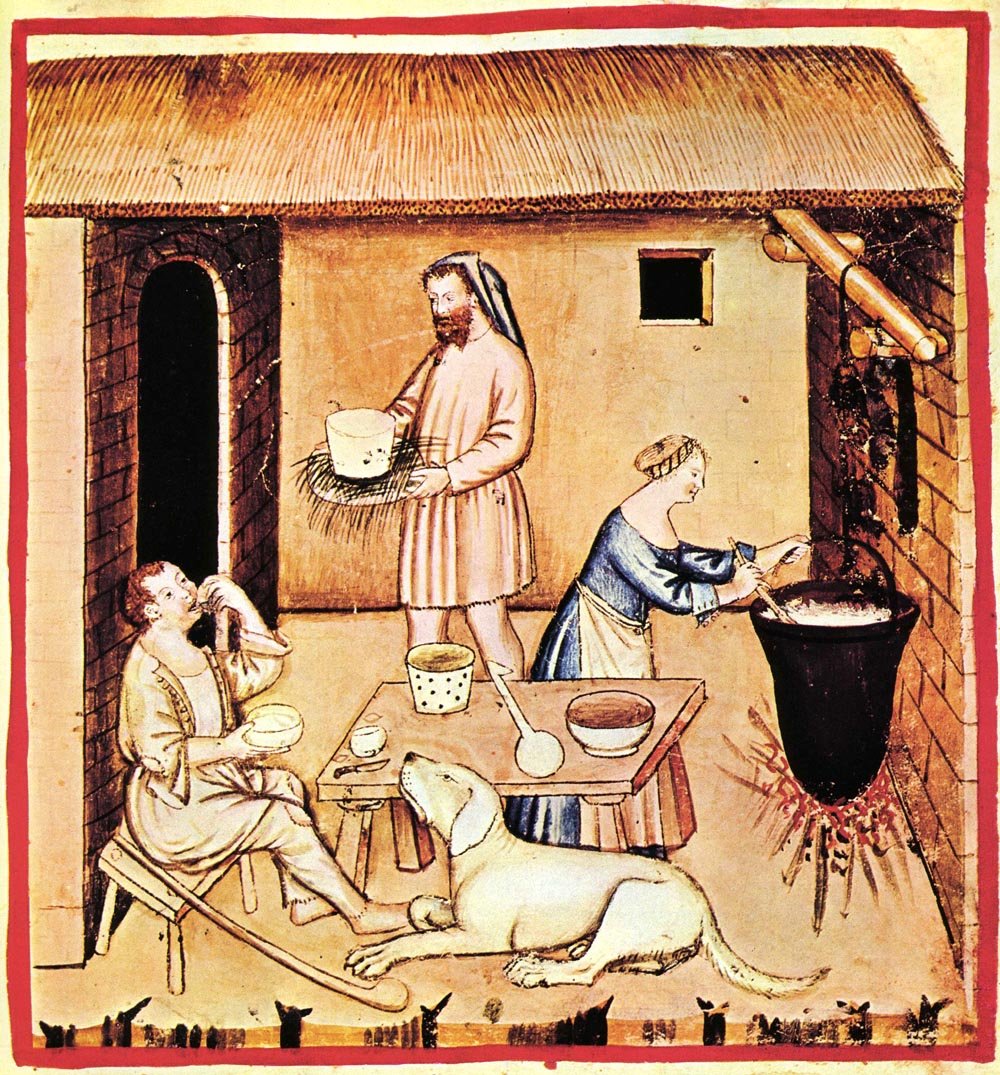
If bread was the backbone, pottage was the heart. It was a thick stew, cooked slowly in a pot over the fire, and it could hold almost anything: grain, beans, cabbage, onions, herbs and, on a good day, a bit of meat.
For a long time historians could only guess at the recipe. Then chemists got involved. Two scientists at the University of Bristol, Julie Dunne and Richard Evershed, analysed the fat locked inside broken pots excavated at West Cotton, a medieval village in Northamptonshire. Pottery soaks up fat like a sponge, and the traces can survive for centuries.
The results, published in 2019 in the Journal of Archaeological Science, were a nice surprise. The pots had been used for stews of beef and mutton, cooked up with leeks and cabbage. According to the magazine Current Archaeology, the team tested 123 pieces of pottery from 73 vessels. Around three in five contained traces of beef or mutton, and roughly one in four seems to have been kept for dairy alone.
And pork? Only about one pot in ten. The researchers think pigs were more often roasted whole on a spit than chopped into the stew. So the next time someone tells you peasants lived on boiled turnips, you have chemistry on your side.
The cheese surprise
The same study found plenty of dairy, probably the soft, fresh “green cheeses” that peasants are known to have eaten. “Green” here does not mean mouldy. It means young and unripened, a bit like cottage cheese.
That fits what Dyer found in the harvest records, where cheese turns up alongside bread from the start. Cows, sheep and goats gave milk, milk became butter and cheese, and cheese kept for a while without a fridge. For a family with one cow, that was a very good deal.
Meat: rare, then not so rare
So did peasants eat meat? Yes, but how much depended a great deal on when you were born.
Dyer’s harvest workers are the clearest example. In the 1200s their meals were mostly bread. Two centuries later the picture had flipped: bread mattered far less, and a high share of the diet came from meat and ale. Even the details changed. Barley and rye bread gave way to wheat, and bacon gave way to beef.
What happened in between? Dyer places the change across the 1300s, the century of the Black Death. When plague killed a huge share of the population, the survivors found that labour was suddenly scarce and valuable, and workers were in a position to demand better pay and better food. If you want the wider picture of how those years reshaped ordinary life, it is all in our overview of daily life in the Middle Ages.
Fish days: when the Church set the menu
Even when there was meat, you could not always eat it. The Church banned meat on fast days. The British Museum notes that Fridays were compulsory fish days, and in the earlier Middle Ages Wednesdays and Saturdays were too. Add the forty days of Lent, when fish replaced meat entirely, and a large part of the year was meat-free by law.
For a peasant far from the sea, “fish” usually meant salted, smoked or dried fish rather than a fresh trout. Tasty? Let’s say it was an acquired taste. The Church shaped far more than the menu, of course, and you can read how it ran almost every corner of life in our piece on religion in the Middle Ages.
What did they drink? (Spoiler: water)
You have probably heard that medieval people never drank water because it would kill them, so they drank beer all day instead. It is one of those facts everybody knows and nobody checks.
The historian Katherine Harvey, writing for the Wellcome Collection, is clear on this: whatever the dangers, people in the Middle Ages drank water. What is true is that water had a poor reputation. Doctors preferred wine, and some writers sneered at water as a drink fit only for labourers. Ale was certainly a huge part of the ordinary diet, and it was often brewed by women at home. But peasants drank water as well, and people had their own ways of testing whether a source was any good.
Medieval ale, by the way, was not your modern pint. It was often thick and even a little chewy, closer to a drinkable snack than to a night out. If you enjoy busting popular beliefs like this one, there are plenty more in our list of medieval myths.
When the food ran out
All of this assumes the harvest came in. Sometimes it did not. Phillipp Schofield, professor of medieval history at Aberystwyth University, counts 23 bad harvest years, for one grain or more, in the 140 years from 1210 to 1350. The worst stretch was the Great Famine in the 1310s, with 1316 the most terrible year of all.
In bad years people traded down to cheaper grains like rye and oats. In truly desperate times, chroniclers describe people eating dogs, cats, horses and even tree bark. Besieged garrisons were pushed to the same grim menu, as you will see in our look at how castles were starved out.
The end of winter was always the hungry season, even in normal years. The stored grain was running low and the new crops were not yet ready. Spring meant hope, but it also meant tightening your belt.
So, would you have eaten well?
Honestly? It depends when you turned up. A peasant in the 1200s ate a plain, filling, rather repetitive diet built on bread, pottage and cheese. A farm worker in the 1400s might eat more meat than many people do today. Neither was a feast with a roast boar. But neither was the miserable gruel of the movies either.
Not bad for people who never saw a potato. Potatoes only reached Europe from the Americas after 1492, so every chip-free meal above was entirely normal.
Frequently asked questions
Did medieval peasants eat meat?
Yes. Residues in cooking pots show stews with beef and mutton, and meat became much more common after the Black Death. It was still banned on church fast days.
What was pottage?
Pottage was a thick, slow-cooked stew of grain, greens like cabbage or leeks, and sometimes meat. It was cooked in one pot over the fire and eaten almost every day.
What bread did medieval peasants eat?
Mostly dark, coarse bread from barley, rye or oats, sometimes stretched with peas and beans. White wheat bread was a luxury until the later Middle Ages.
Did medieval people drink water?
Yes. Water had a low reputation and ale was very popular, but historians are clear that ordinary people drank water too.
Sources
- University of Bristol, Medieval peasant menu (news release on the West Cotton study, 2019)
- Current Archaeology, Dissecting the diet of medieval peasants
- Christopher Dyer, “Changes in Diet in the Late Middle Ages: the Case of Harvest Workers”, Agricultural History Review 36 (1988), abstract
- The British Museum, How to cook a medieval feast
- Rosslyn Chapel, Diet and Drink in the Middle Ages (PDF)
- Katherine Harvey, Wellcome Collection, The vilest of all beverages
- Phillipp Schofield, EuropeNow, Famine and Dearth in Medieval England