
How Did Parliament Begin?
Every medieval king eventually ran into the same awkward problem: wars are expensive, and the money belonged to other people. You could simply grab it, but that tended to end with angry barons, burning castles and, in one famous case, a very long document called Magna Carta. The smarter move was to call the important people together, explain how badly you needed cash, and hope they agreed. That rather grumpy conversation is where the origins of parliament really lie. Over a few centuries it turned into an assembly with knights, townsmen, a Speaker and the power to remove a king. Pull up a bench. It’s a long session.
Jump to a section:
The origins of parliament: kings who needed advice (and money)
The origins of parliament go back well before anyone said the word. English kings had always liked to consult their top people. The Anglo-Saxons had the Witan, a gathering of the king’s chief advisers and nobles. The UK Parliament’s own history is clear that it was a sounding board, not a brake: the king could act without its approval.
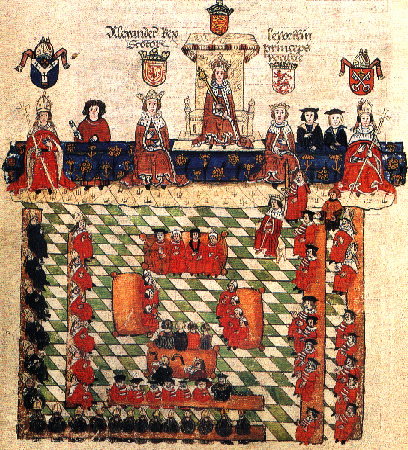
After 1066 the Norman kings carried on the habit. Their specially summoned assembly of great lords and churchmen was called the Great Council, in Latin the magnum concilium, and Parliament’s historians see it as the seed of today’s House of Lords. Kings increasingly wanted these men to back their decisions, and above all their taxes. Keep that word, taxes, in mind. It’s the engine behind the whole story.
Where does the word “parliament” come from?
It comes from French. In the 1200s “parlement” was simply a talk or a discussion, from the verb parler, to speak. According to the UK Parliament, the earliest recorded use of the term in England comes from 1236, when it described a meeting of the king’s Great Council.
Magna Carta had already pushed things along in 1215. Parliament’s timeline notes that King John’s charter recognised the barons’ right to counsel the king through his Great Council. In other words, kings were expected to ask first, especially before taking money. The full drama of that summer at Runnymede deserves a story of its own.
Iceland and León: who got there first?
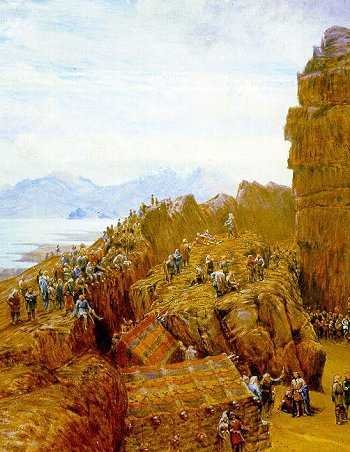
England likes to call Westminster the “mother of parliaments”, but it was not the first assembly of its kind. In Iceland, UNESCO explains, the Althing was set up in 930 as an open-air assembly for the whole island. For two weeks each year it met at Þingvellir to make laws and settle quarrels, and it kept meeting there until 1798.
Spain has a strong claim too. In 1188 King Alfonso IX of León held a royal council at which elected men from the towns and cities sat alongside the nobles and bishops. UNESCO added the resulting decrees to its Memory of the World register, and the nomination calls them the earliest written proof of parliamentary government in Europe. There is one catch, which the nomination admits: no original copy survives, only later versions. So the origins of parliament are not purely English, even if England’s version became the most copied.
Henry III, an empty purse and the “Mad Parliament”
Back in England, the next chapter in the origins of parliament was written by a king who kept running short of money: Henry III. In 1254, according to Parliament’s timeline, sheriffs had orders to send knights chosen in the counties to talk about taxation. A few years later Henry was in real trouble. Britannica says a reckless scheme in Sicily had left him bankrupt, and in 1258 his barons cornered him. When parliament met at Oxford that June, one chronicler called it the “Mad Parliament”, and the name stuck.
The barons named their price. Under the Provisions of Oxford, a council of fifteen barons would advise the king on every important matter, and parliament would gather three times every year. Henry signed, then spent the next few years trying to wriggle out of it. That did not go well.
Simon de Montfort invites the towns
The man who forced the issue was Simon de Montfort, Earl of Leicester and, awkwardly, Henry’s own brother-in-law. He beat the royal army at Lewes in May 1264 and found himself running England in the king’s name, with Henry held captive. To make his government look legitimate, he summoned a parliament.
It met at Westminster on 20 January 1265, and the guest list made history. The National Archives still holds the record of who was called: bishops, abbots and magnates as usual, but also two knights from every county and two burgesses each from towns such as York and Lincoln, plus men from the Cinque Ports. It was the earliest recorded occasion on which ordinary townsmen were brought into an English parliament. Unusually, the archives point out, de Montfort mostly wanted their support and advice rather than their money.
His triumph did not last. On 4 August 1265 the king’s son, the future Edward I, defeated him at the Battle of Evesham, and de Montfort was killed. Even so, a plaque on the Leicester Tower at Evesham, close to where he fell, calls him “the father and founder of the British House of Commons”, and the origins of parliament in its modern shape are usually traced to his winter assembly.
Edward I and the Model Parliament
The prince who killed de Montfort ended up copying his idea. As King Edward I, he had wars with France and Scotland to pay for, plus a Welsh revolt he had only just crushed, and he worked out that taxes went down more easily if the people paying them had agreed. In 1295 he summoned the assembly that the Victorian historian William Stubbs later named the Model Parliament. Britannica describes a huge gathering: bishops and abbots, archdeacons, seven earls and 42 barons, plus two knights from each shire and two representatives from each city and borough.
Edward’s summons included a famous line borrowed from Roman law: what touches everyone should be approved by everyone. It sounds wonderfully democratic. In practice it meant, “I’m about to tax you, so you may as well say yes.” Still, the pattern of lords, churchmen, county knights and town burgesses stuck, and Parliament’s timeline treats 1295 as the template for what followed.
Lords, Commons and the first Speaker
Over the next century, the origins of parliament turned into something we would recognise. From 1278, clerks began collecting its business, especially petitions and new laws, into what became the Rolls of Parliament. By 1332 the county knights and town burgesses were being called “the Commons”, and from 1341 they held their discussions apart from the king and the great lords. That’s the beginning of two houses. In 1362, a statute said all taxation needed Parliament’s consent, which gave the Commons a lever they would pull for centuries.
Then came the Good Parliament of 1376. Old King Edward III was failing, and the Commons were furious about corruption at court. They chose Sir Peter de la Mare to speak for them, and together with the Lords they put some of the king’s ministers on trial. This was impeachment, a weapon Parliament would use again and again. De la Mare is often counted as the first Speaker, although the title first appears in the official record for Thomas Hungerford in 1377. His reward for bravery? The king’s son John of Gaunt had him locked up in Nottingham Castle once Parliament went home.
Bats, devils and the Unlearned Parliament
Medieval Parliaments picked up some brilliant nicknames, and they add a lot of colour to the origins of parliament. In October 1404 Henry IV summoned one to Coventry and ordered that no lawyers be elected. The History of Parliament’s research suggests he thought lawyers were stirring up opposition to his taxes. The chronicler Thomas Walsingham mocked it as the “Unlearned Parliament”. The ban only half worked: six of the 99 MPs we know about were still lawyers.
In 1426, with the Duke of Gloucester and Bishop Henry Beaufort on the edge of open war, Parliament met in Leicester. Members were told to leave their weapons at their lodgings, so, a London chronicler reported, they arrived carrying hefty bats over their shoulders instead. That is how it became the “Parliament of Bats”. As for the “Parliament of Devils”, which met at Coventry in 1459 and punished the Yorkist leaders who had fled abroad, historians point out that its scary name was added much later.
When Parliament helped unmake a king
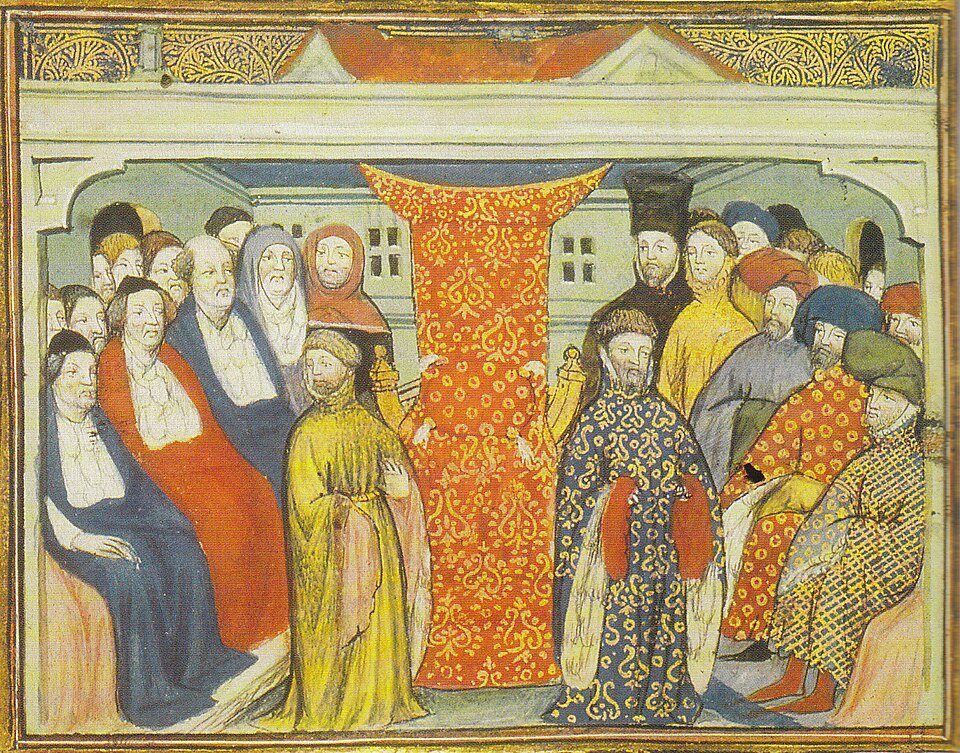
By 1399 the assembly had become powerful enough to help change who wore the crown. Richard II had made too many enemies, and his cousin Henry of Bolingbroke returned from exile with an army. Parliament’s timeline records that Richard was deposed and Henry IV’s reign began, with the lords and the Commons giving the change their seal of approval. A body that started as the king’s advisers had just helped remove one.
That’s the real lesson from the origins of parliament: nobody designed it. It grew out of royal money troubles, baronial revolts and a lot of arguing, one crisis at a time. To see how the rulers who sat across the table won and lost their power, explore medieval kings. For the charter that started the “ask first” habit, discover what Magna Carta was, and to see how the landholding system behind all those lords and knights worked, find out what feudalism was.
Frequently asked questions
Why do historians argue about which parliament came first?
Because it depends on what counts. Iceland’s Althing met from 930, León brought elected townsmen into a royal council in 1188, and England added knights and burgesses in 1265. Each is “first” at something slightly different.
Did ordinary people get to vote for medieval MPs?
No. The knights and burgesses were chosen by small groups of better-off men in the counties and towns. Peasants and women had no say, and the vote would stay limited for centuries.
What did the earliest English parliaments actually do all day?
Mostly they talked about money. Kings asked for taxes, and members answered with lists of complaints and petitions they wanted fixed first. Law-making and trials, such as impeachments, grew out of that bargaining.
Where did medieval English parliaments meet?
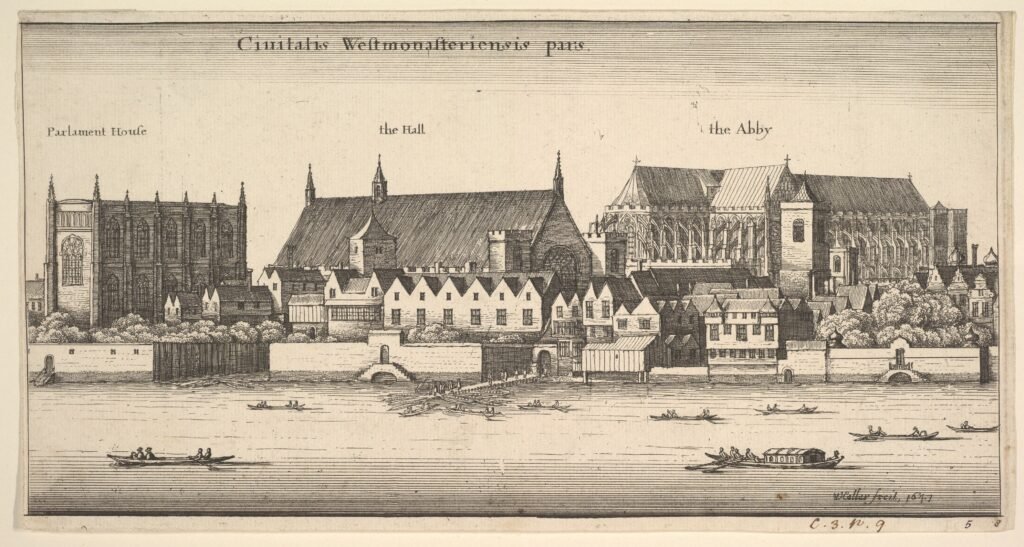
Usually at Westminster, but not always. Kings called them wherever suited them, including Oxford in 1258, Coventry in 1404 and Leicester in 1426. From 1352 the Commons often gathered in the Chapter House of Westminster Abbey.
Sources
- UK Parliament, Origins of Parliament
- UK Parliament, Key dates 1215–1399
- UK Parliament, Simon de Montfort’s Parliament
- UK Parliament, The rise of the Commons
- The National Archives, List of people summoned to the 1265 Parliament
- The National Archives, The Mad Parliament
- Encyclopaedia Britannica, Provisions of Oxford
- Encyclopaedia Britannica, Model Parliament
- Simon Payling, History of Parliament, A new beginning? Stubbs’s ‘Model’ Parliament of 1295 (2019)
- UNESCO World Heritage Centre, Þingvellir National Park
- UNESCO Memory of the World, The Decreta of León of 1188 (nomination file)
- History Hit, When Was Parliament First Summoned and First Prorogued?
- British Heritage, Evesham remembers the Father of Parliament
- Hannes Kleineke, History of Parliament, The Good, the Bad and the Wonderful (2019)
- Simon Payling, History of Parliament, Too few lawyers? The ‘Unlearned Parliament’ of October 1404 (2019)
- Hannes Kleineke, History of Parliament, The true beginning of troubles? The Parliament of Bats, 1426 (2026)
- History of Parliament, Bats and Devils: Henry VI’s ‘seasonally-named’ parliaments (2019)