
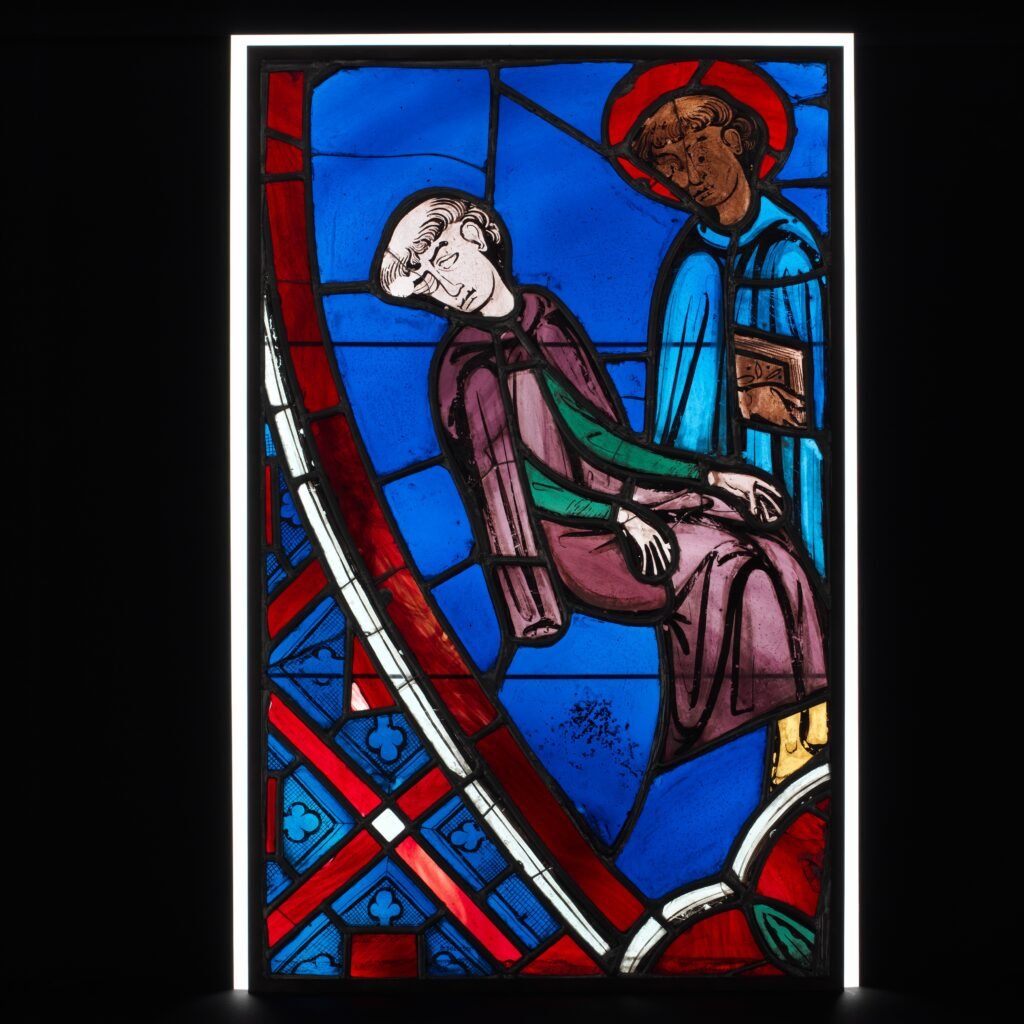
How Was Medieval Stained Glass Made?
Long before cinema screens, medieval people had their own blockbusters, and they were glowing on the walls of their churches. Step inside a great cathedral on a sunny morning and the light comes through in deep blues, ruby reds and gold, with saints, kings and monsters looking down at you. Medieval stained glass was the high-tech special effect of its day. But how do you make a picture out of sand, ash and a little molten metal, with no electricity and no modern tools? Pull on a pair of very thick gloves. We’re heading into the workshop.
Jump to a section:
Why churches fell in love with coloured glass
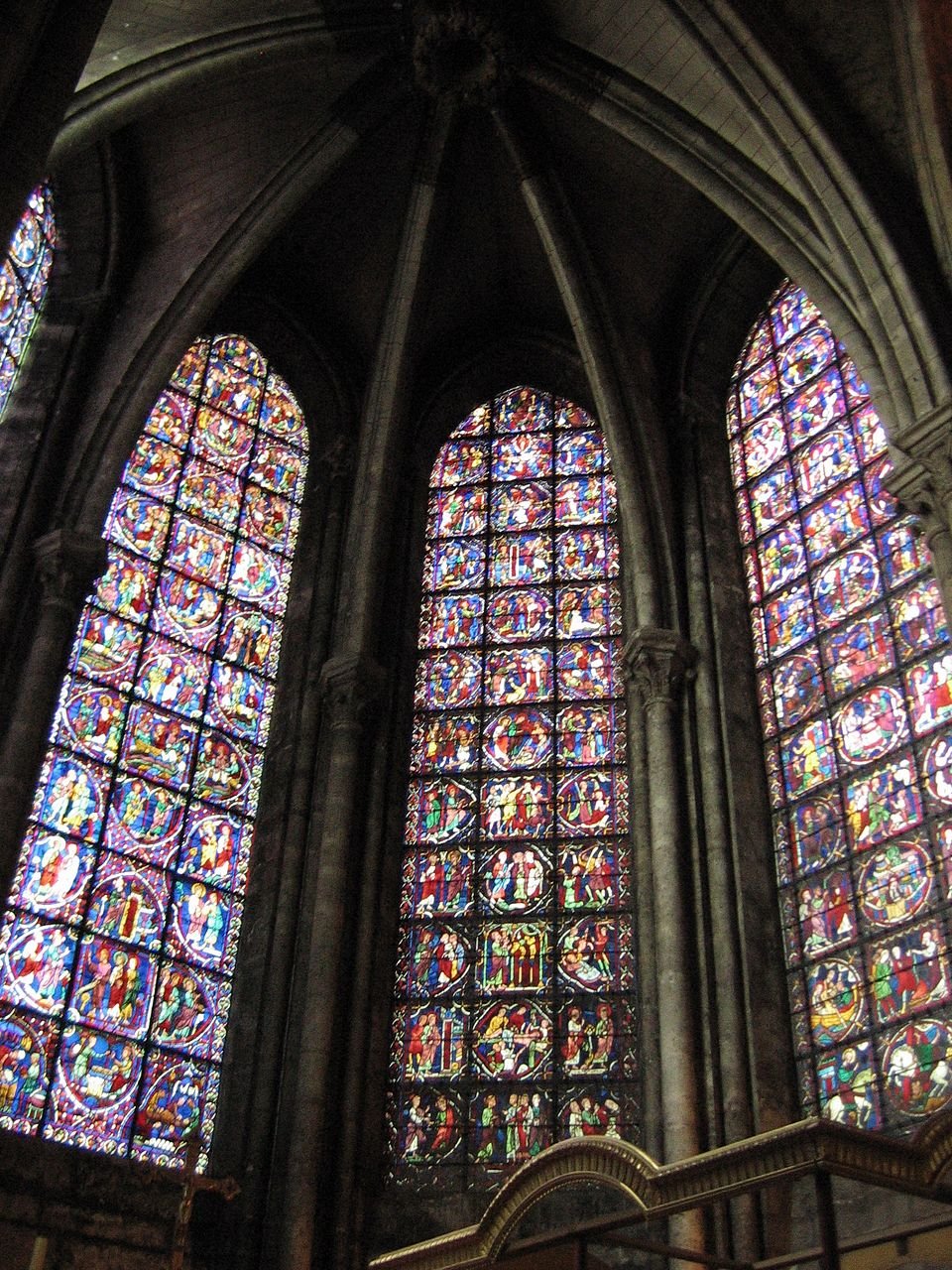
Coloured glass windows go back to ancient Rome, but the Metropolitan Museum of Art dates the golden age of European stained glass to the years between 1150 and 1500. Those centuries were also the age of Gothic architecture, whose builders found ways to open up walls for far larger windows.
The results could be breathtaking. In Paris, the Sainte-Chapelle was put up in just seven years to house the Crown of Thorns, a relic acquired by King Louis IX. According to the French Ministry of Culture, its fifteen windows each rise about 15 metres and together they pack in 1,113 Bible scenes, drawn from both Testaments. That is a lot of Bible to take in before lunch.
Step 1: cook up some glass
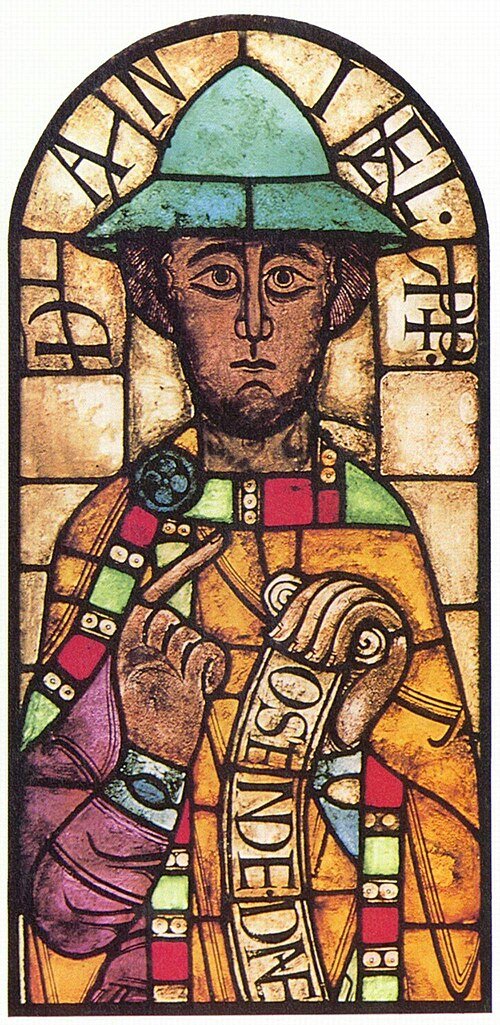
Our best guide to the process is a monk from twelfth-century Germany who wrote under the name Theophilus. His handbook, On Diverse Arts, describes the glassmakers and glass painters of his day at work. It is basically a medieval DIY manual, with fewer diagrams and more prayer.
The raw ingredients were surprisingly humble. As the Met explains, glass was made by melting sand together with wood ash. Theophilus recommended the ash of beech logs. In a summary of his instructions published by Aleteia, the ash-and-sand mixture is heated and stirred for a whole night and day, then melted down in clay pots inside the furnace.
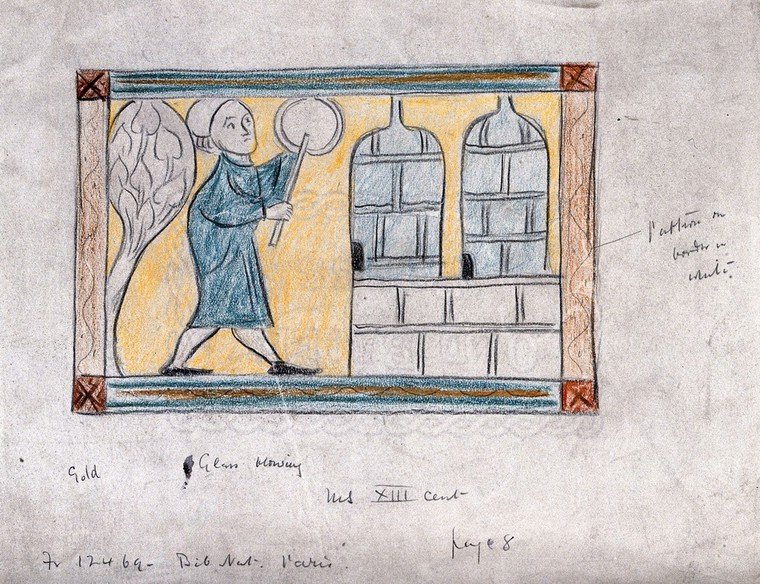
Next came the glassblower. According to the Met, a gob of molten glass could be blown into a long sausage shape, cut along its length and opened out flat. Alternatively, it could be spun on an iron rod called a pontil until it opened out into a round disc, known as a crown. Either way, the sheets were never perfectly even, and that fact will matter later on.
Step 2: add the colour
Most medieval stained glass was coloured all the way through, which is why it glows rather than just looking painted. Powdered metals were stirred into the hot mixture, the Met notes. The Norfolk Stained Glass website, which records the county’s stained glass from medieval to modern times, gives the recipe book: copper for red, cobalt for blue, manganese for pinks and purples, and iron for a range of greens and a strong yellow.
Red caused the most trouble. Glass coloured red all the way through came out so dark that hardly any light got in. The solution was clever: clear glass was coated with a thin layer of red glass, a process called flashing. This flashed glass let the light through and still glowed like rubies.
Step 3: draw the design
Every window began with a full-size drawing, called a cartoon. Today we picture cartoons on paper, but the Norfolk Stained Glass project explains that medieval designers drew them on a whitewashed table. Paper only became cheap enough for this job in the sixteenth century. So the master glazier’s most important tool was, in effect, a giant tabletop sketchpad.
The glass pieces were laid out over the drawing like a jigsaw, each colour in its proper place. Get it wrong and your saint might end up with a green face. It happened less often than you might fear.
Step 4: cut it without a glass cutter
The modern glass cutter did not exist. Instead, medieval glaziers guided a crack through the sheet with a red-hot iron to get the rough shape, then nibbled away at the edges with a hooked tool called a grozing iron until the piece fitted. Diamond cutters, the Norfolk project notes, only arrived in the 1600s. Patience was not optional.
Step 5: paint and fire
Faces, hair, the folds in a robe: all the fine details were painted on. The Met describes artists using black paint for outlines and shadows. According to the Norfolk Stained Glass project, the paint went on the inner side of the glass, and the pieces then went into a kiln, where the heat fused the paint permanently onto the surface. That is why, centuries later, the details are still there.
In the early fourteenth century glaziers discovered a new trick, known as silver stain. Painted onto the glass and fired a second time, it turned clear glass anything from lemon yellow to orange. Suddenly a single piece could show a white robe and a golden crown, with no lead line in between. Medieval artists, unsurprisingly, went wild for gold halos.
Step 6: lead it all together
Finally, the jigsaw had to become a window. The Met explains that every piece of glass slotted into strips of lead with an H-shaped profile, called cames. Where the cames met, they were soldered together, and putty was pressed in to keep out the rain. An iron framework, the armature, held the finished panels steady against the wind. Look closely at any medieval window and you will see those dark lead lines working almost like the outlines in a colouring book.
Myth alert: is the glass slowly melting?
You may have heard that the panes in old windows bulge at the bottom because glass is really a very slow liquid that has been dripping downwards for centuries. It is a great story. It is also wrong.
In 2017 two glass scientists, Ozgur Gulbiten and John Mauro, calculated how much medieval glass could actually flow, taking Westminster Abbey’s glass of 1268 as their example. As the American Ceramic Society reports, the answer was about one nanometre in a billion years. That is far too little for anyone to notice, ever. The real reason for the uneven panes is the way the glass was made. Crown glass ended up chunkier at the centre and thin towards the rim, and it simply looked more stable to put the heavier side at the bottom.
The record breaker: York’s Great East Window
If you want to see medieval stained glass on a truly heroic scale, head to York. The Great East Window of York Minster took shape from 1405 to 1408 under the glazier John Thornton, whose fee was £56. According to the Minster, no other single stretch of medieval stained glass in the country is larger, and the University of York compares its size to a tennis court. Its 311 panels tell the story of everything, from Genesis to the Apocalypse.
Keeping it going is a job for experts. The Minster explains that a restoration began in 2005, cost £11.5 million and took the York Glaziers Trust around 92,400 hours of work. The last panel went back into place on 2 January 2018. Thornton, presumably, would have charged more.
Why medieval stained glass still dazzles
Medieval stained glass was art, theology and engineering rolled into one. It taught Bible stories to people who could not read, it showed off the wealth of the church and its donors, and it turned plain stone buildings into something that felt close to heaven. And it was all done with sand, ash, metal, lead and enormous skill.
To see how glass fitted alongside painting, carving and building in the Middle Ages, explore medieval art. If you like rich colour and tiny details, you will also enjoy the story of how illuminated manuscripts were made, or the secrets of the Book of Kells.
Frequently asked questions
Where did the colours in medieval stained glass come from?
Mostly from metals mixed into the molten glass. Copper gave red, cobalt gave blue, manganese gave purples and pinks, and iron gave greens and yellows. From the early fourteenth century, silver stain added yellows and golds.
Who was Theophilus?
A monk working in Germany in the 1100s who wrote a handbook called On Diverse Arts. It describes how glass was made, painted and assembled, and it is our most important medieval guide to the craft.
Do church windows really sag over time?
No. Calculations published in 2017 showed that medieval glass at room temperature would move only about a nanometre in a billion years. Panes are uneven because of the way the glass was made.
Which medieval window in Britain is the biggest?
The Great East Window of York Minster, created from 1405 to 1408 by John Thornton. Its 311 panels make it the biggest continuous area of medieval glass in Britain.
What does “flashed” glass mean?
It is clear glass covered with a thin layer of coloured glass. Medieval glaziers used it mainly for red, because glass that was red all the way through was too dark to let much light in.
Sources
- The Metropolitan Museum of Art, Stained Glass in Medieval Europe (2001)
- Norfolk Stained Glass, Norfolk & Norwich Stained Glass from Medieval to Modern: Making stained glass
- Zelda Caldwell, Aleteia, How was stained glass made in the Middle Ages? (2018)
- French Ministry of Culture, Sainte-Chapelle
- April Gocha, The American Ceramic Society, Glass viscosity calculations definitively debunk the myth of observable flow in medieval windows (2017)
- York Minster, Country’s largest medieval jigsaw complete after a decade (2018)
- University of York, The Great East Window of York Minster: An English Masterpiece (book page, 2018)