Medieval Siege Warfare: How Castles and Cities Were Taken
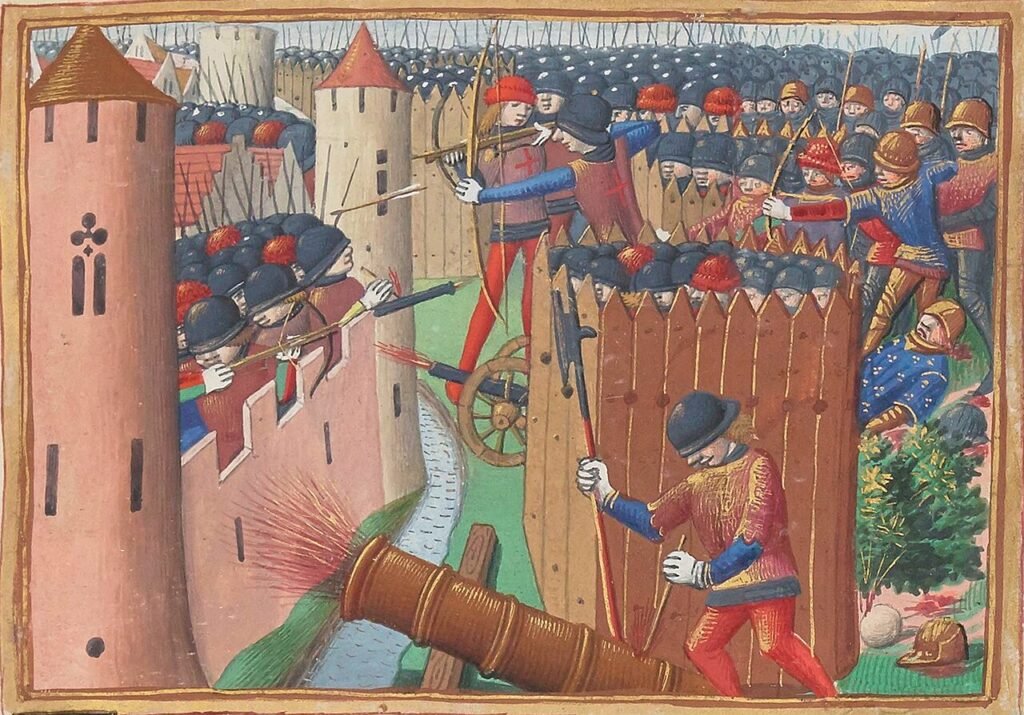
For most of the Middle Ages, wars were decided less by armies meeting in open fields than by armies sitting outside walls. A medieval siege was a contest of patience, engineering and nerve: the attackers tried to starve, batter, climb, dig or bargain their way in, while the defenders tried to hold out until help arrived or the besiegers gave up. Medieval siege warfare produced some of the longest and strangest episodes of the age, from Rochester to Constantinople.
Why medieval siege warfare mattered more than battles
A pitched battle was a gamble. In a few hours a commander could lose his army, his freedom or his life. A castle or a walled town, on the other hand, controlled the land around it: its roads, its river crossings, its harvests and its taxes. Whoever held the strongholds held the country.
That is why, once castles spread across Europe from the 11th century onward, sieges came to outnumber battles. A cautious general could fight a whole campaign without ever risking one. Great fortresses such as Crac des Chevaliers in Syria, built by the Knights Hospitaller between 1142 and 1271, are monuments to this kind of war.
Sieges were not the easy option, though. They were slow and extremely expensive, and time usually worked against the attacker. Many soldiers owed only a fixed term of service, typically 40 days, after which they expected to go home. An army also had to eat. During the siege of Kenilworth Castle in 1266, at least 20 English counties had to send food to feed the king’s forces.
How a siege began: surround and talk
The first move was to close the ring. The attackers camped around the target, cut the roads and stopped food and reinforcements from getting in. Then, before any serious fighting, came an offer: surrender now and receive terms.
This opening offer mattered a great deal. A garrison that gave up early could hope for decent terms. A garrison that refused, forced the attackers into months of misery and was then taken by storm could expect very little. Mercy for defenders who had turned down their chance was the exception, not the rule. Both sides knew this, and it shaped every decision that followed.
Starving them out
The simplest way to win was to wait. Sooner or later, a surrounded garrison ran short of food or water. Trapped defenders are recorded eating their horses, then dogs and cats, before finally opening the gates. It was a long way from the bread, pottage and ale of ordinary daily life in the Middle Ages
The best English example is Kenilworth. Rebel supporters of Simon de Montfort held the castle against King Henry III from 25 June to 13 December 1266, a total of 172 days, in one of the longest sieges in medieval English history. More than 1,200 people were inside, including women, children and servants. Among the castle’s outer defences was a giant lake, known as the mere.
Henry threw enormous resources at it: nine siege engines, 60,000 crossbow bolts and even barges dragged overland from Chester for an attack across the water. None of it worked. What finally ended the siege was hunger and disease. When the garrison surrendered, it had been badly weakened by dysentery and had only two days of food left.
Going over the walls: ladders and siege towers
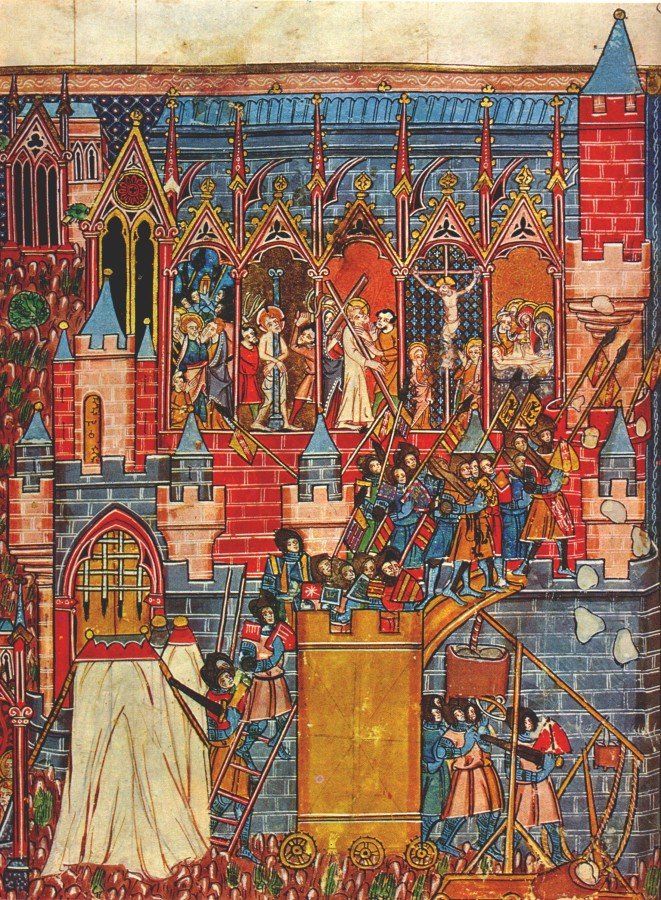
If waiting was not possible, the most direct approach was to climb. Scaling ladders were cheap and quick to make, but men on ladders were horribly exposed. The safer and far more costly answer was the siege tower: a tall wooden structure on wheels, pushed up to the wall so that soldiers could cross onto the battlements from the top.
Siege towers were often given names of their own, and the sight of one creeping toward a wall must have been terrifying. They had one great weakness, however. They were made of wood, and defenders did everything they could to set them alight.
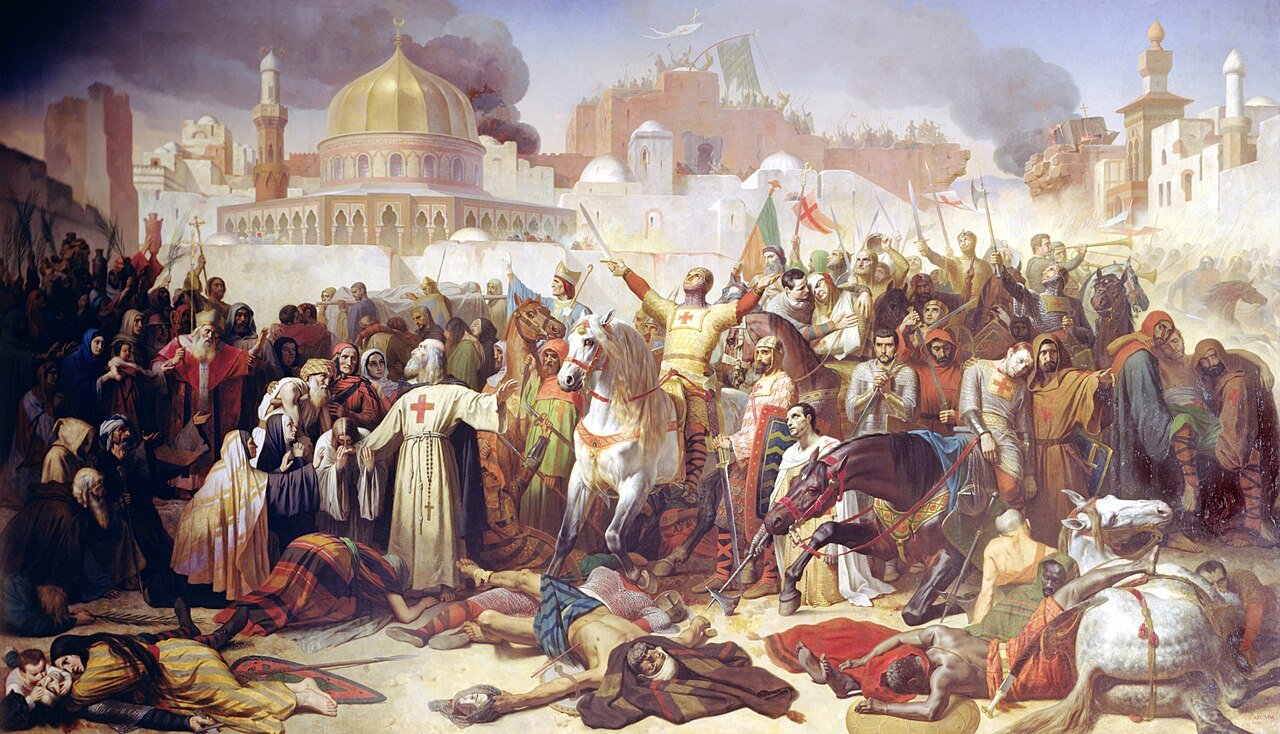
A successful assault could end a siege far faster than hunger. During the First Crusade, the Crusaders began their siege of Jerusalem in June 1099, and the city fell five weeks later, on 15 July. The whole expedition had begun with a sermon by Pope Urban II, at a time when the medieval Church could summon armies.
Going through: battering rams
Gates and thin stretches of wall could be attacked head-on with a battering ram. The design had barely changed since ancient times: a heavy tree trunk, tipped with metal, swung again and again against the same spot. It was dangerous work, because the men swinging it stood directly beneath the wall, where the defenders could reach them most easily.
Going under: mining
The most feared method was also the quietest. Miners dug a tunnel beneath a wall or tower, holding up the roof with wooden props as they went. When the tunnel was ready, they packed it with fuel and set it on fire. The props burned through, the tunnel caved in, and the masonry above came down with it.
King John’s siege of Rochester Castle, between October and December 1215, is the most famous example. His miners dug under the south-east turret of the great keep. To get the fire hot enough, the king ordered the fat of forty pigs, described as “too fat to eat”. The corner of the keep collapsed. The rebels fell back into the northern half of the building and kept fighting, until starvation forced them to surrender. John’s troubles with his barons are part of a bigger story, told in our guide to medieval kings.
Mining did not always work. At Dover Castle in 1216, miners working for Prince Louis of France tunnelled through the chalk and brought down the eastern tower of the main gate. The castle’s commander, Hubert de Burgh, had his men block the gap with timber beams, rubble and earth, and they drove the attackers back out through the breach. The siege failed.
Defenders could also fight underground. They dug tunnels of their own, called countermines, to break into the enemy’s workings and smoke the miners out.
Throwing things: mangonels and trebuchets
Stone-throwing machines were the artillery of the Middle Ages. The names used at the time are confusing, but the basic idea was a long wooden arm with a sling or bucket at one end. In the great counterweight trebuchet, a heavy box of stones on the short end of the arm dropped, whipping the long end upward and hurling a missile toward the target. Large machines could throw boulders weighing anywhere from 50 to 250 kilograms.
Trebuchets did not only throw stones. Burning material was a common load, and besiegers sometimes launched manure and dead bodies over the walls, hoping to spread disease among the people inside.
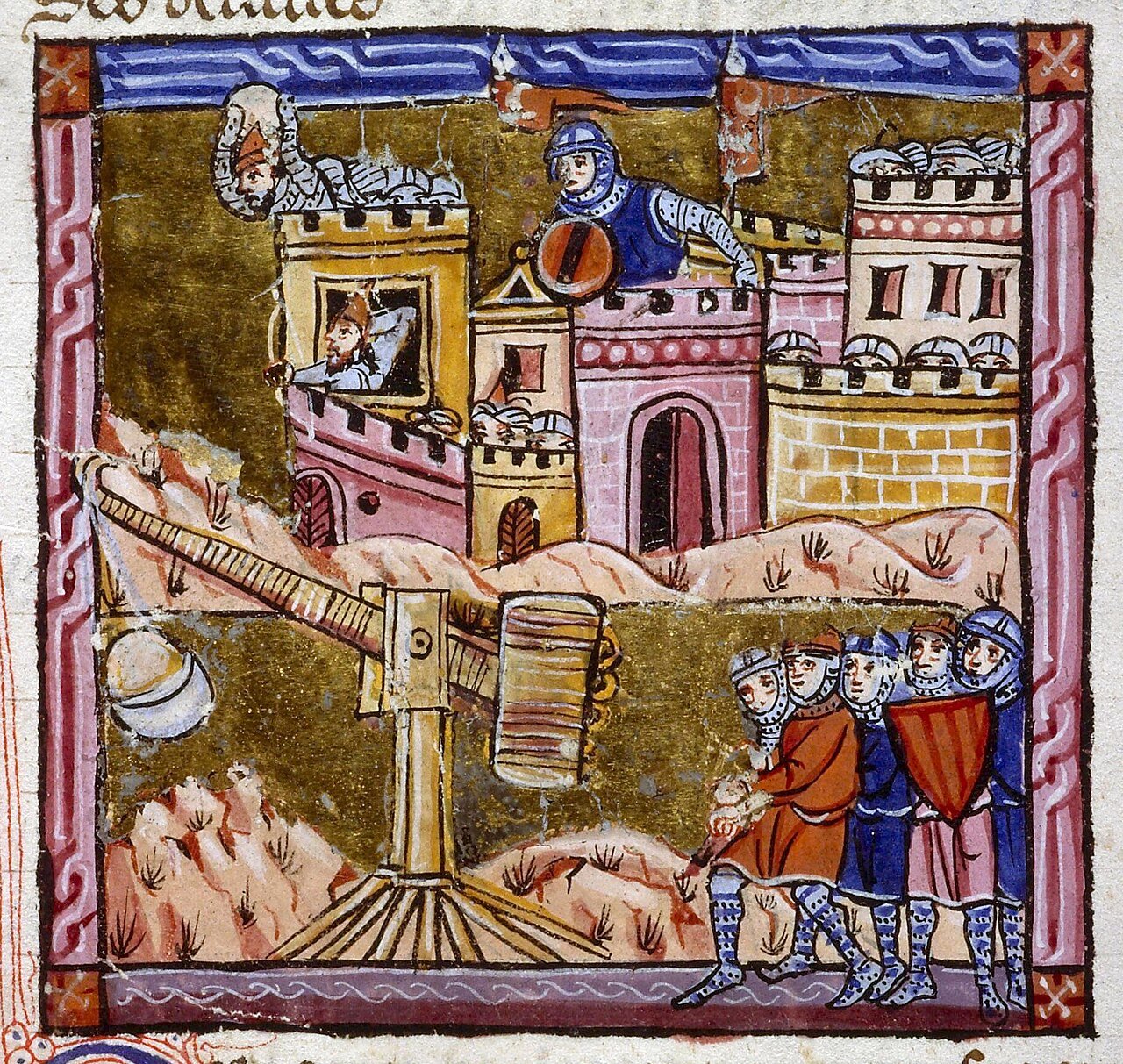
The most famous of these machines was built for King Edward I of England at the siege of Stirling Castle in 1304. Edward already had up to a dozen siege engines there, yet he ordered his engineers to construct the largest trebuchet made up to that time. It was called the War Wolf, and it is reported to have sent a missile through two of the castle’s walls.
It is worth keeping these machines in proportion. English Heritage notes that the stones these engines threw mainly had a psychological effect, rather than knocking fortifications down.
How the defenders fought back
A castle was a machine for making every one of these attacks harder. Wide ditches and water defences kept towers, rams and miners away from the foot of the wall. Towers placed at regular intervals let archers shoot along the face of the wall at anyone trying to climb it. Gaps in the battlements gave archers and crossbowmen a clear view while protecting their bodies.
At the top of the wall, defenders built wooden galleries called hoardings, which jutted out over the edge so that men could drop things straight down onto attackers at the base. What they dropped is one of the best-known myths about castles. Hot oil was rarely used. Hot sand, boiling water, burning coals and quicklime were the usual choices.
Above all, the defenders played for time. Every week they held out was a week in which the enemy’s food, money and patience ran lower, and in which a relieving army might appear on the horizon.
Treachery, tricks and deals
Many of the strongest places in the medieval world were never broken at all. They were opened from the inside.
The siege of Antioch during the First Crusade lasted from 20 October 1097 to 28 June 1098, and for months the city held. The breakthrough came when one of their leaders, Bohemond, made secret contact with Firouz, an Armenian Christian soldier in the garrison who commanded one section of the defences. On 2 June 1098, Firouz let the Crusaders in.
Cunning could work as well as bribery. Château Gaillard was built on a cliff above the River Seine by Richard the Lionheart. King Philip II of France took it in 1204 after a siege of eight months. His men undermined one of its outer strongpoints, and then got further inside by climbing in through the latrines.
Gunpowder and the end of the medieval siege
For centuries the advantage lay with the defender. A good wall cost far less to hold than to take. Gunpowder changed that. By the 15th century, armies were bringing up batteries of huge cannons that fired balls of more than 100 kilograms, and the old, slow style of siege was effectively finished.
The most dramatic proof came at Constantinople. Its land walls, a triple line of fortifications built under the emperor Theodosius II in the 5th century, had protected the city for centuries. In 1453 the Ottoman sultan Mehmed II arrived with something earlier besiegers had lacked: cannons, made for him by a Hungarian engineer named Urban. The largest was 9 metres long and could fire a 500-kilogram ball more than 1.5 kilometres.
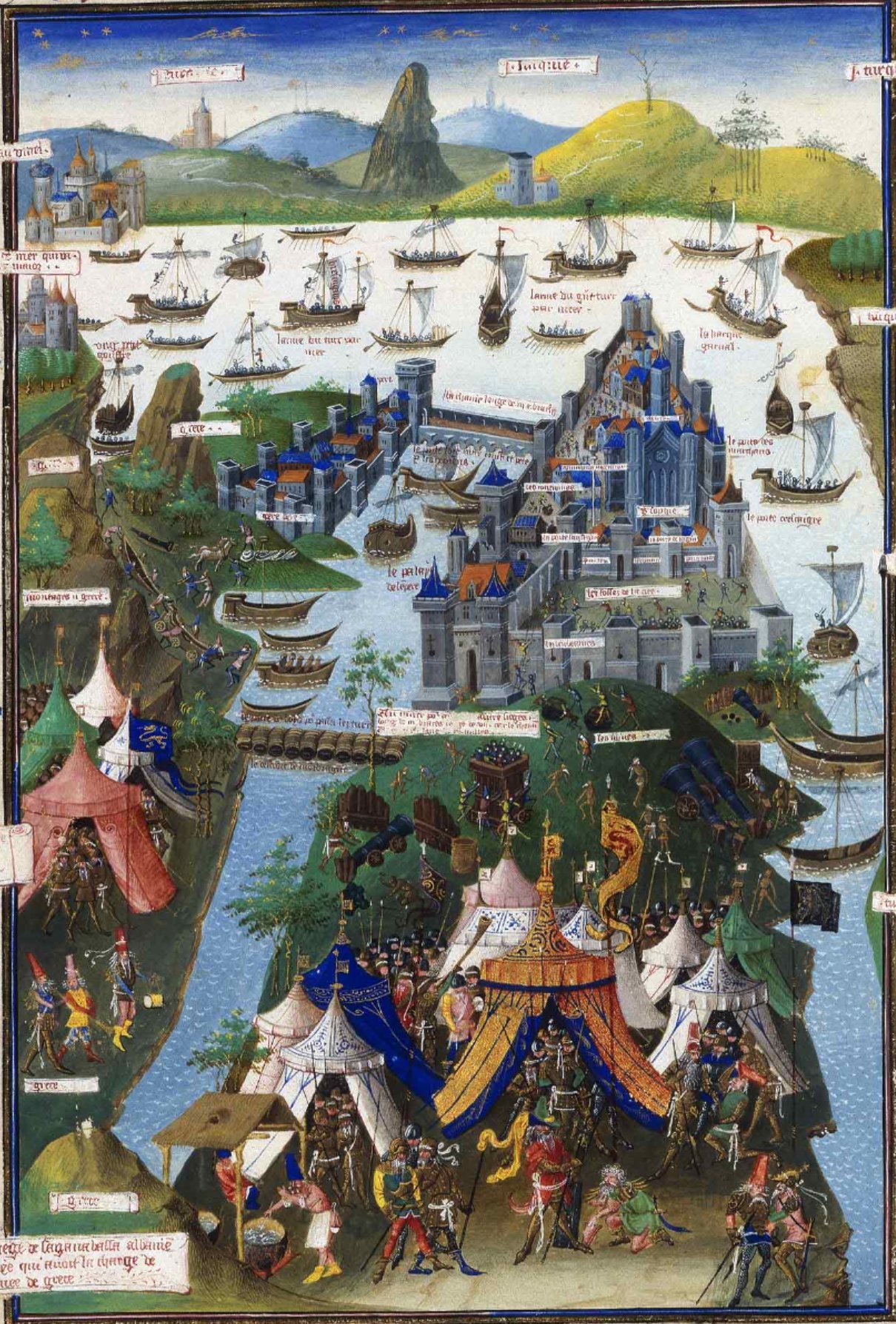
A few thousand defenders faced an Ottoman army that modern historians put at 60,000 to 80,000 men. After 55 days the walls were breached, and on 29 May 1453 the city fell. The Byzantine Empire ended with it, and so, in effect, did the age of the high-walled medieval castle.
Frequently asked questions
How long did a medieval siege last?
Anything from a few days to most of a year. Jerusalem fell in 1099 after about five weeks. Rochester held out for around two months in 1215. Kenilworth lasted 172 days in 1266, and Château Gaillard and Antioch each took roughly eight months.
What was the most effective siege weapon?
Hunger. Machines, mines and towers get the attention, but again and again it was starvation and disease that finally forced a garrison to give up, as at Rochester and Kenilworth.
Did defenders really pour boiling oil on attackers?
Very rarely. Boiling water, heated sand and quicklime were the usual choices.
What did trebuchets throw?
Mostly stones, with large machines hurling boulders of 50 to 250 kilograms. They could also throw burning material, and sometimes manure or corpses in the hope of spreading disease.
Which place was besieged the most?
In the British Isles, the record belongs to Carlisle, which has been besieged ten times.
Sources
- Mark Cartwright, “Siege Warfare in Medieval Europe”, World History Encyclopedia
- English Heritage, “10 Things You Probably Didn’t Know About Sieges”
- English Heritage, “The Siege of Kenilworth Castle”
- English Heritage, “History of Rochester Castle”
- English Heritage, “The Sieges of Dover”
- Encyclopaedia Britannica, “Château Gaillard”
- Encyclopaedia Britannica, “Siege of Antioch”
- Encyclopaedia Britannica, “Fall of Constantinople”
- Mark Cartwright, “1453: The Fall of Constantinople”, World History Encyclopedia
- The Metropolitan Museum of Art, “The Crusades (1095–1291)”
- UNESCO World Heritage Centre, “Crac des Chevaliers and Qal’at Salah El-Din”
- Live Science, report on Edward I’s War Wolf trebuchet at Stirling Castle