
How Heavy Was Medieval Armour?
Everyone knows medieval knights were so weighed down by steel that they had to be lowered onto their horses by crane, and if they fell over they lay there like upturned beetles. Everyone knows this, and almost everyone is wrong. So how heavy was medieval armour, really? Museums can answer that question in kilograms, because they’ve put the real thing on the scales. The numbers are surprising, the experiments are entertaining, and at least one king owned a suit that weighed more than 40 kilograms. Let’s get suited up.
Jump to a section:
How heavy was medieval armour? The short answer
A complete suit of plate made for the battlefield usually tipped the scales at 20 to 25 kilos (45–55 lb). That figure comes from Dirk Breiding, a curator at New York’s Metropolitan Museum, home to one of the world’s great armour collections. Of that, the helmet alone was 2 to 4 kilos.
Put that in perspective. Breiding points out that a full suit of field armour weighs less than a modern firefighter’s complete kit with breathing gear, and less than the loads most infantrymen have hauled to war over the last two centuries. Medieval men-at-arms trained in armour from their teens, and their armour was made to measure. A fit man in a well-fitting suit could walk, run, lie down, get up and mount a horse without help.
Weighing the real thing
The best evidence sits in museum storerooms, and curators love a good weigh-in. The Met’s online catalogue records the weight of several of its most famous armours:
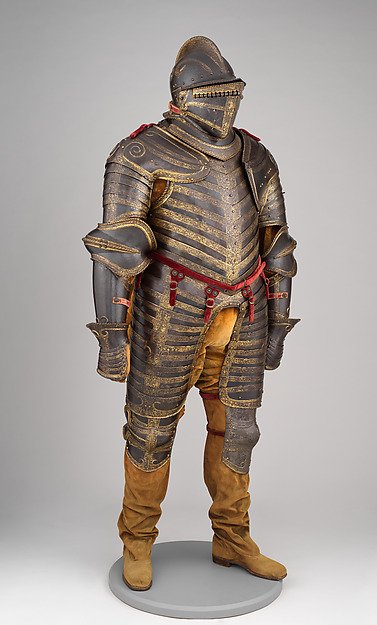
- Henry VIII’s field armour, made in Italy around 1544: about 22.9 kilograms. This is a battle armour, built for a king in his fifties who, frankly, was not the slim athlete he had been in his youth.
- A late 15th-century Gothic armour, assembled from German and Italian pieces and heavily restored in the 1920s: about 20.5 kilograms, without its helmet.
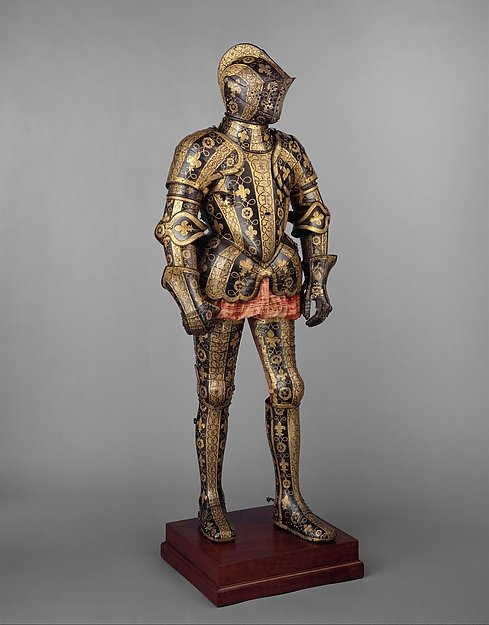
- The armour of George Clifford, Earl of Cumberland, made at the royal workshops in Greenwich in 1586: about 27.2 kilograms, or 60 pounds. Clifford was Elizabeth I’s champion, and his suit came with extra pieces for jousting, which helps explain the figure.
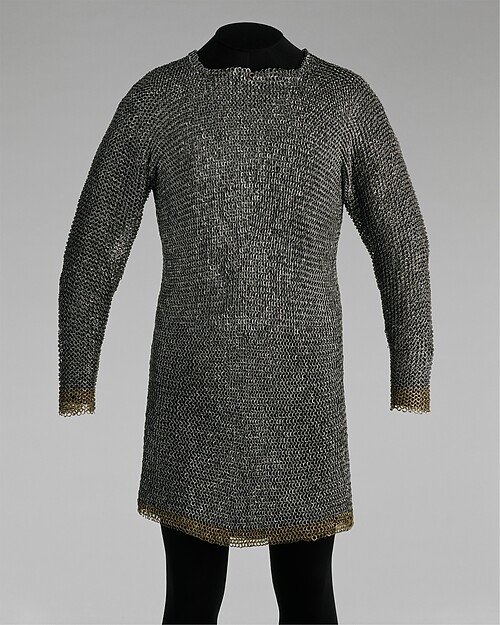
Mail was lighter than you might think, but not trivial. The Met’s record for a 15th-century German mail shirt, made of steel and brass rings, gives a weight of about 9 kilograms. Before full plate became common in the 1300s and 1400s, a knight’s main protection was a long mail coat worn over padded clothing, and the weight hung mostly from his shoulders. Plate armour spread the load over the whole body, which is one reason it was more comfortable to fight in than it looks.
The heavyweights: armour for sport
Now for the exceptions, because when you ask how heavy was medieval armour, the honest answer is “it depends what for”. Armour made for tournaments, where men rode at each other with lances for sport and prestige, could be far heavier than battle armour. It didn’t need to be worn for long, and its job was to keep a nobleman alive while he was hit, deliberately, at full gallop.
The Royal Museum of the Armed Forces and Military History in Brussels has a reinforced tournament armour attributed to King Philip II of Spain. It weighs some 40 kilograms, which, the museum says, is about twice as much as armour intended for war. In England, the Royal Armouries keep an armour made for Henry VIII to fight on foot at the Field of Cloth of Gold in 1520. It covers almost every inch of the body and weighs 42.6 kilograms, again roughly double a normal battle armour. It was never finished. Three months before the event, the French king changed the rules of the foot combat, and the armour was no longer needed. Even royal tailoring has bad days.
What did science say?
How heavy was medieval armour to actually live in, though? Weight isn’t the whole story. In 2011, a team led by Graham Askew at the University of Leeds put four men who regularly wore armour onto a treadmill, wearing faithful reproductions of 15th-century European armour, and measured how much energy they used. Their results, published in the Proceedings of the Royal Society B, were striking. Walking in armour took 2.1 to 2.3 times as much energy as walking without it, and running took 1.9 times as much.
Interestingly, the armour cost more energy than carrying the same weight in a pack on the body. The researchers put that down to two things: the extra effort of swinging heavy steel-covered arms and legs, and a breastplate that made it harder to breathe deeply. Their study also gives a heavier range for a full 15th-century field armour, 30 to 50 kilograms, than the Met’s typical figure, a reminder that individual suits varied a lot.
In other words, a knight could move perfectly well, but he got tired faster. On a hot day, over a long distance or through deep mud, that mattered enormously. Just ask the French men-at-arms who struggled across a sodden field at the Battle of Agincourt in 1415.
So where did the crane come from?
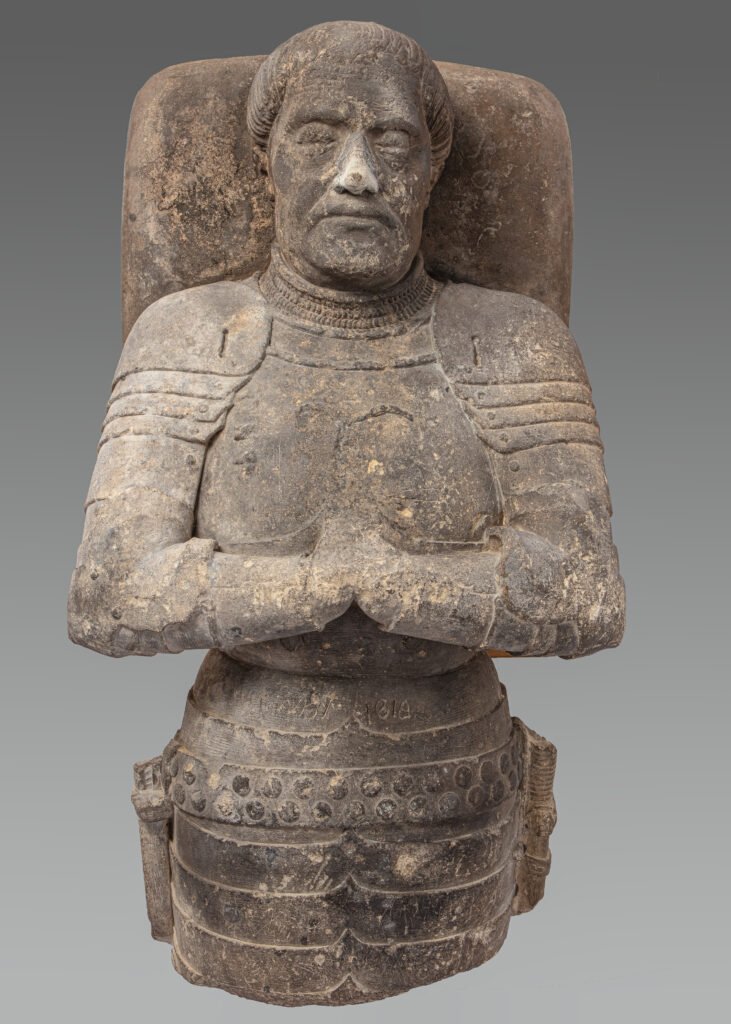
Not from the Middle Ages. According to Breiding, the notion of knights being lifted into the saddle by machinery seems to have started as a joke in the late 19th century. It was then fixed in the popular imagination by Laurence Olivier’s 1944 film of Henry V, which included a knight being winched into his saddle, despite objections from the film’s historical advisers. A crane, Breiding writes drily, was “absolutely unnecessary”. It’s one of the classic medieval myths, alongside the idea that people thought the world was flat.
Medieval artists, incidentally, often showed armoured men vaulting, climbing ladders and fighting on foot with no trouble at all. Their audiences would have laughed at the crane too.
The verdict
So, how heavy was medieval armour? For battle, usually about 20 to 25 kilograms, spread evenly over a trained man’s body, and comparable to what a modern infantryman carries. Tournament armour could reach 40 kilograms or more, but it was a specialist sports kit, worn briefly. Knights were not helpless tin cans. They were athletes in very expensive, very sweaty tracksuits made of steel.
For other ways the Middle Ages has been misremembered, find out whether Vikings really wore horned helmets.
Frequently asked questions
How heavy was medieval armor in pounds?
A typical battle armour weighed about 45 to 55 pounds. Tournament armour could reach 90 pounds or more, but it was never meant for a long day’s fighting.
Could a knight get up if he fell over?
Yes. Museum curators and modern experiments agree that a fit man in well-fitting plate could get up, roll over and climb back into the saddle unaided. Exhaustion and mud were the real dangers.
Was chain mail lighter than plate?
A mail shirt alone could weigh around 9 kilograms, and a full mail coat with leggings more. Plate was not necessarily heavier overall, and it spread the weight more evenly.
Why was tournament armour so heavy?
Because it was built to take direct hits from lances in sporting contests. Extra reinforcing plates made it safer, and the wearer only had to carry it for a short time.
Sources
- Dirk H. Breiding, The Metropolitan Museum of Art, Arms and Armor: Common Misconceptions and Frequently Asked Questions (2004)
- The Metropolitan Museum of Art, Field Armor of King Henry VIII of England
- The Metropolitan Museum of Art, Gothic Armor
- The Metropolitan Museum of Art, Armor Garniture of George Clifford, Third Earl of Cumberland
- The Metropolitan Museum of Art, Mail Shirt
- Royal Museum of the Armed Forces and Military History, Brussels, Reinforced tournament armour, attributed to Philip II
- Royal Armouries, Henry VIII’s foot combat armour
- Graham N. Askew, Federico Formenti and Alberto E. Minetti, “Limitations imposed by wearing armour on Medieval soldiers’ locomotor performance”, Proceedings of the Royal Society B, via Medievalists.net