
Medieval Music: From Gregorian Chant to Troubadours
If your idea of medieval music is a hooded monk droning in a dark church, you’ve got about a tenth of the picture. The Middle Ages also gave us love songs, drinking songs, dance tunes, a round about a cuckoo and possibly a flatulent goat, the first written notes that a modern musician could almost sight-read, and instruments that needed two people just to play one. Over roughly a thousand years, music went from one unaccompanied tune passed on by memory to dazzling pieces for four voices. Tune up your lute and let’s listen in.
Jump to a section:
Plainchant: the soundtrack of the monastery
For much of the Middle Ages, the medieval music most people heard most often was sung in church. Monks and nuns sang the psalms and prayers of the daily services from long before dawn until bedtime, every day of the year. You can follow that punishing timetable in a day in the life of a medieval monk.
That repertoire is known today as Gregorian chant. Its name honours Pope Gregory the Great, who died in 604, and later tradition imagined him receiving the melodies from the Holy Spirit in the form of a dove. Historians are less romantic. As Wikipedia’s article on the subject explains, most of the chant we know came from a later blend of Roman and Frankish traditions, put together mainly in the 9th and 10th centuries under Charlemagne’s successors. Gregory got the credit; anonymous singers did the work.
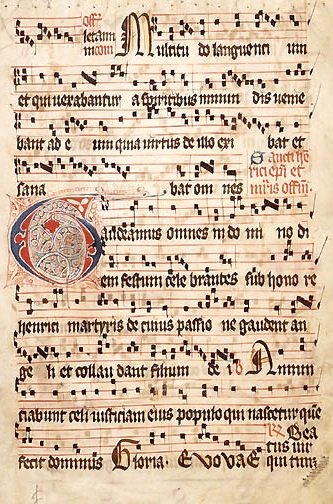
Chant is unaccompanied song in Latin, with everyone singing the same tune. For centuries, singers learned the melodies by ear, and a huge amount had to be memorised. The earliest surviving books with musical notation, made around 930, used little marks called neumes written above the words. They showed whether the voice went up or down, but not by exactly how much. They reminded you of a tune you already knew; they couldn’t teach you a new one.
The monk who taught the world to read music
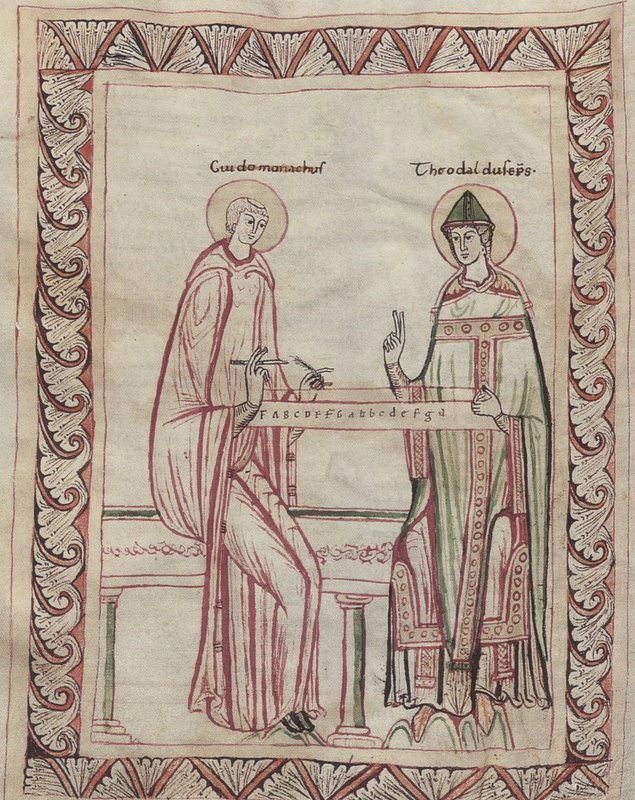
Enter Guido of Arezzo, an Italian monk born around 991. Around 1025 he wrote a handbook for singers called the Micrologus and championed an idea that sounds simple: draw horizontal lines, and place each note on a line or in a space, so its exact pitch is fixed. That staff is still in use on every piano stand on the planet.
Guido also gave singers a memory trick. He used a hymn to St John the Baptist, Ut queant laxis, in which each phrase begins one note higher than the one before. The first syllables of those phrases, ut, re, mi, fa, sol and la, became names for the notes. “Ut” later became “do”, and “si” (in English-speaking countries later “ti”) was added for the seventh note, which is why Julie Andrews could eventually sing “Do-Re-Mi”. According to Wikipedia, Guido’s methods reportedly cut the usual ten years of training for a church singer to a year or two. Pope John XIX was impressed enough to summon him to Rome around 1028.
When one tune wasn’t enough
Once music could be written down accurately, composers could start stacking melodies on top of each other. Singing in several independent parts is called polyphony, and its early church form was called organum. Medieval music took a giant leap at Notre-Dame in Paris, the cathedral whose style is explained in Romanesque vs Gothic.
Between about 1160 and 1250, a group of composers there created a famous collection of polyphony, the Magnus Liber Organi, the “great book of organum”. Only two of their names survive, Léonin and Pérotin, thanks to an English student known simply as Anonymous IV, who wrote about them decades later. Pérotin is the first composer whose music for four voices still survives. In 1198 and 1199, the bishop of Paris, Odo of Sully, issued decrees allowing polyphony on great feast days, although the singers had probably been doing it already.
In the following century, the French poet and composer Guillaume de Machaut, a canon of Reims Cathedral, wrote his Messe de Nostre Dame before 1365. It’s the earliest complete setting of the main sung parts of the Mass that can be credited to a single composer. Before Machaut, composers were mostly anonymous craftsmen. After him, the idea of the composer as a named artist began to catch on.
Troubadours: love songs for the court
Not all medieval music was holy, and the most fun was often made far from any altar. In the late 1000s, poet-musicians called troubadours started composing songs in Occitan, the language of southern France. The earliest whose works survive was Duke William IX of Aquitaine, grandfather of Eleanor of Aquitaine. Their favourite subject was love, usually love for a noble lady who was beautiful, distant and, quite often, married to someone else.
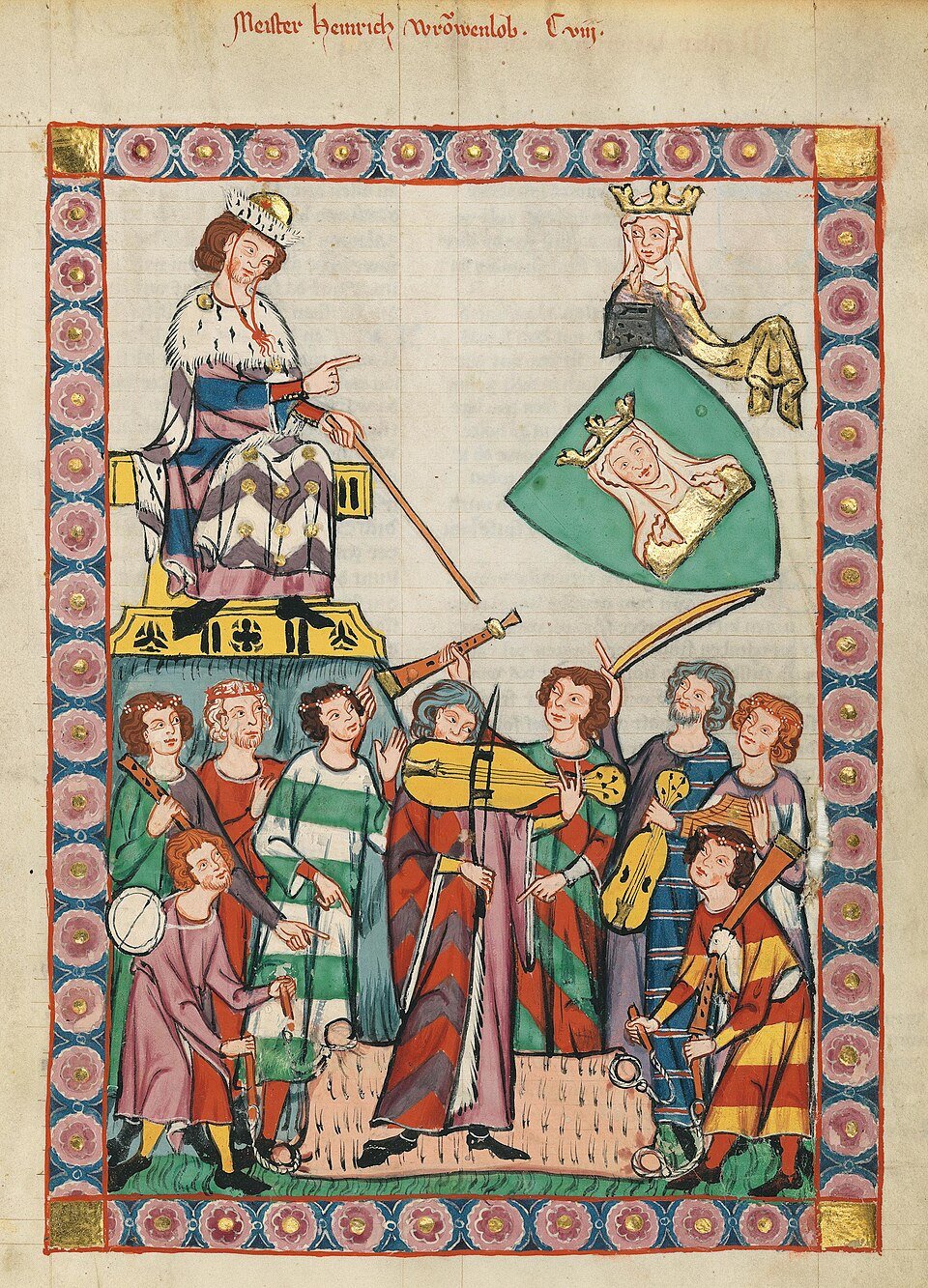
Around 2,500 troubadour poems survive, but fewer than 300 of their melodies. There were women composers too, called trobairitz, the first known women composers of secular music in the Western tradition. Only one of their tunes survives, by the Comtessa de Dia. The fashion spread north to the trouvères of northern France and east to the German Minnesingers, whose portraits fill the gorgeous Codex Manesse.
Sumer is icumen in: a medieval hit
England produced one of the most charming pieces of medieval music. “Sumer is icumen in” (“Summer has come in”) is a round that celebrates spring, with cuckoos singing, seeds growing and animals frolicking. It survives in a British Library manuscript copied in the early 1260s, linked to Reading Abbey, and it is the oldest known piece for six-part polyphony. Below the English words, someone added a pious Latin text about the Crucifixion, just in case.
One line, “bucke uerteþ”, has long been read as “the buck farts”, which has made generations of students very happy. Scholars aren’t sure. Some argue the verb may simply mean “moves about” or “leaps”. Science has not yet settled the matter.
Hurdy-gurdies, shawms and other noisemakers
Medieval music was played on an amazing range of instruments: harps, lutes, fiddles, psalteries, recorders, bagpipes and loud reed instruments called shawms, perfect for outdoor processions. One early instrument, the organistrum, was an ancestor of the hurdy-gurdy. It was so big that, as Wikipedia notes, two people played it: one turned a crank while the other worked the keys. A 12th-century carving at the cathedral of Santiago de Compostela shows exactly that, with two musicians sharing the job.
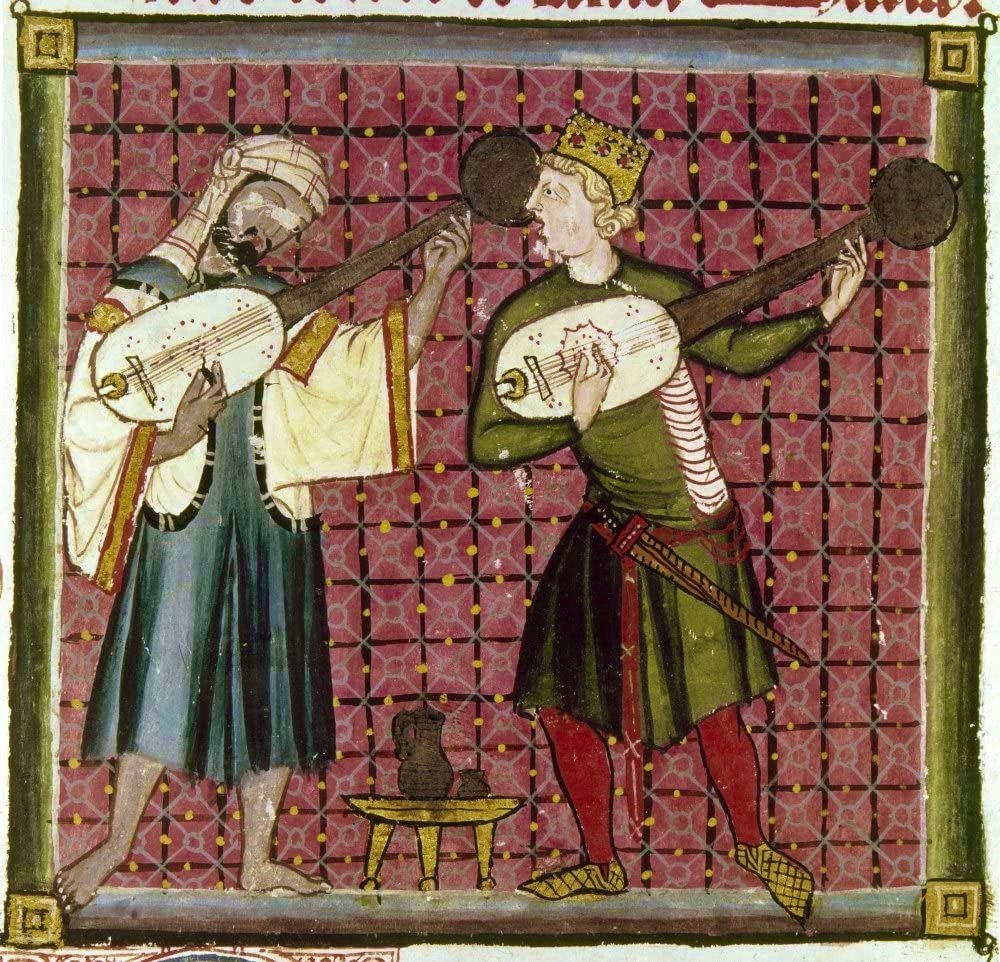
Some of the best pictures of instruments come from the Cantigas de Santa Maria, a collection of 420 songs in praise of the Virgin Mary compiled at the court of King Alfonso X of Castile, who died in 1284. One of its manuscripts contains 41 miniatures showing pairs of musicians, including Christian and Muslim players side by side. Wandering minstrels took tunes like these from castle to tavern to marketplace, and even the margins of manuscripts were full of animals playing instruments, as you’ll see in medieval marginalia.
Medieval music laid the foundations for nearly everything that came after: written notes, harmony, the named composer, even the do-re-mi you learned at school. To see how music fitted into the wider artistic world of the period, explore medieval art.
Frequently asked questions
Did medieval people listen to anything besides church music?
Absolutely. Courts enjoyed troubadour love songs, towns had dances and festival music, and minstrels performed in castles, taverns and marketplaces. Most of that popular music was never written down, so it’s lost.
Who invented musical notation?
No single person. Early neumes existed by the 900s, but Guido of Arezzo’s system of lines, developed in the 1020s, made notes precise. It became the basis of the modern staff.
Were there female composers in the Middle Ages?
Yes. The abbess Hildegard of Bingen wrote dozens of chants in the 1100s, and the trobairitz of southern France composed love songs. The Comtessa de Dia’s song is the only trobairitz melody that survives.
What does medieval music sound like?
It depends on the century and the setting: from calm, single-line chant to complex overlapping voices and lively dances on fiddles, pipes and drums. Many early-music groups record it today.
Sources
- Wikipedia, Gregorian chant
- Wikipedia, Guido of Arezzo
- Wikipedia, Notre-Dame school
- Wikipedia, Messe de Nostre Dame
- Wikipedia, Troubadour
- Wikipedia, Sumer Is Icumen In
- Wikipedia, Hurdy-gurdy
- Wikipedia, Cantigas de Santa Maria