
Trebuchet vs Catapult: What’s the Real Difference?
Here’s a cheap way to start an argument at a castle gift shop. Point at the big wooden siege engine in the courtyard and say “nice catapult”. Somebody nearby will wince. Somebody else will correct you. And the funny part? You were not exactly wrong. The trebuchet vs catapult debate is one of those questions where everybody is half right, the films are mostly wrong, and the real story is better than both. So let’s settle it properly, with a comparison table, a Roman donkey joke and one myth that fooled historians for a couple of centuries.
Jump to a section:

Trebuchet vs catapult: the one-sentence answer
Every trebuchet is a catapult, but not every catapult is a trebuchet.
“Catapult” is the umbrella word. It covers any machine built to throw something heavy at somebody you dislike. Under that umbrella sit several very different families of machine. The trebuchet is just one of them, the one that happens to work like a giant seesaw.
Think of it like “vehicle” and “bicycle”. Calling a bicycle a vehicle is technically fine. Calling every vehicle a bicycle will get you some strange looks at the car dealership.
The old-school catapults: bend it or twist it
Before the trebuchet came along, throwing machines stored their energy in one of two ways. Encyclopaedia Britannica sums up the difference neatly: almost every catapult apart from the trebuchet was powered by something either bent or twisted.
- Bent (tension). Think oversized bow. You haul it back, the wood or horn flexes, and when you let go, it snaps straight and fires.
- Twisted (torsion). Take a thick bundle of cords made from animal sinew or hair, twisted tight like a wrung-out towel. Push an arm into that bundle, crank it back, release, and the bundle untwists violently.
The Greeks and Romans became very, very good at the twisted kind. Two versions are worth knowing.
The ballista: a crossbow with a gym membership
A ballista had two arms, each stuck into its own twisted bundle, with a bowstring between them. It usually shot heavy bolts or stones on a fairly flat path. If a trebuchet is a seesaw, a ballista is a very angry crossbow.
The onager: the kicking donkey
The onager was the one-armed version. A single beam stood in a twisted bundle, and at its tip sat a cup or a sling for a stone. Winch it down, release it, and the arm slammed upright.
Its name is the best joke in ancient engineering. Onager means “wild ass”, and according to Britannica it came from the way the back end of the machine jumped up when it fired. The Roman soldier and historian Ammianus Marcellinus, writing in the 390s, went further. He explained that wild asses, when chased by hunters, kick stones backwards at them hard enough to break bones. A weapon named after a furious donkey. The Romans, it turns out, were funnier than their marble statues suggest.
Enter the trebuchet: a lever with a sling
The trebuchet throws away the twisted cords entirely. It is a long beam on a pivot, with a short end and a long end, and a sling hanging from the long end. Pull the short end down hard and the long end whips up, flinging the stone out of the sling.
There were two ways to do the pulling:
- People power. The first trebuchets had a team of people hauling on ropes tied to the short end. Historians call this the traction trebuchet. Rebuilt models show a small one, worked by seven people, could get four stones into the air in a little more than sixty seconds.
- Gravity power. Later, someone had the bright idea of replacing the crowd with a huge box of rocks and earth. That is the counterweight trebuchet, the giant you see in films and at castle festivals.
Want the step-by-step version, with the sling physics and the famous War Wolf? It’s all in our explainer on how a trebuchet worked. For the trebuchet vs catapult question, the key point is simple: no bending, no twisting, just leverage and a sling.
Side by side: trebuchet vs catapult
| Torsion catapult (ballista, onager) | Trebuchet | |
|---|---|---|
| Power source | Twisted bundles of sinew or hair | People pulling ropes, or a falling counterweight |
| Main heyday | Ancient Greece and Rome | The Middle Ages |
| Ammunition | Bolts and smaller stones | Stones, from a few kilograms to well over 100 |
| Shape of the shot | Flatter, more direct | High, looping arc |
| Weak spot | Cords lose their spring and need careful upkeep | Huge, slow to build, impossible to hide |
| Best at | Picking off people and light targets | Hammering walls and roofs, again and again |
On raw muscle the big trebuchet wins easily. Britannica reckons a large counterweight machine with a ten-ton weight could throw a stone of about 135 kilograms some 275 metres. No twisted bundle of hair was ever going to match that.
The Hollywood catapult: a myth with a bucket
Now for the twist in the trebuchet vs catapult story, and it’s a good one.
You know the classic film catapult. One arm, a bucket or spoon on top, a medieval army cranking it back outside a castle. Most people call it a mangonel. Plenty of older books say the Roman onager simply carried on into the Middle Ages under that new name, and even Britannica’s entry on the onager notes that it was later called a mangonel.
Here’s the problem. A growing number of military historians think that machine was barely used in medieval Europe at all.
The historian Peter Purton went as far as calling it “the myth of the mangonel” in a 2006 article. His argument goes like this. The twisted-cord stone throwers seem to fade out of the written record after late Roman times. Medieval writers used words like mangonel and petraria for stone throwers, but in Purton’s reading those words usually meant the rope-pulled trebuchet, not a torsion machine. In a 2018 review of Michael Fulton’s book Artillery in the Era of the Crusades, Purton notes that Fulton also accepts that the onager did not survive into medieval times, and that this view is now widely shared.
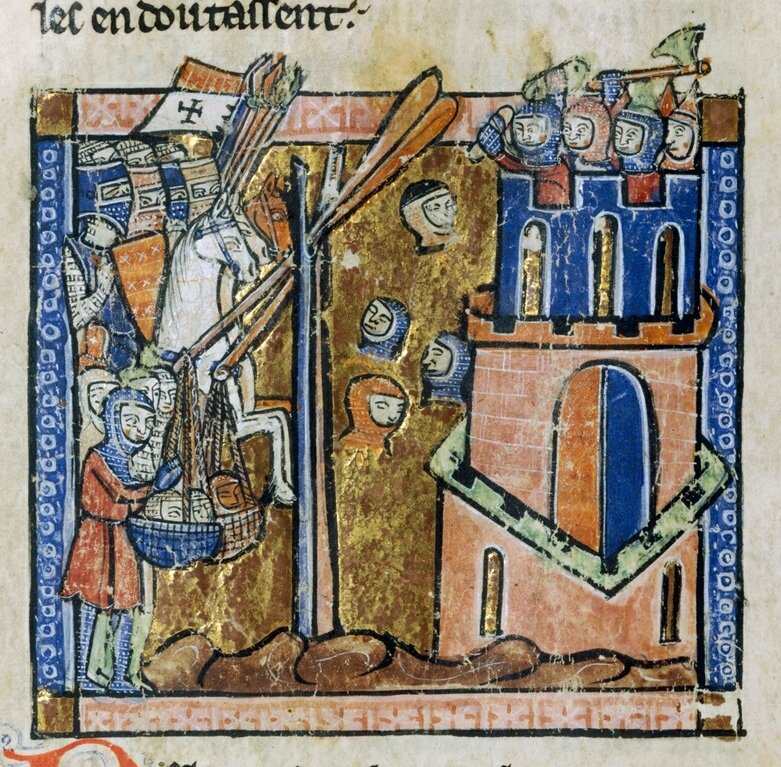
And the pictures? Medieval drawings of onager-style machines turn up late, in the 1300s and 1400s, like the one at the top of this page. That gap leaves historians wondering whether those artists were drawing machines they had actually seen, or ideas borrowed from old books.
To be fair, the debate is not completely closed. Some scholars still argue that torsion machines lingered on in some places. And one torsion weapon definitely did: the springald, a large bolt-thrower that worked a bit like an oversized crossbow. But the one-armed bucket catapult battering medieval walls? There is much less evidence for it than films would have you believe. Feel free to file it alongside the other medieval myths that refuse to retire.
So which was better?
In the trebuchet vs catapult showdown, it depends what you wanted to break.
If you were a Roman general who needed to sweep defenders off a wall with fast, flat shots, torsion machines were superb. Their cords, however, demanded constant care, and the technology needed specialists who knew exactly how to build and tune it.
If you were a medieval commander facing a stone castle, the trebuchet was your friend. The rope-pulled version was cheap, simple and quick to fire. The counterweight version, which according to Michael Fulton’s research appeared only towards the end of the 1100s, could hurl far heavier stones and land them in the same spot again and again. Repetition is what knocks down walls.
That is why, by the high Middle Ages, the trebuchet ruled the siege lines. It stayed on top until gunpowder arrived and cannon took over the job. If you want to see where all these machines fit into the bigger picture of starving, tunnelling and storming a fortress, our main article on medieval siege warfare has the full story.
The quick recap for the gift shop
Next time somebody corrects you in that castle courtyard, here’s the trebuchet vs catapult answer, free of charge:
- A catapult is any throwing machine. A trebuchet is one type.
- Classic catapults stored energy by bending or twisting. Trebuchets used leverage, powered by people or by a counterweight.
- The Romans loved twisted-cord machines. Medieval armies mostly used trebuchets.
- The one-armed “medieval” catapult from films may be largely a myth.
Then walk away slowly. Nobody likes a show-off at the gift shop.
Frequently asked questions
Trebuchet vs catapult: what is the main difference?
“Catapult” is the general term for any throwing machine. A trebuchet is a specific kind that uses a lever and a sling, powered by people pulling ropes or by a falling counterweight. Most other catapults were powered by bent wood or twisted cords.
Is a trebuchet more powerful than a catapult?
The biggest counterweight trebuchets threw much heavier stones than ancient torsion machines. Britannica gives an example of a 135-kilogram stone thrown about 275 metres.
Did medieval armies use catapults with a bucket arm?
Probably far less than films suggest. Many historians now think the one-armed torsion catapult, the onager, fell out of use after Roman times, and that the medieval “mangonel” was usually a rope-pulled trebuchet.
What is an onager?
An onager was a Roman one-armed torsion catapult. Its name means “wild ass”, because the back of the machine kicked up when it fired.
Sources
- Encyclopaedia Britannica, Catapult
- Encyclopaedia Britannica, Onager
- Ancient Warfare blog (Karwansaray Publishers), From words machines shall be made: sources for the onager (with Ammianus Marcellinus, Res Gestae 23.4)
- Peter Purton, review of Michael S. Fulton, Artillery in the Era of the Crusades, De Re Militari (2018)
- Peter Purton, “The myth of the mangonel: torsion artillery in the Middle Ages”, Arms & Armour 3 (2006), pp. 79–90
- EXARC Journal, Traction Trebuchet